
Albuquerque Short Sale Process: 2026 Homeowner Guide
Foreclosure isn't an inevitable conclusion; it's a choice you can decline. With 379 properties in Albuquerque facing foreclosure as of July 2026, many homeowners feel trapped by mounting debt and aggressive collectors. Navigating the Albuquerque short sale process can feel like walking through a legal maze without a map. You want to protect your credit and find a graceful way to move forward, but the technical jargon and shifting lender requirements are overwhelming.
I understand the stress of these financial transitions. You deserve a partner who offers clarity instead of pressure. This guide provides a clear, step-by-step roadmap designed to settle your debt and safeguard your future home-buying ability. We will explore the latest 2026 New Mexico purchase agreement updates, including the mandatory Independent Consideration rules, and detail exactly how to demonstrate financial hardship to your lender. By the end, you will have a strategic plan to trade uncertainty for peace of mind and a fresh start.
Key Takeaways
- Understand why a short sale is a strategic financial exit rather than a failure in the evolving 2026 New Mexico housing market.
- Master the five critical steps of the Albuquerque short sale process to ensure your hardship package meets every strict lender requirement.
- Evaluate the significant credit advantages of a short sale over foreclosure, including how to navigate New Mexico deficiency judgment statutes.
- Learn how to document specific financial hardships, such as medical emergencies or senior transitions, to prove insolvency to your mortgage holder.
- Discover how a specialized listing strategy can attract the right buyers quickly while satisfying the latest state disclosure and fee regulations.
What is a Short Sale and Why Consider One in Albuquerque?
Understanding What is a short sale is the first step toward reclaiming your financial freedom. In this transaction, you sell your home for less than the remaining balance on your mortgage. It's a complex process where your lender agrees to accept a lower payoff to avoid the high costs of foreclosure. For many homeowners, this serves as a strategic exit that allows you to settle debt and move forward without the long term damage of a foreclosure on your record.
To better understand this concept, watch this helpful video:
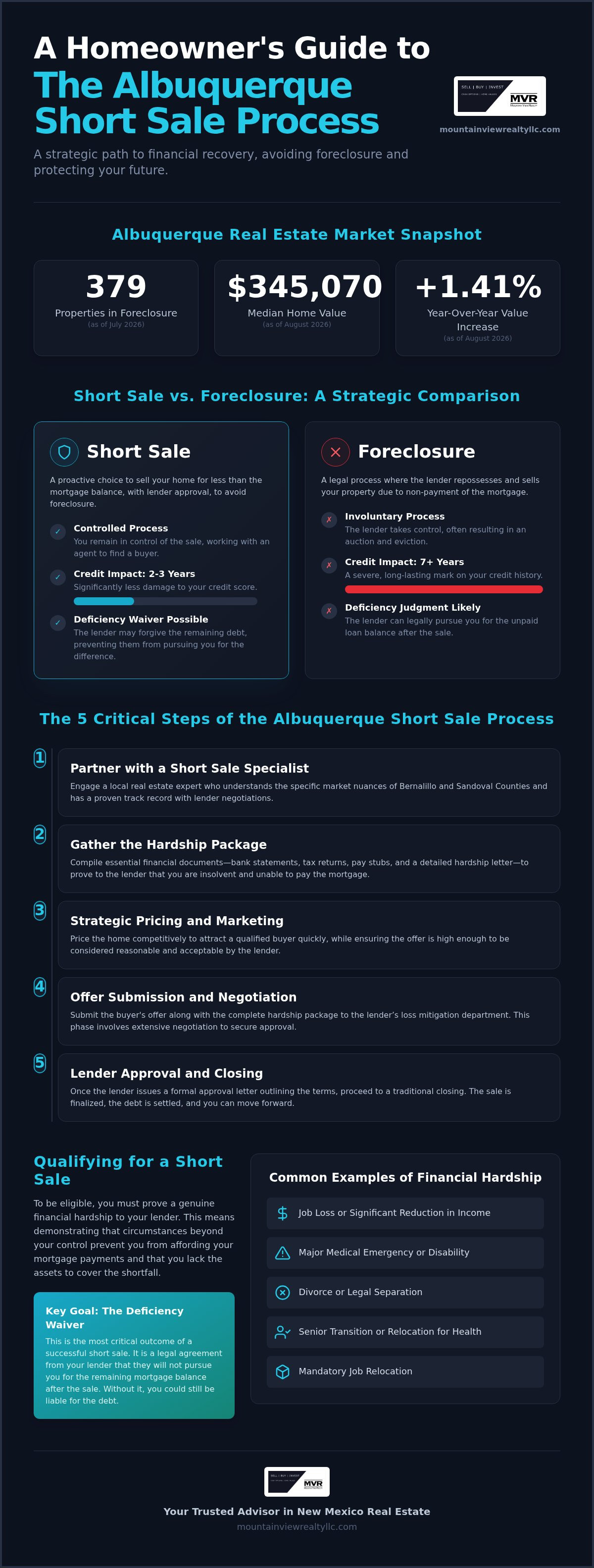
As of August 2026, the median home value in Albuquerque is $345,070. While values have increased by 1.41% year over year, 379 properties in the city are currently in foreclosure. The Albuquerque short sale process is a proactive way to resolve these distressed situations. It requires the lender to approve a deficiency waiver, meaning they agree not to pursue you for the remaining balance. This is especially relevant given the March 2026 New Mexico Purchase Agreement overhaul. This update introduced mandatory Independent Consideration fees that buyers must pay directly to sellers, providing immediate funds while the buyer conducts due diligence.
The Local Landscape: Bernalillo and Sandoval Counties
Market dynamics in Bernalillo and Sandoval Counties vary significantly by neighborhood. In Sandia Heights, larger luxury estates may face different appraisal challenges than smaller suburban homes in Rio Rancho South. Lenders are often more willing to negotiate when they see clear evidence of local market shifts and neighborhood specific data. Many Albuquerque families choose this path during major life transitions, such as senior relocations or divorce, where maintaining credit health is a top priority. Using a local expert ensures your home is positioned correctly to satisfy both the bank's requirements and the current market demand.
Protecting Your Financial Future
Securing a deficiency waiver is the most critical part of the Albuquerque short sale process. Without this legal protection, you could remain liable for the unpaid debt for years to come. A successful short sale typically impacts your credit for only two to three years, whereas a foreclosure can linger for seven or more. Looking at your home with an investor's eye helps you see the property as a financial asset to be settled efficiently. This perspective reduces emotional stress and focuses on the ultimate goal: a clean break and a protected future. It's about finding a strategic solution that respects your journey and your long term goals.
The 5 Critical Steps of the Albuquerque Short Sale Process
The Albuquerque short sale process isn't a sprint; it's a methodical journey that requires precision. Successfully completing one requires more than just listing a home. You need a structured approach to convince your lender that accepting less than what's owed is the best financial decision for all parties. While every bank has its own quirks, most transactions follow five essential steps.
- Step 1: Partnering with a Short Sale Specialist. You need a local expert who understands the specific nuances of Bernalillo and Sandoval Counties. This isn't the time for a generalist.
- Step 2: Gathering the Hardship Package. This is your financial resume. It proves to the lender that your situation is genuine and that you lack the assets to pay the mortgage.
- Step 3: Strategic Pricing and Marketing. We must price the home to attract a buyer quickly while staying within a range the bank will actually approve.
- Step 4: The Offer and Negotiation Phase. Once an offer is accepted, the real work begins. We submit the entire package to the lender's loss mitigation department.
- Step 5: Approval and Closing. After the bank issues an approval letter, we move to a traditional closing, ensuring the debt is settled and you can walk away.
For a broader look at how these transactions affect you on a national level, you can review this consumer guide to short sales. Understanding these foundations helps you stay empowered throughout the transaction.
Preparing Your Hardship Documentation
Lenders need to see a clear, honest picture of your financial life. Your hardship letter is the centerpiece of this package. It should be a concise narrative explaining why you can no longer meet your mortgage obligations. Common triggers in the Albuquerque market include medical emergencies, job loss, or senior transitions. You will also need to provide at least two months of bank statements, two years of tax returns, and recent pay stubs. Accuracy is vital. Even a small discrepancy in your financial disclosure can trigger a "request for more information," which often resets the bank's internal clock and causes weeks of delay.
Navigating Lender Bureaucracy
Major banks and local New Mexico credit unions operate on different timelines. In the 2026 market, expect the negotiation phase to take anywhere from 60 to 120 days. This "waiting period" is often the most stressful part of the Albuquerque short sale process. Banks utilize third party appraisers or brokers to perform a Broker Price Opinion (BPO) to verify the home's value. We manage these expectations by providing the bank with local market data that justifies the offer price. If you're feeling overwhelmed by the paperwork, a confidential consultation can help clarify your specific path forward. Staying organized and patient is the key to securing that final approval letter.
Short Sale vs. Foreclosure: Comparing Your Exit Strategies
Choosing between a short sale and a foreclosure is a choice between taking control or letting circumstances dictate your future. Foreclosure is a public, involuntary process that strips away your ability to manage your financial narrative. In contrast, the Albuquerque short sale process allows you to exit your property with dignity. It's a strategic move that treats a difficult situation like a business transaction rather than a personal failure. By choosing a short sale, you're actively protecting your future ability to build wealth.
To help you weigh these options, the following table outlines the primary differences between these two exit strategies in the 2026 market:
| Feature | Short Sale | Foreclosure |
|---|---|---|
| Credit Impact | Typically 2 to 3 years | Typically 7 years |
| Public Record | Reported as "Settled" or "Paid in Full" | Publicly recorded foreclosure judgment |
| Future Home Buying | Possible in as little as 2 years | Usually requires 5 to 7 years |
| Deficiency Liability | Negotiated waiver possible | High risk of deficiency judgment |
Credit Recovery Timelines
The path back to homeownership is much shorter after a successful short sale. Under current FHA guidelines, you may qualify for a new mortgage in as little as three years; sometimes only two if you can prove extenuating circumstances like a medical emergency. Conventional loan guidelines are similarly favorable compared to the strict seven year waiting period required after a foreclosure. Because a short sale is often reported as "settled for less than the full balance" rather than a "foreclosure," it doesn't carry the same catastrophic weight in automated underwriting systems. This allows families to rebuild their lives and their net worth much faster.
The Legal Edge in New Mexico
New Mexico is a judicial foreclosure state, which means your lender must go through the court system to take your property. This process is slow and expensive for the bank. This legal reality gives a short sale specialist significant leverage during negotiations. When we engage in the Albuquerque short sale process, our primary goal is securing a full release of the deficiency. Without this, a lender in New Mexico could potentially pursue a judgment against you for the difference between the sale price and the loan balance. Having an expert advocate ensures that when the keys are handed over, the debt is truly gone. We focus on the fine print so you can focus on your next chapter.
Qualifying for a Short Sale: The "Hardship" Requirement
Lenders view the Albuquerque short sale process as a loss mitigation strategy. They only agree to it when they're convinced that foreclosure is the only other, and more expensive, option. To qualify, you must prove a legitimate financial hardship. This isn't about wanting a bigger yard or a shorter commute. Lenders look for life altering events like job loss, medical emergencies, divorce, or senior transitions. They need to see that your financial circumstances have changed fundamentally since you first signed your mortgage.
You must also pass the insolvency test. If you have significant cash reserves or other liquid assets, the bank will expect you to use them. They want to see that you truly cannot afford the mortgage and have no other way to pay the difference. Finally, the property must be underwater. This means the current market value is less than your total loan balance. Simply wanting to move isn't enough for a lender to take a loss on your loan; you must demonstrate that staying is no longer a viable option.
Writing an Effective Hardship Letter
Your hardship letter is your chance to tell your story. I recommend an approach that is honest, strategic, and educational. Don't just list your problems; explain how they directly impacted your ability to pay your mortgage. Lenders prioritize facts over emotions. If you lost your job at a major employer in Sandoval County, state the date and the specific impact on your monthly income. Avoid common pitfalls like being overly vague or sounding angry. A clear, factual narrative helps the bank's loss mitigation department process your file with fewer delays.
Senior Transitions and Estate Sales
In Bernalillo County, many short sales involve seniors moving into assisted living facilities. This is a specific type of hardship that banks recognize. When a homeowner's health requires a move to a care facility, the financial burden of maintaining a home often becomes impossible. Dealing with the Albuquerque short sale process during these moments requires a gentle touch and deep local expertise. We understand the unique pressures families face during these transitions.
Handling a short sale within an estate or probate scenario adds another layer of complexity. We focus on protecting the family's remaining assets while satisfying the lender's requirements. This ensures the estate isn't drained by a property that no longer serves the heirs. It's about finding a graceful exit that respects the family's legacy and financial health. By treating the property as a financial asset to be resolved, we help families move forward with their peace of mind intact.
Why a Specialized Albuquerque Listing Strategy Matters
Standard real estate tactics often fail when applied to the Albuquerque short sale process. Most agents simply list the home on the MLS and wait for a generic offer. We take a much more proactive and strategic stance. You need a buyer who is both financially qualified and patient enough to handle several months of lender negotiations. Our "List with a Twist" approach focuses on finding these specific buyers by marketing the property's unique possibilities. We don't just sell the home as a distressed asset; we sell the potential it offers to a savvy new owner.
High quality presentation is non negotiable for us. We utilize drone photography and cinematic video for every property, regardless of its financial status. This luxury level marketing serves two vital purposes. First, it attracts a higher caliber of buyer who is less likely to walk away during the long waiting period. Second, it provides the lender's appraiser with a clear, professional view of the home's condition. This is critical during the Broker Price Opinion (BPO) phase when the bank decides on an acceptable payoff. If you need a faster exit than the bank allows, consider how this strategy compares to our CashOffer+ service, which prioritizes immediate results and certainty.
The Mountain View Realty LLC Advantage
Robb Krautbauer offers a professional perspective that few agents in New Mexico can match. With 15 years of investing experience and 10 years as a licensed agent, he understands the underlying mechanics of distressed debt. He has helped over 200 families in the Albuquerque metro navigate complex real estate transitions. This deep experience allows us to focus on protecting your equity while significantly reducing your daily stress. We provide an educational, no fluff consultation. You will receive the hard facts about your situation so you can make empowered decisions. We believe in telling you what you need to hear to protect your long term financial health.
Your Next Move Starts Here
Confidentiality is the cornerstone of our service. Whether you are in Sandia Heights, Rio Rancho, or Corrales, we protect your privacy throughout the entire transaction. We don't view a short sale as a finality; it is a strategic step toward your next chapter. Our process involves creating a comprehensive plan for where you will go next. This ensures you aren't just leaving a house, but moving toward a new opportunity with your credit intact. When you are ready for a professional partner who values your peace of mind, we are here to guide the way. Grab a time on our calendar for a confidential strategy session to discuss your specific needs and goals.
Secure Your Financial Fresh Start
You now have the roadmap to turn a daunting financial situation into a strategic exit. We've explored how the Albuquerque short sale process provides a more dignified path than foreclosure, allowing you to rebuild your credit in just a few years. By documenting your hardship accurately and using a specialized marketing strategy, you can settle your debt permanently. This protects your future home buying ability and provides the peace of mind you deserve.
My approach is built on 15 years of investing experience and 10 years as a licensed agent helping families across Bernalillo and Sandoval Counties. I provide the honest, strategic, and educational guidance you need to hear to make the right choice for your family. You don't have to face the banks alone or feel overwhelmed by the paperwork.
Let's work together to secure your financial recovery and prepare for your next chapter with confidence. Your future is worth the effort of a well planned transition.
Robb Krautbauer
Owner & Qualifying Broker
Frequently Asked Questions
How much does it cost me to do a short sale in Albuquerque?
In most cases, the Albuquerque short sale process costs the homeowner zero dollars in out of pocket expenses. Your lender typically pays the real estate commissions, title fees, and even any delinquent property taxes from the proceeds of the sale. This allows you to settle your debt without needing to bring cash to the closing table. It's a strategic way to transition out of a difficult financial situation while preserving your remaining liquid assets.
Can I stay in my home during the short sale process?
You can generally remain in your home throughout the entire transaction until the day the sale officially closes. Since you still own the property, you have the right to occupy it while we negotiate with your lender. This provides your family with stability and time to plan your relocation. We work to ensure the transition is smooth, giving you a clear date for when you need to move to your next residence.
Will the bank come after me for the remaining balance (deficiency)?
Whether a bank pursues a deficiency judgment depends entirely on the language in your short sale approval letter. In New Mexico, lenders have the legal right to seek the remaining balance, but our primary goal is negotiating a full release of liability. We advocate for a waiver that prevents the bank from coming after you later. Having an experienced specialist ensures these legal protections are clearly stated before you sign any final closing documents.
How long does a typical Albuquerque short sale take to close in 2026?
A typical Albuquerque short sale process in 2026 takes between 60 and 120 days to reach a closing. This timeline includes the time needed to find a buyer, submit your hardship package, and wait for the lender's loss mitigation department to review the file. While some local credit unions move faster, larger national banks often require more time for their internal appraisals and multiple levels of management approval. Patience is essential during this period.
Can I do a short sale if I am already in foreclosure?
You can absolutely start a short sale even if your lender has already initiated foreclosure proceedings. As long as the final foreclosure auction has not taken place, there is still time to negotiate a sale. Banks often prefer a short sale because it's less expensive for them than completing a judicial foreclosure. We work quickly to notify the bank's legal team of a pending offer to potentially pause the auction clock.
Do I have to be behind on my payments to qualify for a short sale?
You don't always have to be behind on your mortgage payments to qualify, though it's more common. Some lenders will consider a short sale if you can prove that a default is imminent due to a verified hardship, such as a job transfer or medical crisis. This is often called a proactive short sale. Proving insolvency is key; if you can show that your expenses will soon exceed your income, the bank may listen.
What is the difference between a short sale and a deed-in-lieu of foreclosure?
A short sale involves selling your home to a third party buyer on the open market, whereas a deed-in-lieu of foreclosure involves handing the property title directly back to the lender. Short sales are often preferred because they allow for more control over the final sales price and often look better on a credit report. A deed-in-lieu is typically a last resort when a property cannot be sold despite a specialized listing strategy.

Article by
Robb Krautbauer
Robb Krautbauer is the Owner and Qualifying Broker of Mountain View Realty, serving Albuquerque, Rio Rancho, Santa Fe, and surrounding New Mexico communities. With more than a decade of real estate experience, Robb specializes in luxury homes, strategic home marketing, and helping homeowners navigate important life transitions with confidence.
Known for combining luxury-level marketing, AI-powered technology, and innovative selling strategies, Robb helps clients maximize their home's value while creating a smooth, personalized selling experience. Whether assisting luxury homeowners, retirees, families downsizing, or real estate investors, his focus is always on delivering expert guidance, honest advice, and exceptional results.
When he's not helping clients achieve their real estate goals, Robb enjoys studying market trends, emerging technology, and investment strategies that keep Mountain View Realty at the forefront of the industry.
Disclaimer
**Disclaimer:** The information provided in this article is for general educational purposes only and should not be considered legal, tax, financial, or professional advice. Real estate laws, market conditions, and regulations change over time and may vary based on your individual circumstances. Before making any real estate decision, consult with qualified legal, tax, or financial professionals. If you have questions about buying or selling real estate in New Mexico, contact Mountain View Realty for guidance specific to your situation. © 2026 Mountain View Realty. All rights reserved. The content on this website may not be reproduced without written permission.


