
Buy and Sell a Home Simultaneously: A Practical Albuquerque Guide
What if the best way to avoid carrying two homes isn’t to rush one closing, but to plan both transactions as a single move? If you need to buy and sell home simultaneously in Albuquerque, the order matters. A delayed sale, a purchase offer that depends on your current home selling, or a change in timing can affect your budget and moving plans.
It’s reasonable to worry about paying for two homes at once or having one transaction fall through. The good news is that you have options, and each comes with trade-offs. A clear plan can help you weigh a home sale contingency, buying before you sell, or a path such as Home Trade-In against your priorities.
This guide explains how to coordinate the sequence, compare the available approaches, and build in practical contingencies for an Albuquerque-area move. You’ll come away with a more realistic timeline and a plan designed to protect your equity while reducing uncertainty.
Key Takeaways
- Coordinate your home sale and purchase as connected transactions, even when the closings happen on different dates.
- Compare sale-first, buy-first, and coordinated paths to see how each may affect financing, timing, and moving flexibility.
- Before making offers, set your preferred move date, acceptable overlap, and priorities for protecting your equity.
- To buy and sell home simultaneously, build a practical sequence around your finances, home preparation, contract milestones, and backup plans.
- Consider whether a traditional sale or an option such as Home Trade-In better fits your timing and priorities.
Buying and selling a home simultaneously: what the plan must solve
Choosing a next home while getting your current one ready to sell can feel like two major decisions with no clean pause between them. You may be weighing a property you want against the risk of carrying overlapping housing costs, while also trying to plan where you’ll live and when you’ll move.
To buy and sell home simultaneously is to coordinate two separate transactions around your finances, contracts, and move. It doesn’t mean both closings must happen on the same day. A sound plan connects the important decisions while leaving room for dates or circumstances to change.
Why coordinating two home transactions feels difficult
Each transaction affects the other. Your purchase approval and available cash shape what you can offer. Your sale price and closing date affect when you may have access to proceeds. Contract dates, possession terms, and the actual move must also fit together. The real estate closing process involves steps that lead to the transfer of ownership, so it helps to consider each closing as a sequence of milestones rather than a single calendar event.
That creates a balancing act: securing a suitable next home may call for making a decision before your current home sale is complete, but buying too early could leave you responsible for overlapping costs. Waiting to sell first can reduce that overlap, yet may mean arranging temporary housing or storage if your next home isn’t ready.
Consider an Albuquerque homeowner preparing to move across town. They find a home that fits their needs while their current property still needs preparation before listing. They’ll need to consider whether their finances support a purchase before the sale closes, how a delay could affect their move, and what possession timing to request. The right approach depends on their priorities and circumstances, not a one-size-fits-all calendar.
What a successful simultaneous move actually means
Success isn’t automatically two closings on one date. It means choosing a sequence that reflects what matters most to you, such as protecting equity, limiting overlapping costs, avoiding a temporary move, or having more control over the move date. These priorities can compete, so identify which ones are essential and where you have flexibility.
Matching contract, closing, and possession dates takes coordination among the parties involved, but no plan can guarantee every date will hold. Financing, property readiness, or a change in either transaction can affect the schedule. Build the plan around realistic options, including what you would do if the sale closes later than expected or the purchase date shifts.
A simultaneous move is a coordinated set of decisions across two separate transactions, shaped around your finances, timing, and priorities.
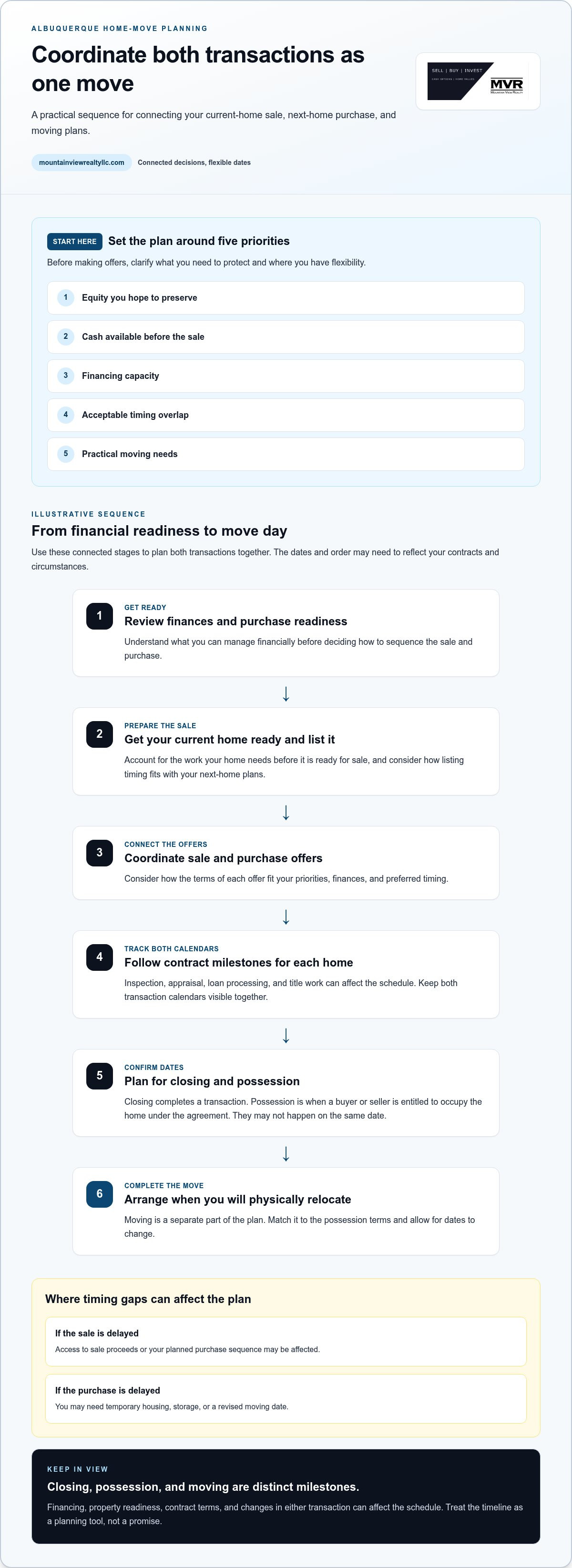
Start by clarifying five variables: the equity you hope to preserve, cash available before the sale, financing capacity, acceptable timing overlap, and practical moving needs. A well-made plan doesn’t remove every risk. It helps you see where the transactions depend on each other, prepare for changes, and make informed choices without relying on everything going exactly to plan.
How purchase and sale timelines interact from offer to closing
Coordinating a sale and purchase works best when you plan the steps as a connected sequence. Start by reviewing your finances and purchase readiness, then prepare the current home for sale. From there, the timing of each offer, contract milestone, closing, and move can affect the next decision.
The dates aren’t automatic. They depend on contract terms, financing, property readiness, and the people involved in each transaction. A working timeline can help you spot conflicts early, but treat it as a planning tool rather than a promise.
The key milestones that need to line up
Before making offers, understand what you can manage financially and what work your current home needs before it’s ready for sale. Then coordinate when to list, when to pursue a purchase, and how each offer’s terms fit your priorities. After contracts are in place, inspection, appraisal, loan processing, and title work can all affect the schedule. Keep the two transaction calendars visible together.
Use this illustrative sequence to start a conversation about timing. It’s an example, not a set schedule:
Example timeline: Review finances and purchase readiness → prepare and list the current home → coordinate sale and purchase offers → track contract milestones for both homes → confirm closing and possession dates → arrange the move.
Some steps may overlap. For instance, you might be preparing your home for listing while considering a purchase offer. The order and timing should reflect your specific contracts and circumstances. New Mexico contract requirements can vary by the agreement and applicable rules, so avoid assuming that one transaction’s dates or terms automatically apply to the other.
Where timing gaps can create stress
A delayed sale can affect when you have access to proceeds or whether your planned purchase sequence still works. A delayed purchase may leave you arranging temporary housing, storage, or a revised moving date. Build flexibility into the plan where possible, and identify in advance which changes would create the greatest strain.
Keep three dates distinct. Closing is when the transaction is completed. Possession is when the buyer or seller is entitled to occupy the home under the agreement. Moving is when you physically relocate. Depending on the agreement, possession may not happen on the closing date. For example, a seller might close on a home but have an agreed period to move out afterward, which affects when the buyer can move in.
Aligned target dates can simplify the plan, but they don’t make either closing risk-free. Confirm dates as the transactions progress, and keep a backup plan for a shift in closing, possession, or moving arrangements. If you’re weighing a purchase and sale sequence in Albuquerque, reviewing your home-buying and selling options with a local real estate advisor can help clarify the trade-offs.
Compare sale-first, buy-first, and coordinated paths
There’s no single sequence that works for every homeowner. The right path depends on how much financial certainty you need, how important a continuous move is, and how much flexibility you have if dates shift. Compare the trade-offs before deciding how to buy and sell home simultaneously.
| Approach | Timing control | Financing considerations | Moving flexibility | Exposure to delays |
|---|---|---|---|---|
| Sell first | You know the sale outcome before committing to a purchase. | Sale proceeds can clarify funds available, though purchase financing still depends on your circumstances. | You may need temporary housing or storage if the next home isn’t ready. | A slower search for a suitable home can extend the time between transactions. |
| Buy first | You can secure a next home before the current home sale is complete. | Review how you would manage costs if the current home takes longer to sell. Bridge financing or home-equity borrowing may be possibilities, subject to an individual lender’s review and approval. | May offer more continuity between homes, depending on closing and possession dates. | A delay in selling can increase financial and scheduling pressure. |
| Coordinated path | You plan both transactions together and align target dates where possible. | Financing needs depend on the structure of the transactions and your financial position. | Offers flexibility to weigh move timing against sale and purchase terms. | More dates and contract milestones need active coordination; a change in one transaction can affect the plan. |
Selling first: more clarity on proceeds, less certainty on the next home
Selling before buying can make the sale outcome clearer as you assess your next purchase. That may suit homeowners who value a firmer picture of available funds over moving directly from one home to another. The trade-off is that your preferred next home may not be ready or available when your sale closes. Temporary housing or storage could help bridge a gap, but whether you need either depends on your timing and arrangements.
Buying first or using a coordinated strategy
Buying first may support a more continuous move, but it can also bring added pressure if the current home sale is delayed. Any bridge financing or home-equity borrowing is a possibility to discuss in light of your specific finances, not an assumed solution. A lender’s review matters, and no borrowing option should be treated as automatic.
A coordinated strategy considers the sale and purchase together while preserving room for different timing outcomes. Home Trade-In is one option to evaluate alongside a traditional sale, not a universal fit. Compare the specific terms and financial assumptions for your situation. For a closer look at its trade-offs, explore the Albuquerque home trade-in comparison.
As you compare paths, rank your priorities: clarity on sale proceeds, continuity between homes, financial flexibility, or control over the move. That list can help guide the sequence without assuming that any path removes every risk.
Build a practical plan for both closings and the move
A written plan turns two connected transactions into manageable decisions. Before choosing a sequence, decide what matters most, review your finances, and map the sale, purchase, and move together. That gives you a clearer way to compare options and respond if a date changes.
Start with these steps:
- Set your priorities. Rank financial certainty, move continuity, timing flexibility, and the sale proceeds you hope to preserve. Note which needs are firm and where you can adjust.
- Review your finances. Understand your available funds and the costs you could carry if dates overlap. Discuss purchase readiness and possible financing with your lender before making commitments.
- Prepare the current home. Identify what needs attention before it can be listed, and consider how the sale approach may affect your timing. Your home selling options in Albuquerque can shape the broader plan.
- Coordinate offers and dates. Compare the proposed terms for each transaction, including relevant contract milestones and possession arrangements. Avoid assuming that target dates will automatically align.
- Plan the move and contingencies. Track the dates, responsibilities, and backup choices in one shared timeline so everyone working on the move can refer to the same plan.
Set priorities before choosing a sequence
Make your non-negotiables specific. Write down your preferred move date, how much overlap you could manage, and what protecting equity means for your plans. A homeowner downsizing may place greater weight on simplifying the move, while someone settling an estate may need to coordinate decisions with other family members. In Albuquerque, Rio Rancho, Corrales, or Santa Fe, the priorities remain personal; avoid basing your plan on assumed prices or conditions in a particular area.
Then put the working details in a shared timeline. Include offer and contract dates, financing milestones, inspection or appraisal appointments, title work, possession terms, and moving arrangements. Assign a person to track each item and update the calendar as confirmed dates change. This helps reveal conflicts early, such as a planned move that comes before the buyer can take possession.
Create contingencies for delays and changed plans
Consider what you would do if the sale closes later than expected, the purchase date shifts, or the purchase doesn’t proceed. Depending on your circumstances, temporary housing or storage may be useful fallback options, but they aren’t required in every plan. Decide what changes would trigger a backup choice and how they could affect your finances, belongings, and move schedule.
A backup plan belongs in every two-transaction timeline because target dates can change even when the plan is carefully coordinated. It won’t remove uncertainty, but it can help you make the next decision with less pressure.
Choose an Albuquerque strategy that protects your equity and reduces stress
The best plan connects your priorities, available equity, financing, and timing. Start by deciding what you want to protect most: a preferred move window, clarity about sale proceeds, or the ability to move directly from one home to the next. Then compare each selling path against those needs, including what you would do if a date changes.
There’s no universal answer for homeowners preparing to buy and sell home simultaneously. A traditional listing may suit someone focused on marketing the current home for sale. An alternative path may appeal to a homeowner whose timing or move priorities call for a different approach. The useful comparison is not simply which path sounds fastest. Consider how each option fits your equity goals, purchase plans, and tolerance for uncertainty.
When a tailored sale strategy can help
A coordinated plan may help you weigh the sale strategy and next-home purchase together, rather than treating them as separate decisions. Home Trade-In is one path to consider alongside a traditional sale. It won’t be the right fit for every homeowner, so compare the specific terms and how they relate to your circumstances before choosing. A strategy should support your priorities, not promise a particular outcome.
Robb Krautbauer brings 15 years of real-estate investing experience and 10 years as a licensed agent to these conversations. Mountain View Realty LLC has helped more than 200 families and investors buy and sell across the Albuquerque metro. That experience can offer useful perspective as you weigh trade-offs, but the right plan still depends on your property, finances, and goals.
What to bring to a planning conversation
You don’t need every detail settled to begin. Bring what you know, and use the discussion to clarify what needs further review. A short preparation list can keep the conversation focused:
- Your current-home timeline: Note any preparation or sale milestones already in mind.
- Your next-home goals: Describe the type of move you’re considering and what matters most in the next home.
- Known financial constraints: Identify questions about equity, available funds, or financing that may affect the sequence.
- Your preferred move window: Share the dates you hope to meet and how much flexibility you have.
Robb can help compare possible paths and identify questions tied to your situation, including which assumptions need a lender’s review and how to think through timing trade-offs. You can begin with a planning conversation before committing to a sale or purchase strategy. A clearer view of your options can help you choose your next steps with care.
Make your next move with a clear plan
You don’t have to settle every detail before taking a thoughtful next step. Start by deciding what a workable move looks like for you: which timing or financial trade-offs you could accept, and which ones you’d rather avoid. That gives you a practical basis for choosing how to buy and sell home simultaneously without assuming both transactions will follow a perfect schedule.
Use your priorities to guide the conversation, not a one-size-fits-all formula. A plan can change as your circumstances, contract terms, or preferred home evolve. What matters is understanding the choices before you commit, so you can move forward with intention and keep your equity and peace of mind in view.
A well-considered move starts with clear priorities. Take the next step at a pace that feels right for you.
Robb Krautbauer, Owner & Qualifying Broker
Frequently Asked Questions
Can you buy and sell a home at the same time?
Yes. The practical consideration is that your sale and purchase each have their own agreement, paperwork, and parties involved. Keep copies of both contracts and note which decisions apply to which property. This can help prevent details such as requested repairs, deadlines, or included items from getting mixed up. A real estate professional can help you understand how the two sets of terms relate to your plans.
Is it possible to buy a new home before selling your current one?
Yes, but first ask your lender to assess your purchase under the scenario that your current mortgage is still in place. The lender can explain how existing obligations may affect your qualification and what information is needed to review your situation. Don’t assume that expected sale proceeds will be available for the purchase before the sale is complete. Confirm how your planned funds fit the purchase requirements.
What happens if my current home does not sell before the new home closes?
If the purchase closes first, you’ll need to decide how to manage the current property while it remains unsold. Depending on your circumstances, you could continue marketing it or reconsider your plan for the property. Review your budget and any obligations connected to both homes before choosing a response. Your next steps will depend on your agreements, finances, and the advice of the professionals involved.
Can the sale and purchase closings happen on the same day?
They can be scheduled for the same day, but don’t assume that money from the sale will be available for the purchase at the exact moment it’s needed. Ask the professionals handling each transaction to clarify the expected sequence and funds-transfer arrangements. If your purchase relies on sale proceeds, understanding that detail ahead of time can help you avoid planning around an assumption about when funds will be accessible.
How much cash do I need to buy and sell a home simultaneously?
There’s no single cash figure that fits every homeowner. Build a personal estimate that accounts for the funds required for your purchase, transaction expenses, moving costs, and any period when expenses for both homes may overlap. Also consider your expected net sale proceeds after existing obligations are addressed. A lender can review purchase-related funds, while your real estate professional can help you organize questions about the sale.
How long does it take to buy and sell a home at the same time?
The total time varies with the preparation needed for your current home, the timing of a suitable purchase, and the steps required by each agreement. Rather than rely on one overall estimate, record when each property is ready for its next milestone and update those dates as new information comes in. This gives you a clearer view of what is complete and what still needs attention.
Should I sell my current home before making an offer on another one?
That depends partly on whether you need proceeds from the sale to support your purchase and how much uncertainty you’re comfortable accepting. You may be able to make an offer that depends on selling your current home, but that condition can affect how a seller evaluates it. Consider your financial limits and what you’d do if the seller doesn’t accept those terms before deciding how to proceed.

Article by
Robb Krautbauer
Robb Krautbauer is the Owner and Qualifying Broker of Mountain View Realty, serving Albuquerque, Rio Rancho, Santa Fe, and surrounding New Mexico communities. With more than a decade of real estate experience, Robb specializes in luxury homes, strategic home marketing, and helping homeowners navigate important life transitions with confidence.
Known for combining luxury-level marketing, AI-powered technology, and innovative selling strategies, Robb helps clients maximize their home's value while creating a smooth, personalized selling experience. Whether assisting luxury homeowners, retirees, families downsizing, or real estate investors, his focus is always on delivering expert guidance, honest advice, and exceptional results.
When he's not helping clients achieve their real estate goals, Robb enjoys studying market trends, emerging technology, and investment strategies that keep Mountain View Realty at the forefront of the industry.
Disclaimer
**Disclaimer:** The information provided in this article is for general educational purposes only and should not be considered legal, tax, financial, or professional advice. Real estate laws, market conditions, and regulations change over time and may vary based on your individual circumstances. Before making any real estate decision, consult with qualified legal, tax, or financial professionals. If you have questions about buying or selling real estate in New Mexico, contact Mountain View Realty for guidance specific to your situation. © 2026 Mountain View Realty. All rights reserved. The content on this website may not be reproduced without written permission.


