
Buying Investment Property in Albuquerque: A 2026 Guide
What if the Albuquerque neighborhood with the strongest reputation isn’t the right investment for your plan? Buying investment property in Albuquerque takes more than choosing a familiar area or an appealing property type. Before deciding whether a purchase makes sense, look closely at potential income, operating costs, condition, and the time and work ownership may require.
This guide gives you a practical way to compare residential investment properties against your goals, without relying on promises of returns. You’ll learn how to organize costs and property information, weigh local considerations across the Albuquerque metro, and compare property types using the same framework. The aim is a clearer buying plan, not a one-size-fits-all answer.
Robb Krautbauer brings 15 years of real-estate investing experience and 10 years as a licensed agent to the process. That perspective can help you examine the numbers while understanding the steps involved. We’ll start with the fundamentals of evaluating a property, then look at local locations, ownership responsibilities, and questions to help you choose a confident next step.
Key Takeaways
- Start with a clear investment goal so you can judge whether a property fits your plan, not just its personal appeal.
- When buying investment property in Albuquerque, compare each candidate using the same assumptions for purchase costs, ongoing expenses, condition, and downside risk.
- Compare Albuquerque, Rio Rancho, Corrales, Placitas, and Los Ranchos as distinct search contexts, then weigh property types against your priorities.
- Use due diligence to test your initial numbers. Inspection findings, title details, insurance terms, and documented expenses can change your decision.
- Turn your goals into practical search criteria and a repeatable comparison process before choosing a property.
Buying Investment Property in Albuquerque Starts With a Clear Goal
Before comparing homes, decide what you want the purchase to do. An investment property is evaluated against a financial or ownership objective; a second home is usually chosen first for personal use. That distinction shapes what you prioritize, from location and layout to the expenses and responsibilities you’re willing to take on.
Buying investment property in Albuquerque calls for a goal you can use to screen options, not a promise about future performance. You might prioritize potential income, long-term ownership, diversification, or another defined objective. Any potential return depends on assumptions about the specific property and its costs. Those assumptions can change, and results are never guaranteed.
For broader economic context, the Economy of New Mexico overview describes industries that shape the state. That context can inform your questions, but it can’t predict the performance of an individual property.
To explore how different investment options connect to your goals, watch this video:
Investment property: A home purchased primarily to support a financial or ownership goal, rather than for your own regular use.
Second home: A property selected mainly for personal use, such as a place to stay during visits or time away.
Investment property or second home: which goal are you pursuing?
For personal use, comfort, privacy, and a preferred setting may lead your decision. An investment-focused purchase calls for different questions: what ownership responsibilities come with the property, which expenses belong in your calculations, and how does the opportunity fit your intended time horizon? Neither purpose is inherently better. Be clear about which one will guide your choices.
If your goal is diversification or long-term ownership, write down what that means to you before touring. A specific objective helps you compare properties and recognize when a desirable feature is a preference rather than a requirement.
Set Albuquerque investment criteria before touring homes
Translate your goal into boundaries you can apply consistently. Set a purchase budget, decide how long you expect to own the property, and consider how much repair work or ongoing involvement you’re prepared to take on. Separate firm requirements from preferences. That way, an attractive design or setting won’t replace a careful review of the property and its costs.
- Must-haves: Define your budget limits, ownership horizon, and acceptable level of repair involvement.
- Preferences: Note features such as acreage, custom design, or luxury finishes, then rank them by importance.
- Local context: Compare an Albuquerque home, a Rio Rancho property, or a Corrales home with acreage according to your priorities, not assumptions about future returns.
For example, if limited repair involvement is essential, a property needing substantial work may not suit your plan, even if its setting appeals to you. If acreage matters more, you might include Corrales in your search and reconsider other preferences. The goal is a clear starting point. Next, test each candidate against its own costs and assumptions.
How to Underwrite an Albuquerque Investment Property
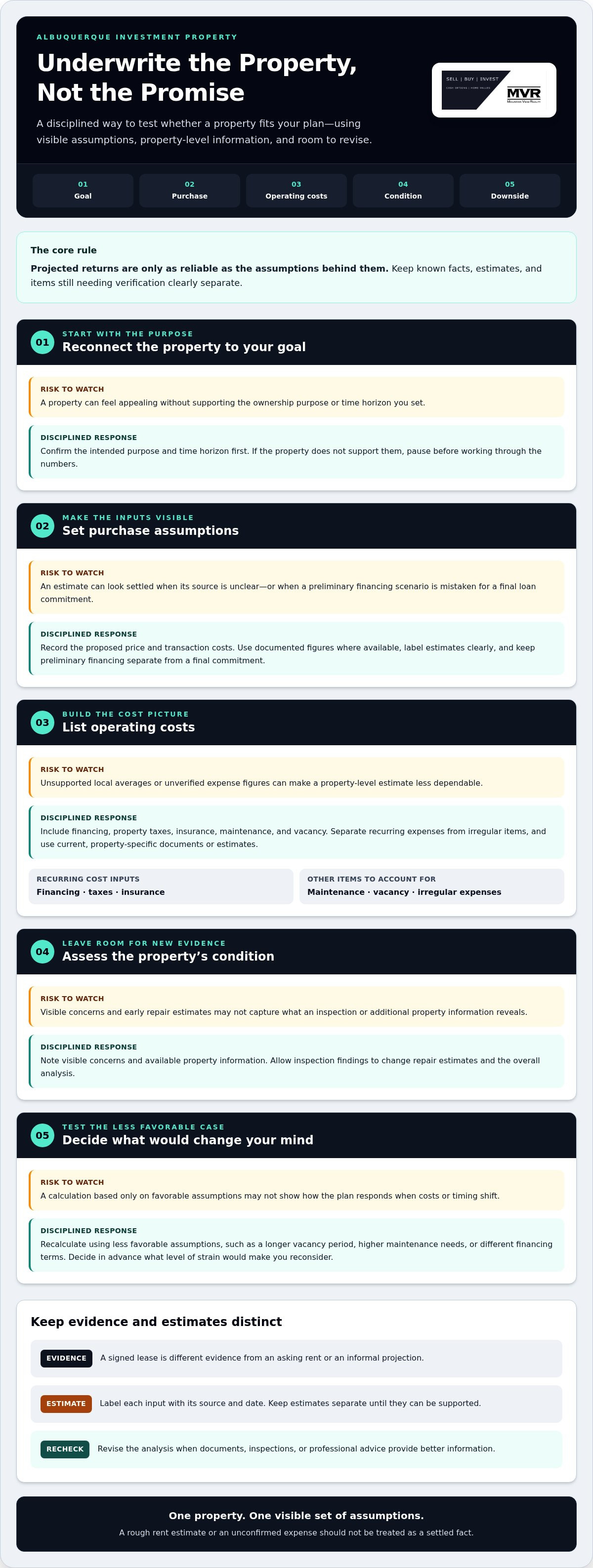
Underwriting is a disciplined way to test whether a property fits your plan before you make an offer. For each candidate, record what you know, what you estimate, and what still needs verification. A rough rent estimate or an unconfirmed expense shouldn’t appear in your calculations as a settled fact.
Projected returns are only as reliable as the assumptions behind them. Keep the inputs visible so you can revise the analysis when documents, inspections, or professional advice provide better information. The City’s Albuquerque Housing Now initiative offers broader context on local housing challenges, but it doesn’t establish the income or expenses for a specific property.
- Reconnect the property to your goal. Confirm the intended ownership purpose and time horizon. If the property doesn’t support them, pause before working through the numbers.
- Set purchase assumptions. Record the proposed price and transaction costs using documented figures where available. Mark estimates clearly, and don’t treat a preliminary financing scenario as a final loan commitment.
- List operating costs. Include financing, property taxes, insurance, maintenance, and vacancy. Separate recurring expenses from irregular items, and use current, property-specific documents or estimates rather than unsupported local averages.
- Assess condition. Note visible concerns and available property information. Leave room for inspection findings to change repair estimates and the overall analysis.
- Test a downside case. Recalculate with less favorable assumptions, such as a longer vacancy period, higher maintenance needs, or different financing terms. Decide in advance what level of strain would make you reconsider.
Build a property-level income and expense picture
Separate documented income evidence from a rent estimate. A signed lease, for example, is different evidence from an asking rent or informal projection. Label each input with its source and date. Use documented amounts in your calculations and keep estimates separate until you can support them.
Track recurring costs, such as financing, taxes, and insurance, alongside irregular expenses like repairs and transaction costs. Include vacancy as an assumption, not a promise that a unit will or won’t be occupied. If an expense is unknown, flag it rather than filling the gap with a local average you can’t verify.
Stress-test the plan before making an offer
Compare your preferred case with a conservative one. Increase the maintenance allowance, account for vacancy, or model a delay before the property is ready for its intended use. Then consider whether your available funds and ownership plan can absorb those changes. A qualified financial or tax professional can review relevant financial questions; seek legal advice for legal issues.
When buying investment property in Albuquerque, a careful worksheet won’t remove uncertainty, but it can show which assumptions matter most. Mountain View Realty LLC can help you compare residential properties against your criteria. Discuss your property comparisons as you refine your plan.
Compare Albuquerque Investment Locations and Property Types
A neighborhood name can suggest a certain kind of property, but it can’t tell you whether a specific home fits your investment plan. Compare homes using the same questions about condition, upkeep, intended use, and resale options. Mountain View Realty LLC serves buyers and investors across the Albuquerque metro, including Bernalillo and Sandoval Counties. Within that broad area, each property still deserves its own review.
The table is a starting framework, not a ranking. Location labels identify search contexts, not claims about rent, demand, or future returns. Use current maps and relevant city or county records to review access, services, and property details, then verify the facts for the address you’re considering.
| Property type | Location context | Likely trade-offs to examine | Investor questions |
|---|---|---|---|
| Single-family home | Albuquerque, Rio Rancho, or Los Ranchos | Compare the home’s condition, layout, upkeep, and access to the places that matter to your intended occupants. | What repairs may be needed? Which features support your plan, and what could limit resale options? |
| Acreage property | Corrales or Placitas | More land may bring different upkeep needs and property-specific considerations. Confirm boundaries and services rather than assuming. | What maintenance does the land require? Which services reach the property, and how might its features shape future buyer interest? |
| Custom home | North ABQ Acres, Sandia Heights, High Desert, or Tanoan | Distinctive design and finishes may suit some buyers, while adding features to assess for upkeep and broader appeal. | Are specialized features in good condition? Do the home’s design and maintenance needs align with your ownership plan? |
Compare property types by workload and investment thesis
Single-family homes, acreage, and custom homes are evaluation categories, not shortcuts to a particular result. A well-maintained home may still need updates; a distinctive property may require more attention to specialized systems or finishes. Your available time, resources, and intended holding period help determine which trade-offs are manageable. Base the comparison on the actual home, not the category alone.
Assess Albuquerque-area communities without relying on reputation
Compare North ABQ Acres, Sandia Heights, High Desert, and Tanoan as separate search areas. For each, examine the individual property and verify access, nearby services, and relevant local information using current sources. Apply the same process in Albuquerque, Rio Rancho, Corrales, Placitas, and Los Ranchos. A consistent review makes buying investment property in Albuquerque a property-level decision, rather than a bet on a community’s reputation.
Albuquerque Investment Property Due Diligence Before You Commit
A property can look sound on paper and still carry costs or restrictions that change your decision. Before committing, compare its actual condition and records with the assumptions in your analysis. Treat due diligence as a decision point: new information may support your original plan, call for revised numbers, or give you a reason to reconsider.
When buying investment property in Albuquerque, verify property-specific details with current, authoritative sources. Tax treatment, zoning, permitted use, rental requirements, and legal obligations can depend on current rules and the property’s circumstances. Don’t rely on a general neighborhood description or an old listing to settle those questions.
Review the property, records, and ownership costs
Organize the review so important details don’t disappear among listing materials and estimates. Use this checklist to guide your next steps:
- Condition: Arrange an inspection and review available repair records. Note items that may affect immediate work, future maintenance, or the property’s intended use.
- Title and ownership records: Review available title documents and identify questions about ownership, recorded interests, or other matters that may affect the purchase. Ask a qualified legal professional to address legal concerns.
- Insurance: Check current availability, coverage, exclusions, and terms for the specific property. Include the verified premium and terms in your analysis rather than relying on a placeholder.
- Documented expenses: Gather available records for taxes, utilities, service costs, and past repairs. Separate confirmed figures from estimates and note where each figure came from.
- Permitted use: Verify zoning and any intended rental use with the relevant current government source. Confirm applicable tax and rental details through authoritative sources or qualified professionals.
An inspection finding can change more than a repair line. If a system needs work, the property may require additional funds, a revised timeline, or a different ownership plan. Update your numbers before deciding whether the opportunity still fits. If a key cost or use question remains unresolved, keep it visible as an open item rather than treating an assumption as fact.
Prepare for ownership responsibilities and risk
Consider the time and attention the property could require. Think through how you’ll coordinate maintenance, make decisions, and handle unexpected work. Keep a reserve plan that reflects your own resources, without assuming vacancy or repairs will follow a predictable schedule.
Stress-test your plan with a conservative scenario. Consider a period without expected income, an unplanned repair, or a delay that extends carrying costs. Ask whether you could manage those pressures without abandoning your broader financial priorities. A qualified financial or tax professional can address financial questions, while legal questions belong with a qualified legal professional.
Local context can help frame your questions, but it shouldn’t replace property-specific verification. Mountain View Realty LLC can help organize the review and compare a property’s details with your stated criteria. A careful process keeps the decision grounded in records, current information, and your capacity to take on the responsibilities.
Build Your Albuquerque Investment Buying Plan With a Local Advisor
A clear buying plan turns your goals into practical search criteria. A local advisor can help you define what fits, compare candidate homes consistently, and keep the focus on documented property details rather than neighborhood reputation or optimistic projections. The decision remains yours, supported by a more organized view of the choices.
Mountain View Realty LLC provides residential buying and investing guidance tailored to each client’s priorities. Robb Krautbauer’s experience as a buy-and-hold investor and licensed agent brings two useful perspectives to the process: examining a property’s economics and assessing it as a residential purchase. That background can inform the discussion, but it can’t guarantee income, appreciation, or a particular result.
Turn your investment criteria into a focused search
Begin with a short written profile of the purchase you want to make. Include your objective, preferred locations, ownership horizon, tolerance for repairs, and practical limits on time and resources. Identify which features are essential and which are flexible. This profile gives you a steady reference point as new listings and possibilities arise.
For each candidate, use the same comparison method. Keep verified facts separate from estimates, and record why a property appears to fit or fall short. For example, a home may match your preferred location but require more repair involvement than you’re prepared to take on. A side-by-side review makes that trade-off visible instead of letting one attractive feature dominate the decision.
- Goals: State the purpose of the purchase and what a suitable outcome would mean to you.
- Location: Note the communities you’re considering and the property characteristics that matter there.
- Risk and workload: Describe the uncertainty, maintenance, and ownership involvement you’re comfortable taking on.
- Evidence: Track the source of key figures and label assumptions that still need verification.
This approach makes buying investment property in Albuquerque a structured decision rather than a search for a promised return. Your plan can change as you learn more. A useful comparison process helps you see which new facts should change your view and which preferences still matter most.
Choose a useful next step without pressure
You don’t need every decision settled before having a planning conversation. Bring your goals, questions, and any properties you’re already considering. An advisor can help organize your criteria, identify where comparisons need more evidence, and clarify what to examine next. For tax, legal, or other specialized questions, rely on the appropriate qualified professional.
If you’re considering a residential investment purchase in the Albuquerque area, you’re welcome to discuss your priorities and questions with Mountain View Realty LLC. A thoughtful conversation can help you decide whether to refine your search, review a specific property, or take more time before moving ahead.
Robb Krautbauer, Owner & Qualifying Broker
Move Forward With a Plan That Fits
Your next step doesn’t have to be a purchase. It could be refining your criteria, reviewing a property’s documents, or deciding which questions need an expert’s attention. That flexibility matters: buying investment property in Albuquerque is a significant decision, and a sound process leaves room to pause when new information changes the picture.
Keep your priorities in writing as you move forward. They can help you stay focused on the reasons behind your search and make decisions with care, rather than feeling pulled along by a property’s presentation or reputation.
A thoughtful pace is a strength. With clear priorities and reliable guidance, you can take the next step on your terms.
Frequently Asked Questions
Is Albuquerque a good place to buy investment property?
It can be, but the answer depends on the individual property and your objectives. A home that suits one buyer’s plans may not work for another. For example, a property needing substantial repairs could be a poor fit if you want limited project involvement, even if you like its location. Treat broad market views as context, not proof of performance, and don’t assume past results or a neighborhood’s reputation predict future returns.
What should I look for when buying an investment property in Albuquerque?
Start by matching the property to your intended use, available time, and purchase limits. Then look beyond the listing description: review the layout, visible maintenance needs, available records, and factors that could affect the property’s appeal to future occupants or buyers. When buying investment property in Albuquerque, ask how the specific home fits your plan. A feature that seems attractive may not justify added upkeep if it doesn’t support your priorities.
How do I calculate whether an Albuquerque rental property is worth buying?
Estimate income, subtract operating expenses and financing costs, and compare the result with the resources and risk you’re willing to commit. Keep a clear record of each input’s source. For example, distinguish a documented lease amount from an estimate based on an asking rent. Then change one assumption at a time, such as vacancy or repair needs, to see which inputs most affect your decision. Confirm current figures before relying on the calculation.
Should I buy a second home or an investment property in Albuquerque?
Choose based on how you expect to use the home and what you want the purchase to accomplish. A place you plan to use personally may be judged by comfort, privacy, and convenience. An investment purchase calls for a different review of ownership obligations and financial assumptions. If your intended use could change, clarify that before proceeding. Financing and other requirements may vary, so discuss current terms with qualified professionals rather than assuming they’re the same.
Which Albuquerque-area locations should I compare for an investment property?
Compare Albuquerque with Rio Rancho, Corrales, Placitas, and Los Ranchos based on the particular property and your needs. A home near services or routes you value may suit your plan better than one with a more familiar community name. Check the property’s surroundings, access, and relevant local information using current sources. Don’t infer rental demand or investment performance from a location label alone; verify evidence tied to the area and property.

Article by
Robb Krautbauer
Robb Krautbauer is the Owner and Qualifying Broker of Mountain View Realty, serving Albuquerque, Rio Rancho, Santa Fe, and surrounding New Mexico communities. With more than a decade of real estate experience, Robb specializes in luxury homes, strategic home marketing, and helping homeowners navigate important life transitions with confidence.
Known for combining luxury-level marketing, AI-powered technology, and innovative selling strategies, Robb helps clients maximize their home's value while creating a smooth, personalized selling experience. Whether assisting luxury homeowners, retirees, families downsizing, or real estate investors, his focus is always on delivering expert guidance, honest advice, and exceptional results.
When he's not helping clients achieve their real estate goals, Robb enjoys studying market trends, emerging technology, and investment strategies that keep Mountain View Realty at the forefront of the industry.
Disclaimer
**Disclaimer:** The information provided in this article is for general educational purposes only and should not be considered legal, tax, financial, or professional advice. Real estate laws, market conditions, and regulations change over time and may vary based on your individual circumstances. Before making any real estate decision, consult with qualified legal, tax, or financial professionals. If you have questions about buying or selling real estate in New Mexico, contact Mountain View Realty for guidance specific to your situation. © 2026 Mountain View Realty. All rights reserved. The content on this website may not be reproduced without written permission.


