Common Home Inspection Issues in Albuquerque: A 2026 Seller’s Checklist
What if the most dangerous threat to your home sale isn't a lowball offer, but a simple hairline crack in your stucco? It's a valid concern for many sellers in the Duke City. You've worked hard to build equity. The thought of a deal falling through due to common home inspection issues in Albuquerque is enough to cause sleepless nights. Navigating New Mexico-specific building standards shouldn't feel like a complex puzzle.
We believe that selling your home should be a process defined by clarity and confidence. This guide identifies the most frequent deal-killers and provides a strategic roadmap to address them before they eat into your proceeds. You'll learn how to manage mandatory repairs and maximize your net profit by staying ahead of the inspector's flashlight. We'll preview the 2026 standards for the state's 25% roofing rule, stucco maintenance, and local radon expectations to ensure you're fully prepared for a smooth, successful closing.
Key Takeaways
- Identify how Albuquerque's high-desert climate and soil conditions create unique challenges for stucco and foundation integrity.
- Differentiate between minor cosmetic flaws and the structural deal-killers that often appear in local inspection reports.
- Prepare for scrutiny on regional systems like evaporative coolers and specific electrical panels common in older metro neighborhoods.
- Learn the strategic steps to mitigate common home inspection issues in Albuquerque, including radon gas and termite concerns, to keep your deal on track.
- Gain the upper hand during negotiations by understanding when to offer a repair credit or choose an alternative sale path to protect your equity.
The Albuquerque Home Inspection Landscape in 2026
Albuquerque’s high-desert environment creates a unique set of challenges for local homeowners. While national standards provide a baseline for what is a home inspection?, local factors like intense UV exposure and expansive clay soils mean that common home inspection issues in Albuquerque often look different than those in more temperate climates. Our 15 years of real estate investing experience has taught us that an inspection report isn't a list of reasons to panic. It’s a strategic document. We use an "investor’s eye" to separate minor maintenance from structural red flags, ensuring you don't overspend on repairs that won't help your bottom line.
The New Mexico Association of Realtors (NMAR) inspection contingency gives buyers a specific window to evaluate your property. This period is often the most stressful part of the transaction because it puts the sale in a state of limbo. Understanding the difference between a cosmetic flaw, like a scuffed baseboard or outdated paint, and a material defect is vital. Material defects affect the value or safety of the home. They require a different level of attention during negotiations to protect your equity and keep the deal moving toward the closing table.
Defining a 'Material Defect' in New Mexico
New Mexico law is clear about disclosure requirements for residential sales. Sellers must reveal any known material defects that could impact a buyer's decision or the home's value. Even if you choose an "as-is" sale path, you can't ignore issues related to baseline safety or habitability, such as faulty wiring or structural instability. A failed inspection that leads to a cancelled contract can damage your home's future marketability significantly. Once a defect is officially identified in a report, it usually must be disclosed to any subsequent potential buyers. This makes it much harder to maintain your original asking price if the first deal falls through due to unresolved issues.
The ROI of a Pre-Listing Inspection
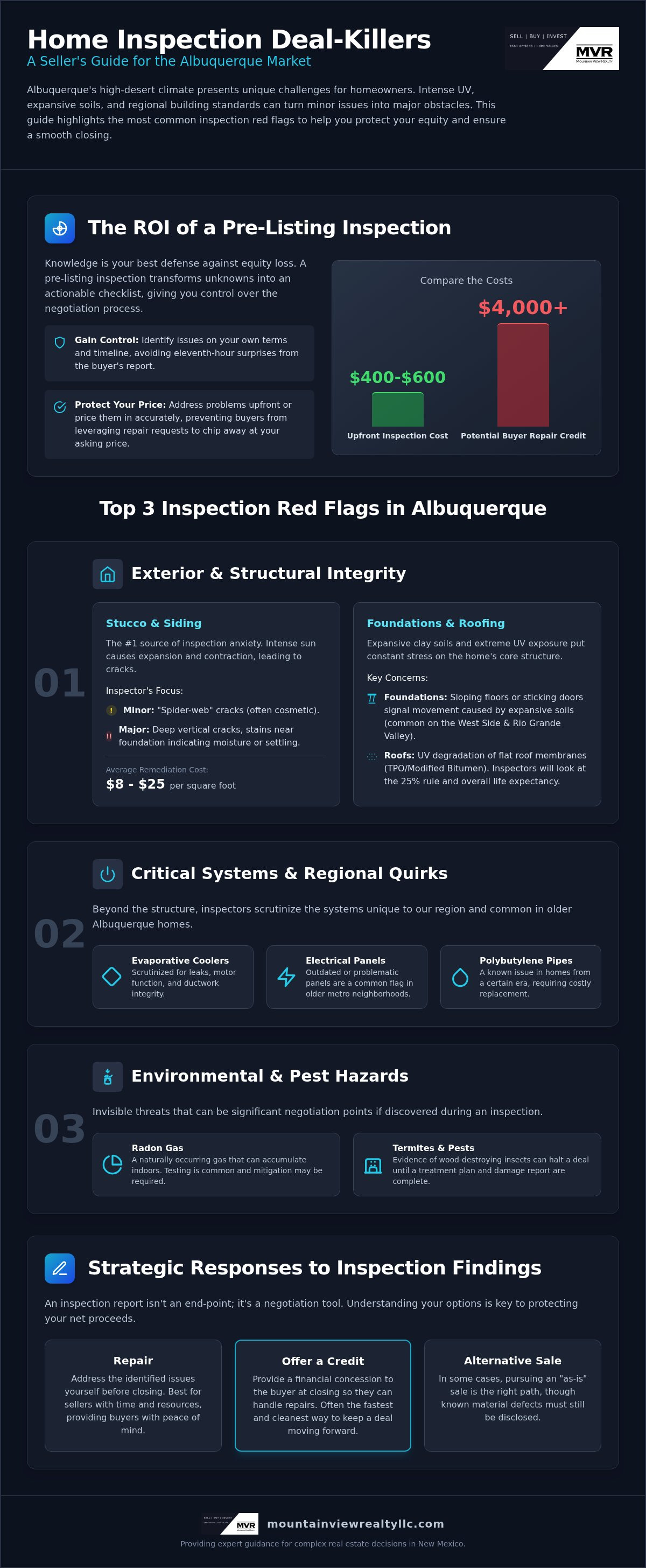
Knowledge is your best defense against equity loss. A professional home inspection in the Albuquerque area typically costs between $400 and $600. This small upfront investment provides a massive return by putting you in the driver's seat. By identifying common home inspection issues in Albuquerque early, you avoid being blindsided by a buyer's $4,000 repair credit request at the eleventh hour. This data allows us to set a realistic budget for our Renovate & Sell path. It ensures you only tackle repairs that drive up your net proceeds rather than just spending money for the sake of it. It transforms the "unknown" into an actionable checklist, replacing stress with a clear plan for a clean report and a faster closing.
Exterior and Structural Deal-Killers: Stucco, Roofs, and Foundations
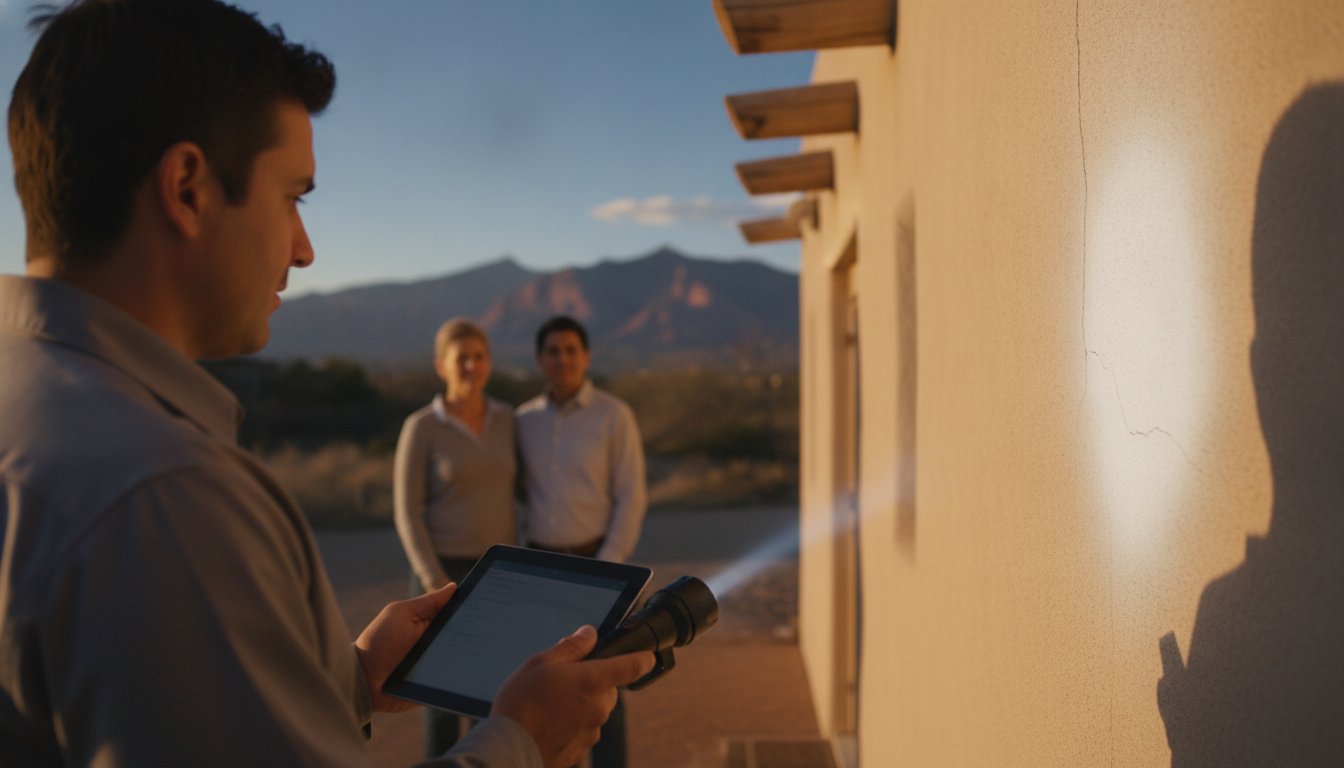
In the high desert, your home’s exterior is its first line of defense against extreme thermal cycling and intense UV exposure. Stucco is the most common finish in our region, but it’s also a frequent source of anxiety during the sales process. Many common home inspection issues in Albuquerque stem from "spider-web" cracks. These are often cosmetic, resulting from the house expanding and contracting in the desert sun. However, deep vertical cracks or staining near the foundation often signal structural settling or moisture intrusion. If you're concerned about how these might affect your bottom line, we can help you evaluate your path through a strategic consultation.
Foundation stability is another regional priority. The Rio Grande Valley and the West Side are known for expansive clay soils. These soils swell when wet and shrink when dry, putting immense pressure on concrete slabs. Inspectors look for sloping floors or doors that stick as signs of movement. Proper drainage and grading are essential to mitigate this risk. If the Albuquerque slope directs monsoon runoff toward your crawlspace rather than away from it, you’ll likely face a request for corrective landscaping or French drains.
The Stucco Inspection: EIFS vs. Traditional Hard-Coat
Inspectors pay close attention to the specific type of stucco used on your home. Synthetic stucco, or EIFS, is notorious for moisture traps if it isn't sealed perfectly around windows and doors. Traditional hard-coat is more durable but still requires a "weep screed" at the bottom. This metal strip allows moisture to escape and prevents it from wicking into your interior walls. In luxury markets like High Desert, remediation for poorly installed stucco is a major deal-killer. Standard repairs often range from $8 to $25 per square foot, making early detection vital for protecting your equity.
Roofing Life Expectancy in the High Desert
Albuquerque’s 2026 UV levels are brutal on roofing membranes. Flat roofs using TPO or modified bitumen are common, but they often suffer from "ponding water" where moisture sits for days after a storm. Parapet walls are another silent killer; if the plaster on these walls cracks, water seeps directly into the roof structure. New Mexico building codes mandate that if more than 25% of a roof is damaged, the entire system must be replaced. Because of this high-stakes rule, many lenders now require a formal "roof certification" before they'll fund a buyer's loan. Addressing these issues before listing ensures your transaction doesn't stall just before the finish line.
Critical Systems: Plumbing, Electrical, and the 'Swamp Cooler' Factor
Your home's internal systems act as its pulse. When these systems falter, they often become the primary common home inspection issues in Albuquerque that buyers use to negotiate steep discounts. Unlike many parts of the country, Albuquerque relies heavily on evaporative cooling, commonly known as swamp coolers. These units are highly efficient in our dry climate, but they are also a frequent source of inspection citations due to corrosion or improper seasonal maintenance. We often see these issues lead to last minute stress during the closing process.
Electrical safety is another non-negotiable for 2026 buyers. If your home is in an established neighborhood, an inspector will immediately check for Federal Pacific or Zinsco electrical panels. These brands are notorious for failing to trip during a surge, creating a significant fire hazard. Most insurance companies now refuse to cover homes with these panels, making them an automatic repair or replacement item. Similarly, polybutylene piping, often called Quest piping, was common in 1980s and 90s builds. It is prone to sudden failure. Its presence alone can trigger a request for a full home repipe before a lender will approve a loan.
Safety standards also extend to your water heater. In New Mexico, these units must be properly strapped to the wall to prevent movement. Venting is equally critical; improper exhaust setups can lead to carbon monoxide buildup. This is a major safety defect that will always appear on a professional report.
The Evaporative Cooler Maintenance Checklist
Inspectors look for rusted pans, faulty pumps, and blocked distribution lines that prevent even airflow. The "switchover" period in spring or fall is particularly tricky. If an inspector can't test the unit because it hasn't been de-winterized, they will often flag it as "untestable," which creates uncertainty for the buyer. If your unit is nearing the end of its life, our Renovate & Sell path can help you upgrade to refrigerated air. This modernizes the home and significantly increases its market value while eliminating cooling concerns from the inspection report entirely.
Aging Infrastructure in North Valley and Nob Hill
Historic districts like Nob Hill and the North Valley require a specialized eye. Inspectors frequently find knob-and-tube wiring or ungrounded outlets in these older properties. A sewer line scope is another essential step for homes built before 1980. This video inspection typically costs between $150 and $300. It is the only way to identify "orangeburg" pipe or heavy cast-iron scale buildup that could lead to a total line collapse. Addressing these infrastructure issues early protects your equity and ensures a seamless transition for the new owners.
Environmental Hazards: Radon and Pests in the Metro Area
Beyond the visible structure of a home, invisible environmental factors often surface as common home inspection issues in Albuquerque. Our city's unique geography, nestled between a volcanic field and granite mountains, creates specific risks that buyers in 2026 are increasingly sensitive to. While these issues might sound intimidating, they're manageable with the right strategic approach. Identifying them early ensures you protect your equity and maintain control over the negotiation process.
Radon gas is a primary concern in the metro area. This colorless, odorless gas occurs naturally as uranium decays in our soil. Areas like Sandia Heights and the Foothills often see higher concentrations due to their proximity to granite formations. Similarly, mid-century luxury homes may harbor lead-based paint or asbestos in textured ceilings. While mold is less common in our dry climate, it becomes a serious material defect when evaporative coolers leak into attic spaces or behind drywall. These aren't deal-killers if you address them with transparency and professional remediation.
Radon Mitigation Strategies
The EPA recommends action if radon levels reach 4.0 pCi/L or higher. In Albuquerque, a professional radon test typically costs between $150 and $300. If your home exceeds the action level, an active soil depressurization system is the standard solution. These systems use a dedicated vent pipe and fan to pull radon from beneath the foundation and release it safely above the roofline. High-end buyers in zones with known high concentrations often view a pre-installed mitigation system as a sign of a well-maintained, safe home.
Wood-Destroying Organisms (WDO)
There's a common myth that termites aren't a problem in the high desert. In reality, subterranean termites are a "when, not if" factor for New Mexico wood structures. A standard home inspection doesn't always include a dedicated WDO report, which usually costs between $100 and $325. Inspectors look for mud tubes or damaged wood, particularly where stucco has direct contact with the soil. This "stucco-to-soil" contact provides a hidden highway for pests. Completing a pre-listing treatment and clearing any debris from the foundation simplifies the closing process and provides the buyer with much-needed peace of mind.
Strategic Responses: Repair, Credit, or Alternative Sale?
The moment the Buyer’s Inspection Notice and Seller’s Response (BinSR) arrives, the real strategy begins. This document lists the common home inspection issues in Albuquerque that the buyer wants you to address before they commit to the purchase. You have several choices at this stage. You can fix the items, offer a financial credit, or decline the request. Using our "Investor’s Eye," we help you determine the most cost-effective path. Often, offering a credit is the cleanest solution. It allows the buyer to choose their own contractors after the closing and releases you from the liability of the repair quality. However, if the buyer's lender requires a "clean" report for financing, we pivot to hiring trusted local professionals to get the job done quickly.
Our Renovate & Sell program is designed for sellers who want to maximize their net proceeds by fixing major issues before they hit the market. If a pre-inspection reveals significant structural or system failures, this path allows you to address them upfront. This turns a potential deal-killer into a verified selling point. Conversely, if the list of repairs is simply too long or your budget is tight, CashOffer+ might be the smarter move. It provides a way to walk away with your equity intact without the stress of a traditional listing or a single repair. It's about finding the path that respects your time and your financial goals.
Negotiating from a Position of Strength
We pride ourselves on being honest and strategic. I'll tell you what you need to hear about your property's condition, not just what you want to hear. This transparency is crucial for a successful sale. We prioritize health and safety items first. These are the non-negotiable repairs that keep a buyer's lender on board. In the fast-paced 2026 Albuquerque market, speed is everything. We use our deep network of local contractors to get reputable bids within days, ensuring your transaction stays on schedule and your equity remains protected.
Alternative Paths for Distressed Properties
Not every home is ready for a traditional parade of buyers. If your inspection report feels overwhelming, you don't have to face it alone. Selling "as-is" is a valid and often preferred choice for those who value their peace of mind over a long renovation. Our diverse home selling options in Albuquerque provide a reliable safety net. We help you protect your equity even when the repair list is longer than your current budget. You deserve a solution that fits your specific journey, whether that involves a strategic renovation or a direct, hassle-free sale.
Take Control of Your Home Sale Strategy
A home inspection shouldn't be a source of fear. It's a tool for clarity. By identifying common home inspection issues in Albuquerque early, you eliminate the stress of the unknown. Whether you're managing stucco cracks in the High Desert or updating a swamp cooler in Nob Hill, preparation is your greatest advantage. We've used our 15 years of investor experience to help over 200 families navigate these exact hurdles, including complex luxury sales like the $1.7M Jemez Pueblo estate.
You have the power to choose the path that fits your life. You might decide to tackle repairs through our Renovate & Sell program or opt for a seamless transition with CashOffer+. Our goal is to provide the intelligence and support you need to maximize your proceeds without the typical headaches of a real estate transaction.
Your journey toward a clean inspection report starts with a single step. We're here to act as your strategic partner every step of the way.
Frequently Asked Questions
What are the most common home inspection failures in Albuquerque?
The most frequent citations involve stucco integrity, flat roof ponding, and neglected evaporative coolers. Inspectors also look for expansive soil movement and outdated electrical panels like Zinsco or Federal Pacific. These common home inspection issues in Albuquerque can stall a sale if not addressed. We use an investor’s eye to help you prioritize which systems require immediate attention and which are merely cosmetic maintenance items that won't impact your bottom line.
Does a seller have to fix everything on a home inspection report in New Mexico?
You aren't legally required to fix every item found in a report. In New Mexico, the process is a negotiation between the buyer and seller. You should prioritize material defects that affect safety or habitability to keep the buyer’s lender on board. We focus on being honest and strategic, helping you decide when to offer a repair credit or use a program like Renovate & Sell to protect your net proceeds.
How much does a typical radon mitigation system cost in ABQ?
While costs vary based on the home's foundation type, a professional radon test in the Albuquerque area typically costs between $150 and $300. If levels exceed the EPA’s 4.0 pCi/L action level, a mitigation system is recommended. These systems use active soil depressurization to vent gas safely. Addressing this early is especially important in high-risk zones like Sandia Heights to ensure a smooth closing for luxury buyers and protect your equity.
Is a stucco inspection part of a standard home inspection?
A standard home inspection includes a visual assessment of the stucco, but it's not an exhaustive specialized test. General inspectors look for cracks, staining, and proper ground clearance. If they find evidence of moisture intrusion or EIFS failure, they'll recommend a secondary, invasive stucco inspection. This is a scenario where specialized knowledge of Southwest building codes saves you from unexpected post-closing liability. We help you navigate these technical requirements with patience and expertise.
What is the NMAR 'As-Is' addendum and how does it affect inspections?
The NMAR "As-Is" addendum states that the seller won't perform any repairs or provide credits for the property's condition. However, it doesn't waive the buyer's right to an inspection. The buyer can still terminate the contract if the report reveals issues they aren't willing to accept. This is where having multiple selling paths, like our CashOffer+ option, provides a strategic safety net for homes with significant deferred maintenance or complex structural concerns.
Should I get a pre-listing inspection for my Albuquerque home?
A pre-listing inspection is a smart move to eliminate the "unknown" factor before your home hits the market. Spending a few hundred dollars now identifies common home inspection issues in Albuquerque that could lead to thousands in lost equity later. It allows you to fix small problems on your own timeline. This proactive approach reduces seller stress and helps us set a more accurate and strategic listing price from day one.
How do I find a reliable home inspector in Rio Rancho or Albuquerque?
You should look for inspectors who are certified by national organizations like ASHI or InterNACHI and have extensive experience with New Mexico's climate. A reliable inspector in Rio Rancho or Albuquerque understands the nuances of "swamp coolers" and expansive clay soils. We maintain a vetted list of local professionals who provide thorough, fair reports. This ensures you receive an honest assessment of your home’s condition before the high-pressure negotiation phase begins.
What happens if a buyer backs out after an inspection in New Mexico?
If a buyer backs out during the inspection contingency period, they typically receive a full refund of their earnest money. In New Mexico, the standard NMAR contract allows buyers to terminate if they're dissatisfied with any aspect of the inspection. This highlights the importance of pre-market preparation. We help you navigate these transitions by offering alternative solutions, such as a Home Trade-In, to keep your moving plans on track even if a traditional deal falters.

Article by
Robb Krautbauer
Robb Krautbauer is the Owner and Qualifying Broker of Mountain View Realty, serving Albuquerque, Rio Rancho, Santa Fe, and surrounding New Mexico communities. With more than a decade of real estate experience, Robb specializes in luxury homes, strategic home marketing, and helping homeowners navigate important life transitions with confidence.
Known for combining luxury-level marketing, AI-powered technology, and innovative selling strategies, Robb helps clients maximize their home's value while creating a smooth, personalized selling experience. Whether assisting luxury homeowners, retirees, families downsizing, or real estate investors, his focus is always on delivering expert guidance, honest advice, and exceptional results.
When he's not helping clients achieve their real estate goals, Robb enjoys studying market trends, emerging technology, and investment strategies that keep Mountain View Realty at the forefront of the industry.
Disclaimer
**Disclaimer:** The information provided in this article is for general educational purposes only and should not be considered legal, tax, financial, or professional advice. Real estate laws, market conditions, and regulations change over time and may vary based on your individual circumstances. Before making any real estate decision, consult with qualified legal, tax, or financial professionals. If you have questions about buying or selling real estate in New Mexico, contact Mountain View Realty for guidance specific to your situation. © 2026 Mountain View Realty. All rights reserved. The content on this website may not be reproduced without written permission.


