
Cost of Living in Albuquerque vs. Phoenix: A 2026 Strategic Comparison
What if your Phoenix home equity could buy a significantly higher tier of lifestyle just four hundred miles to the east? Many residents in the Valley of the Sun are discovering that while Phoenix has stabilized, the cost of "big city" living has become a heavy tax on both wealth and peace of mind. You've likely felt the squeeze of rising housing prices and those legendary summer utility bills that seem to climb every year.
We understand that a move is about more than just numbers; it's about finding a place where your hard-earned success translates into a more sophisticated daily experience. This analysis of the cost of living in Albuquerque vs Phoenix highlights a strategic "luxury arbitrage" opportunity available in 2026. You'll learn how your housing dollar stretches further in New Mexico’s high-desert enclaves, from the foothills of Sandia Heights to the custom estates of North ABQ Acres.
Our guide breaks down the essential data on real estate equity, climate-driven utility savings, and the lifestyle advantages of a less congested metro area. We’ll provide a clear roadmap for leveraging your current Arizona assets to secure a premium New Mexico home. By the end, you'll have the insights needed to plan a stress-free transition to a market where your wealth simply works harder.
Key Takeaways
- Learn why Albuquerque offers a 9% to 16% lower cost of living than Phoenix, providing more financial freedom without sacrificing a high-end lifestyle.
- Discover the "luxury arbitrage" effect where your Phoenix home equity can secure a custom estate in exclusive enclaves like Sandia Heights or North ABQ Acres.
- Analyze the data on how Albuquerque’s high-desert elevation significantly reduces summer utility bills compared to the extreme cooling costs in the Valley of the Sun.
- Understand the strategic trade-offs in the cost of living in Albuquerque vs Phoenix, including New Mexico’s progressive tax brackets and the "ABQ 20-minute rule" for commutes.
- Explore how tools like Home Trade-In allow you to buy your new New Mexico residence before selling your Arizona property, ensuring a stress-free transition.
Albuquerque vs. Phoenix: The 2026 Cost of Living Breakdown
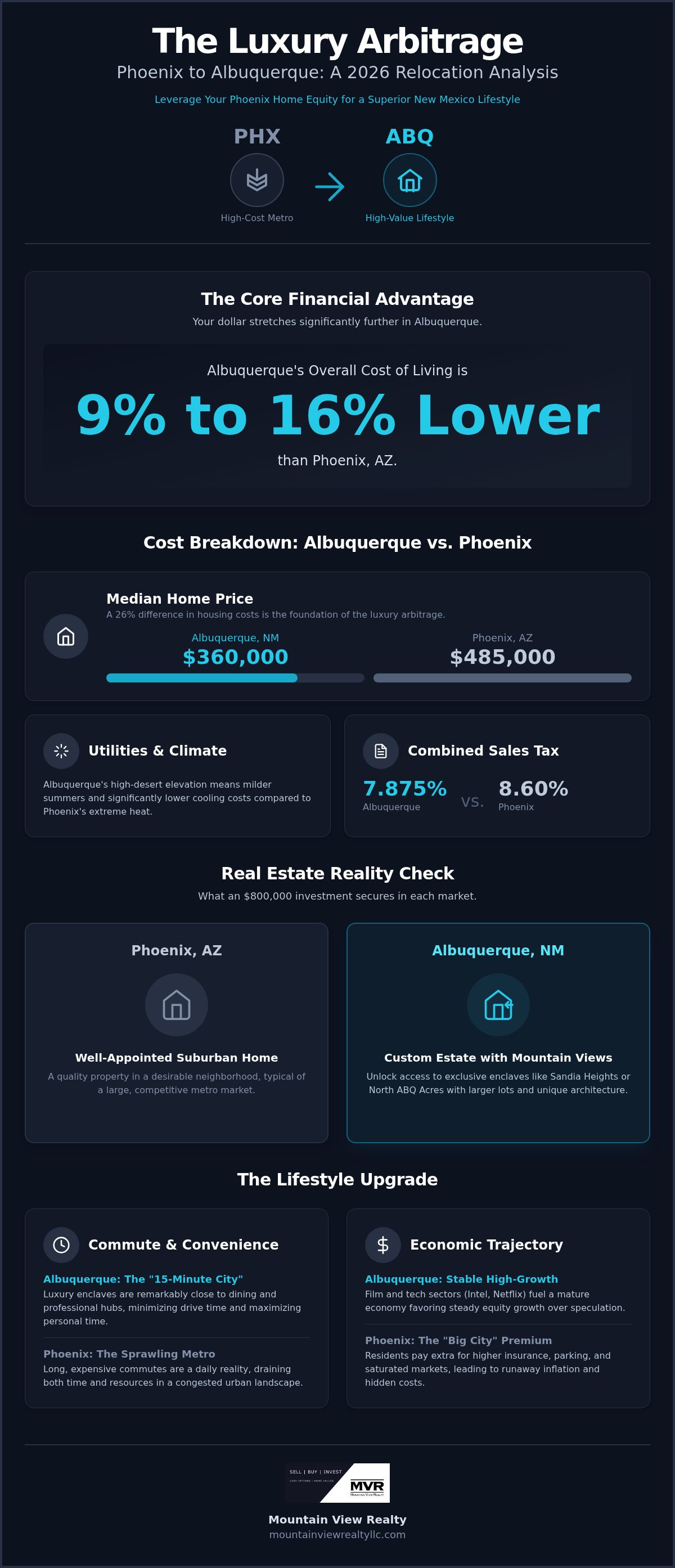
Phoenix's meteoric rise over the last decade has come with a steep price tag. While the Valley of the Sun offers undeniable scale, the financial gap between these two Southwest hubs has widened significantly by 2026. Understanding the cost-of-living index for both regions is essential for any strategic relocation. Current data suggests that Phoenix is between 9% and 16% more expensive than Albuquerque. This difference isn't just a rounding error; it represents a fundamental shift in how far your dollar stretches across housing, utilities, and daily essentials.
The layout of the cities also plays a major role in your monthly budget. Albuquerque’s "15-minute city" design means that luxury enclaves like Sandia Heights are remarkably close to high-end dining and professional hubs. In contrast, the sprawling nature of Phoenix often requires long, expensive commutes that drain both your time and your bank account. When you calculate the cost of living in Albuquerque vs Phoenix, you have to look beyond the price of a gallon of milk and consider the total cost of your time and peace of mind.
| Expense Category | Albuquerque, NM | Phoenix, AZ |
|---|---|---|
| Overall Cost of Living | 9% - 16% Lower | Baseline |
| Median Home Price | $360,000 | $485,000 |
| Sales Tax (Combined) | 7.875% | 8.60% |
| Avg. Gas Price (Aug 2026) | $4.15 per gallon | $4.44 per gallon |
Purchasing Power and Economic Trajectory
Albuquerque's economy has matured into a stable, high-growth environment. The expansion of the film industry and tech sectors like Netflix and Intel has bolstered the local economy without triggering the runaway inflation seen in Phoenix. While the median household income in Phoenix sits around $69,000 compared to Albuquerque's $57,000, the local purchasing power tells a different story. In Albuquerque, your income simply buys more. You aren't just paying for the privilege of being in a large metro area; you're investing in a market that favors steady equity growth over volatile speculation.
The 'Big City' Premium: What Phoenix Residents Pay Extra For
Living in a massive metro area like Phoenix involves hidden costs that many residents simply accept as normal. Higher auto insurance premiums, parking fees in Scottsdale, and the sheer cost of maintaining a lifestyle in a crowded market add up quickly. Albuquerque offers a lower barrier to entry for luxury services. Whether you are looking for private club memberships or high-end renovations, the market is less saturated and more approachable. Luxury Arbitrage in 2026 is the strategic move of liquidating high-priced Phoenix assets to acquire a superior lifestyle and a larger estate in Albuquerque for a significantly lower total investment.
Real Estate Reality: Comparing Housing Prices and Equity
The real estate market defines the primary difference in the cost of living in Albuquerque vs Phoenix. In Phoenix, a budget of $800,000 typically secures a well-appointed suburban home in a desirable neighborhood. In Albuquerque, that same investment opens the door to a custom estate with sweeping mountain views. Current Albuquerque economic data shows a market that remains resilient, offering a significantly lower price-per-square-foot than the Valley of the Sun. While Phoenix continues its outward sprawl, Albuquerque’s growth is naturally constrained by the Sandia Mountains and surrounding Pueblo lands. This geographic scarcity helps protect long-term property values for local homeowners.
Comparing specific neighborhoods highlights the value gap. High Desert in Albuquerque offers a sophisticated, high-altitude lifestyle that rivals North Scottsdale. You'll find that luxury properties in New Mexico often come with larger lots and more architectural character for a fraction of the Phoenix price tag. For those curious about their potential purchasing power, understanding the Albuquerque real estate market is the first step toward a strategic move.
Luxury Tiers: Sandia Heights vs. Paradise Valley
The luxury market in Albuquerque offers a unique "mountain estate" lifestyle that is becoming increasingly rare in Arizona. In Sandia Heights, $1.5 million can secure an expansive custom build on several acres with unobstructed views of the city lights and rugged peaks. Achieving a similar level of privacy and prestige in Paradise Valley often requires a multi-million dollar premium. Robb Krautbauer specializes in luxury marketing for these unique mountain properties, ensuring that the true value of high-desert living is clearly communicated to discerning buyers.
Property Taxes and Homeowners Insurance
Financial planning for a move requires looking at the total carrying cost of a home. Arizona uses a complex system of primary and secondary tax rates, which can vary significantly by district. New Mexico’s property tax structure is more straightforward, with an average effective rate of around 0.67%. Homeowners insurance also tends to be more favorable in Albuquerque. The extreme heat and monsoon risks in Phoenix have pushed premiums higher, while Albuquerque’s milder climate and lower risk profile keep costs manageable. If you are weighing these factors, you might consider a confidential consultation to review how these numbers apply to your specific portfolio.
Utilities and Climate: The Cost of Beating the Heat
Climate is the most visceral difference in the cost of living in Albuquerque vs Phoenix. While both cities share a high-desert aesthetic, the physical reality of living at 5,000 feet versus 1,000 feet significantly changes your monthly operational budget. In Phoenix, the "AC season" is an expensive marathon that often lasts five months or more. Albuquerque’s high-altitude climate limits peak cooling needs to roughly eight weeks of moderate warmth. On average, Phoenix experiences July highs around 106 degrees, while Albuquerque stays a comfortable 14 degrees cooler at approximately 92 degrees.
Energy Bills: PNM vs. APS/SRP
Managing a 3,000 square foot luxury home requires a strategic look at energy consumption. Phoenix residents frequently face summer electric bills between $250 and $350 due to the relentless demand on HVAC systems. In contrast, Albuquerque homeowners using PNM typically see bills in the $120 to $180 range during the same peak period. While New Mexico does have colder winters, the cost of natural gas heating rarely reaches the extreme heights of Arizona’s summer cooling expenses. Tools like the Forbes Cost of Living Calculator confirm that these utility savings are a primary driver for those relocating to the high desert.
Solar ROI in 2026 remains strong in both regions, but Albuquerque offers a unique advantage. The cooler ambient temperatures improve the efficiency of photovoltaic panels compared to the extreme heat of the Phoenix valley. New Mexico’s current state tax credits and net metering policies through PNM provide a faster path to energy independence for luxury homeowners.
Water and Landscaping Maintenance
Water scarcity is a reality in the Southwest, but the costs manifest differently in each city. Maintaining a private pool in Phoenix involves high evaporation rates and chemical costs that can add $100 to $150 to your monthly budget. Albuquerque’s milder summers reduce this burden significantly. Both cities offer robust municipal rebates for xeriscaping, but Albuquerque’s four-season climate allows for a more diverse range of drought-tolerant plants. This seasonal variety reduces the need for the year-round irrigation common in the Valley of the Sun. Your home maintenance schedule in Albuquerque will follow a more traditional rhythm, with distinct periods for winterization and spring preparation that protect your investment over the long term.
Lifestyle and Taxes: Income, Food, and Transportation
The "stress tax" of a major metropolitan area is often overlooked in a standard cost of living in Albuquerque vs Phoenix analysis. While Phoenix offers the scale of a 5.2 million person metro, that size brings significant logistical costs that drain both your time and your wallet. Albuquerque’s layout allows for a "20-minute rule" where almost any luxury amenity or professional hub is accessible within a short drive. This efficiency saves more than just gas money; it preserves your most valuable asset: time. You'll find that the pace of life in the high desert is intentionally designed for ease rather than endurance.
The Commute Tax: Gas, Wear, and Time
Driving in the Valley of the Sun has become increasingly expensive. As of August 2026, Arizona gas prices averaged $4.44 per gallon, which is notably higher than the national average. When you combine high fuel costs with the wear and tear of long commutes on the I-10 or Loop 101, the financial burden adds up quickly. Albuquerque offers a more manageable pace. Neighborhoods like Nob Hill or the North Valley provide high walkability scores and easy access to the city’s extensive trail systems. You'll spend less on vehicle maintenance and fuel, allowing those funds to be redirected toward lifestyle experiences or property improvements.
State Tax Implications for Retirees and Executives
Tax planning is a critical component of any interstate move. Arizona’s flat 2.5% income tax is an attractive feature for high-earning households. However, New Mexico offers strategic advantages for other demographics. In 2026, New Mexico continues to provide favorable tax treatment for Social Security benefits for most retirees, which can significantly offset the state's progressive brackets that cap at 5.9%. For executives and business owners, the lower cost of local services and commercial space in Albuquerque often creates a more favorable bottom line than the crowded Phoenix market.
For investors, moving equity from Arizona to New Mexico can be optimized through a 1031 exchange. This strategy allows you to defer capital gains taxes while transitioning into Albuquerque’s resilient luxury market. The combined sales tax in Albuquerque is also lower at 7.875%, compared to 8.6% in Phoenix. This provides a consistent "discount" on everything from fine dining in the Sawmill District to high-end retail. Healthcare accessibility also remains a strong point for Albuquerque, with specialized clinics and the UNM health system providing sophisticated care without the extreme wait times common in Maricopa County.
Strategizing Your Move: From Phoenix Equity to ABQ Luxury
Moving from the Valley to the High Desert is a tactical financial pivot. If you're selling a property in North Scottsdale or Gilbert, you likely have substantial equity that can be deployed into a premium Albuquerque estate. With the Phoenix median home price sitting at approximately $485,000 compared to Albuquerque’s $360,000, you can often transition to a custom home while significantly reducing your debt. The cost of living in Albuquerque vs Phoenix allows for this "equity play," but it requires careful execution to protect your wealth during the transition.
Mountain View Realty LLC approaches these moves with an educator-led mindset. We focus on providing the data you need to make informed decisions about your transition. Our "List with a Twist" program offers creative solutions for out-of-state sellers, ensuring your property stands out in a competitive market. We prioritize your peace of mind, acting as a strategic partner rather than just a service provider. This approach reduces the inherent stress of complex financial transactions by projecting an atmosphere of simplicity and ease.
The Home Trade-In: Eliminating the Double Move
One of the biggest hurdles in relocation is the timing. Coordinating a sale in Arizona with a purchase in New Mexico often leads to temporary housing or high-stress double moves. Our Home Trade-In program solves this by allowing you to buy your new Albuquerque home before selling your Phoenix property. This strategy protects your equity by preventing desperate price drops and gives you the freedom to move at your own pace. To see how this compares to traditional methods, you can review our guide on home trade in vs traditional sale Albuquerque.
Confidential Consultations for Relocators
A successful move requires more than just a real estate agent. Robb Krautbauer brings 15 years of investor experience and a decade as a broker to every relocation. He looks at properties with an "investor eye," identifying which Albuquerque enclaves, such as Sandia Heights or North ABQ Acres, offer the best long-term value. We invite you to a no-pressure strategy session to discuss your specific goals. Whether you're looking for a 1031 exchange or a senior transition, our goal is to provide a clear, actionable roadmap. By understanding the nuances of the cost of living in Albuquerque vs Phoenix, we help you maximize your real estate portfolio and enjoy the high-desert lifestyle you've earned.
Robb Krautbauer
Owner & Qualifying Broker, Mountain View Realty LLC
Your Next Strategic Move in the Southwest
Deciding on a relocation involves balancing financial growth with personal well-being. As we've explored, the cost of living in Albuquerque vs Phoenix offers a unique opportunity to trade "big city" congestion for high-desert tranquility without sacrificing luxury. By moving equity from the Valley into New Mexico’s resilient market, you aren't just saving on monthly utilities; you're investing in a more sustainable and less stressful future.
Navigating these complex financial transitions requires a partner who understands both the investor’s perspective and the homeowner’s needs. With 15 years of experience in the industry, I focus on creating tailored plans that prioritize your long-term equity and peace of mind. Whether you are exploring a 1031 exchange or planning a senior transition, the goal is always a seamless, professional experience.
I look forward to helping you discover the unique value and beauty of the New Mexico landscape.
Robb Krautbauer
Owner & Qualifying Broker, Mountain View Realty LLC
Frequently Asked Questions
Is it cheaper to live in Albuquerque or Phoenix in 2026?
Albuquerque is about 9% to 16% more affordable than Phoenix in 2026. This difference stems largely from lower housing costs and energy rates. Your housing dollar stretches further in New Mexico, allowing for a more luxurious lifestyle without the "big city" premium found in Maricopa County. It's a strategic move for those who want to maintain a high standard of living while reducing monthly overhead.
How much can I save on housing by moving to Albuquerque from Phoenix?
Moving to the high desert typically saves homeowners an average of $125,000 on initial purchase costs. While the median home price in Phoenix has reached $485,000, Albuquerque remains approachable at approximately $360,000. This equity gap allows for a cash-heavy purchase or a significant upgrade in acreage and views. Many of our clients find they can buy a custom estate for the price of a standard suburban home.
What are the property tax differences between New Mexico and Arizona?
New Mexico’s effective property tax rate is roughly 0.67%, which is slightly above Arizona’s 0.62%. Because Albuquerque property values are lower, the actual dollar amount you pay each year is often lower than in Phoenix. New Mexico’s straightforward assessment process provides a predictable financial environment for luxury estate owners. You won't have to deal with the complex secondary tax districts common in the Valley.
Which city has a better climate for low utility bills?
Albuquerque’s high-altitude climate is far more efficient for keeping utility bills low. Phoenix residents face five months of extreme heat with average July highs of 106 degrees. Albuquerque stays closer to 92 degrees, reducing the "AC season" to just a few weeks and cutting summer electric bills by nearly 50% compared to the Valley. The cooler evenings at 5,000 feet provide natural relief that low-elevation deserts can't match.
Is the Albuquerque real estate market a good investment compared to Phoenix?
Albuquerque offers a resilient, supply-constrained market that favors long-term equity. Unlike the sprawling Phoenix valley, Albuquerque is bounded by mountains and Pueblo lands, creating a natural scarcity of luxury homesites. This stability makes the cost of living in Albuquerque vs Phoenix a strategic play for investors seeking steady growth over market volatility. It’s a mature market that rewards those looking for reliable value.
How does the 'Home Trade-In' program help with out-of-state relocation?
The Home Trade-In program allows you to purchase your new Albuquerque home before listing your current Arizona property. This eliminates the logistical nightmare of a double move or temporary housing. It’s a specialized tool we offer to ensure your transition is seamless, professional, and entirely on your timeline. You can move your belongings once and settle into your new lifestyle without the stress of simultaneous closings.
What is the 'luxury discount' in Albuquerque's real estate market?
The "luxury discount" refers to the superior level of construction and location you get in New Mexico for a lower price. An $800,000 budget in Albuquerque secures a custom estate in Sandia Heights with mountain views. In Phoenix, that same amount typically buys a standard suburban home on a much smaller lot. You aren't just saving money; you're acquiring a higher tier of real estate and a more exclusive lifestyle.
Are state income taxes higher in New Mexico or Arizona?
Arizona features a flat 2.5% income tax, while New Mexico uses a progressive system that reaches 5.9%. However, when you look at the total cost of living in Albuquerque vs Phoenix, the savings on housing and utilities often outweigh the income tax difference. New Mexico also offers specific tax exemptions for Social Security that benefit many retirees. We recommend consulting with a tax professional to see how these brackets affect your specific portfolio.

Article by
Robb Krautbauer
Robb Krautbauer is the Owner and Qualifying Broker of Mountain View Realty, serving Albuquerque, Rio Rancho, Santa Fe, and surrounding New Mexico communities. With more than a decade of real estate experience, Robb specializes in luxury homes, strategic home marketing, and helping homeowners navigate important life transitions with confidence.
Known for combining luxury-level marketing, AI-powered technology, and innovative selling strategies, Robb helps clients maximize their home's value while creating a smooth, personalized selling experience. Whether assisting luxury homeowners, retirees, families downsizing, or real estate investors, his focus is always on delivering expert guidance, honest advice, and exceptional results.
When he's not helping clients achieve their real estate goals, Robb enjoys studying market trends, emerging technology, and investment strategies that keep Mountain View Realty at the forefront of the industry.
Disclaimer
**Disclaimer:** The information provided in this article is for general educational purposes only and should not be considered legal, tax, financial, or professional advice. Real estate laws, market conditions, and regulations change over time and may vary based on your individual circumstances. Before making any real estate decision, consult with qualified legal, tax, or financial professionals. If you have questions about buying or selling real estate in New Mexico, contact Mountain View Realty for guidance specific to your situation. © 2026 Mountain View Realty. All rights reserved. The content on this website may not be reproduced without written permission.


