
Home Appraisal vs. Home Inspection: What Albuquerque Buyers and Sellers Should Know
What if a home’s appraised value looks right, but the property still has costly problems? That’s why home appraisal vs home inspection can feel confusing: both involve a close look at a home, but they answer different questions. An appraisal estimates value, often for a lender. An inspection examines condition and may flag concerns such as roof wear, stucco damage, drainage issues, or older sewer lines, all relevant to Albuquerque-area properties.
If you’re buying or selling, it’s natural to wonder whether one report can stand in for the other, who each evaluation serves, and how the findings could affect your transaction. The short answer is that neither replaces the other. This guide explains what appraisals and inspections can, and can’t, tell you; when they may happen; and what questions to ask about the results. You’ll come away better prepared to weigh your options and make an informed decision, whether you’re considering a home in Albuquerque, Rio Rancho, Corrales, or nearby.
Key Takeaways
- In the home appraisal vs home inspection comparison, one estimates market value while the other documents a home’s condition.
- Understand who each evaluation is intended to inform and what the professional may review or document.
- Use each report for its purpose; neither can answer all the questions raised by the other.
- Review timing and findings in light of your transaction, purchase agreement, lender, and property.
- Consider Albuquerque-area property details alongside both reports when deciding what questions or next steps make sense.
Home appraisal vs. home inspection: what question does each one answer?
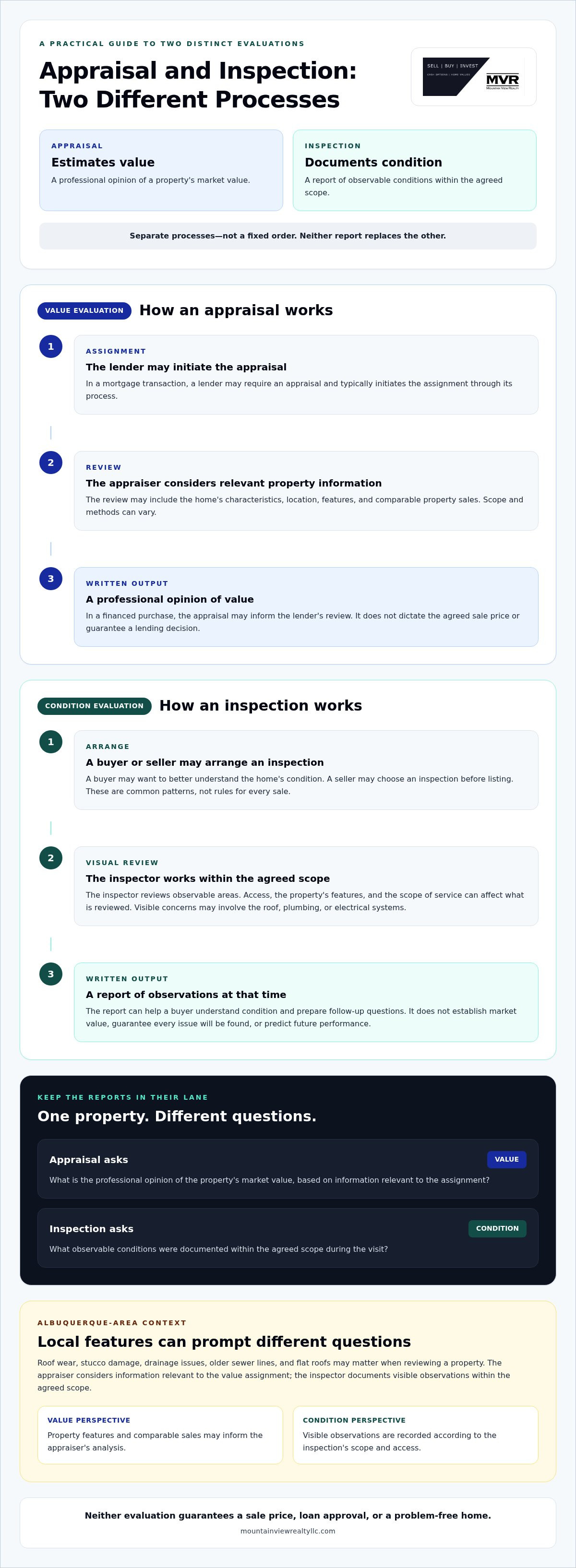
The terms sound similar, and both evaluations may involve a professional visiting the property. But they serve different purposes. In a home appraisal vs home inspection, the appraisal addresses a value question; the inspection addresses a condition question. Neither guarantees a sale price, loan approval, or a problem-free home.
A lender may use an appraisal to help assess whether a property supports the loan amount. A buyer or seller may use an inspection to better understand the home’s visible condition. The exact role and scope of either evaluation can depend on the transaction, the property, and the service arranged.
What does a home appraisal evaluate?
An appraisal is a professional opinion of a property’s market value. The appraiser may consider the home’s characteristics, location, and comparable property sales. The Consumer Financial Protection Bureau explains home appraisals as a way for lenders to assess a home’s value in relation to a mortgage. Methods and scope can vary, and the value reflects the appraiser’s analysis, not a guaranteed selling price.
An online estimate can offer a quick reference, but it isn’t the same as an appraisal. An estimate generated from available data may not reflect the property’s specific features or condition as closely as a professional evaluation. For an Albuquerque home, details such as its size, layout, updates, and location may inform the appraiser’s analysis alongside comparable sales.
What does a home inspection evaluate?
An inspection documents the observable condition of a property at the time of the visit. Depending on the agreed scope and the home, an inspector may report visible concerns involving the roof, plumbing, or electrical systems. The Home Inspection overview describes the general purpose of this evaluation. An inspection can help a buyer understand what may need attention, but it doesn’t establish market value or guarantee that every issue will be found.
Scope matters. A standard inspection may not address every system or concern, and some parts of a property may not be accessible or visible during the visit. For example, a report on an Albuquerque home with a flat roof can describe visible observations, but it shouldn’t be treated as a guarantee about future performance or concealed conditions. Read the report in light of the service arranged and the property itself.
In short: an appraisal estimates value; an inspection reports observable condition. Both can inform a real estate decision, but each has limits. Knowing which question you need answered helps you interpret the findings without asking one report to do the work of the other.
What happens during an appraisal and a home inspection?
The process depends on the transaction and the evaluation’s purpose. In a mortgage transaction, a lender may require an appraisal and arrange one through its process. The Consumer Financial Protection Bureau explains that lenders use appraisals to assess a home’s value. A buyer may arrange an inspection to learn about the property’s condition, while a seller may choose one before listing. These are common patterns, not rules for every sale.
How an appraisal is arranged and reported
For a lender-related appraisal, the lender typically initiates the assignment. The appraiser reviews the property and information relevant to the assignment, which may include its features and comparable sales, then prepares a written opinion of value. The report’s intended use shapes its role. In a financed purchase, it may inform the lender’s review, but it doesn’t dictate the agreed sale price or guarantee a particular lending decision.
How an inspection is arranged and reported
A buyer or seller who wants information about a home may arrange an inspection. The inspector conducts a visual review within the agreed scope and documents observations in a report. The Home Inspection overview describes this general process. Access, the property’s features, and the scope of service can affect what the inspector reviews. The report records observations at that time; it doesn’t promise to uncover every concealed issue or predict future performance.
The reports serve different readers and decisions. An appraisal is a value opinion prepared for its intended use. An inspection report gives the person who arranged it information about observed condition. Neither determines every next step in a transaction.
| Evaluation | Purpose | Focus | Output | Common transaction use |
|---|---|---|---|---|
| Appraisal | Estimate property value | Relevant property information, which may include features and comparable sales | Written opinion of value | May inform a lender’s review in a financed purchase |
| Inspection | Describe observed condition | Visible areas within the agreed scope | Report of observations | May help a buyer understand condition and prepare follow-up questions |
For an Albuquerque-area home, a feature such as a flat roof may prompt different questions in each evaluation. The appraiser considers information relevant to the value assignment; the inspector documents visible observations within the inspection scope. The reports offer distinct perspectives, not a single all-purpose verdict. If you’re weighing how findings fit into a purchase or sale, reviewing your real estate options can be part of a thoughtful transaction plan.
Does an appraisal replace a home inspection, or the other way around?
No. An appraisal and an inspection answer different questions, so one generally can’t stand in for the other. In the home appraisal vs home inspection comparison, the appraisal offers a value opinion, while an inspection documents observable condition within its agreed scope. A property can receive a value conclusion and still have condition concerns that deserve a closer look.
Can an appraisal identify every repair or defect?
No. An appraisal focuses on value, not a comprehensive review of the home’s physical condition. Depending on the assignment, an appraiser may observe or report visible issues that affect the valuation or are relevant to the intended use. But that doesn’t make the appraisal a full condition assessment. The Consumer Financial Protection Bureau’s overview of home appraisals describes their value-focused role. Don’t rely on an appraisal report to identify every repair or defect.
Can an inspection determine what a home is worth?
An inspection report describes observed conditions; it doesn’t establish market value. A finding about a roof, plumbing, or electrical system may prompt a buyer to ask follow-up questions or consider what the finding means for their plans. It doesn’t automatically set a dollar adjustment, require a repair, or change a lender’s decision. Those outcomes depend on the transaction and the people involved.
| Evaluation | What it can clarify | What it can’t establish |
|---|---|---|
| Appraisal | An appraiser’s opinion of value for the assignment’s intended use; relevant property characteristics may inform the analysis. | Every defect, the complete repair needs, or the final sale price. |
| Inspection | Observable condition within the agreed inspection scope and at the time of the review. | Market value, every concealed issue, or future performance of systems and materials. |
Think of the reports as complementary, not interchangeable. An appraisal may include observations relevant to its value analysis, but it isn’t a substitute for a condition report. An inspection can help clarify what was visible during the review, but it can’t tell you what the market would pay for the home.
Whether you need one evaluation or both depends on the transaction, lender, agreement, and property. Treat each report as information for a specific decision, then direct follow-up questions to the people responsible for that part of the transaction. This keeps a value conclusion from being mistaken for a clean bill of health, or a list of condition observations for a pricing opinion.
When should Albuquerque buyers and sellers review each report?
There’s no single review schedule that fits every transaction. Start with the decision in front of you, then use the report’s purpose and scope to guide your questions. For a mortgage appraisal, the lender’s process helps determine when it’s ordered and how it’s used. The Consumer Financial Protection Bureau explains the role of an appraisal in a mortgage transaction. For timing and obligations specific to a purchase, refer to the agreement and lender instructions rather than assuming every transaction follows the same sequence.
A practical review sequence is straightforward:
- Identify the decision. Are you assessing value, condition, or both?
- Check the report’s purpose. Note who requested it and who is meant to use it.
- Read the findings in scope. Separate documented observations or conclusions from assumptions.
- Plan questions. Raise them with the relevant transaction participants before deciding what to do next.
What buyers can do with appraisal and inspection findings
Read each report on its own terms. An appraisal provides a value conclusion for its stated use; an inspection report records observations within its scope. Write down questions next to the relevant passage, including what was reviewed and what remains unclear. Then compare your questions with the purchase agreement and lender communications. This keeps general concerns distinct from any dates or steps that apply to your specific Albuquerque transaction.
What sellers can do before and after an evaluation
Sellers can organize available records about updates, maintenance, and property details before an evaluation. This information can support informed conversations, but it can’t guarantee a particular valuation or inspection result. After reviewing findings, consider how they relate to preparation, timing, and sale strategy. Sellers weighing different approaches can also explore home selling options as part of their planning.
For instance, a buyer considering a home with a flat roof can use each report to frame different questions, while a seller may gather relevant maintenance records before discussing next steps. The reports inform the conversation, but the transaction terms and each person’s priorities shape what follows. Robb welcomes a no-pressure conversation about how findings may fit your real estate plans.
Use both reports to make a more informed Albuquerque real estate decision
Use the reports to answer four questions: What do you need to know about value? What do you need to understand about condition? Who will use each report, and what conversation should follow? This simple framework keeps the home appraisal vs home inspection distinction practical, whether you’re buying or selling in Albuquerque or nearby.
A short checklist for interpreting the two reports
- Clarify the purpose. What question was the report commissioned to answer, and who is meant to use it?
- Review its context. Note the date, scope, assumptions, and stated limitations.
- Separate facts from questions. Mark what the report documents, then list anything that needs clarification.
- Connect findings to your decision. Consider how the information relates to your plans, the property, and the transaction terms.
Local context helps shape useful questions, but it doesn’t predict a specific value or outcome. For example, a report on a home with a flat roof may lead you to ask what was observed and what the report’s scope covered. The answer depends on that property and evaluation, not on a general claim about Albuquerque homes.
How a trusted advisor can help connect findings to your goals
A report is one part of a larger decision. A buyer may be weighing a home’s condition against personal priorities, while a seller may be considering preparation, timing, and how to protect equity. The right next step depends on the individual transaction. An appraisal doesn’t guarantee a sale price, and inspection findings don’t dictate a single response.
Robb Krautbauer brings 15 years of real-estate investing experience and 10 years as a licensed agent to conversations about transaction strategy. His role is to help clients understand the implications, organize questions, and consider options without pressure. For more background on choosing representation, see our guide to selecting an Albuquerque real estate agent.
If you’re reviewing appraisal or inspection findings and would like to talk through how they fit your goals, Robb welcomes a no-pressure conversation about your real estate plans.
Make your next real estate decision with clarity
The key distinction is simple: an appraisal estimates value, while an inspection reports observable condition within its scope. Neither replaces the other, and neither guarantees a particular transaction outcome. Keep the home appraisal vs home inspection reports in context by checking what each was meant to answer, who will use it, and which findings need follow-up.
For Albuquerque buyers and sellers, those details can help shape thoughtful questions about a property and your next steps. Robb Krautbauer brings 15 years of real estate investing experience and 10 years as a licensed agent to client conversations. Mountain View Realty LLC has helped 200+ families and investors buy and sell across the Albuquerque metro, with an emphasis on education and protecting client equity.
If you’re weighing report findings or planning a move, a calm conversation can help you consider your options without pressure.
With a clearer understanding of each report, you can approach your next decision with greater confidence and a plan that reflects your priorities.
Frequently Asked Questions
Is a home appraisal the same as a home inspection?
No. An appraisal estimates a home’s value for its intended use, while an inspection reports observed property conditions within the agreed scope. The Consumer Financial Protection Bureau’s appraisal overview describes how lenders use appraisals to assess value. The home appraisal vs home inspection distinction is important: neither report answers the other’s main question, and neither guarantees a particular transaction outcome.
Do I need both an appraisal and a home inspection when buying a house?
Whether both apply depends on your transaction, loan process, purchase agreement, and goals. The Consumer Financial Protection Bureau explains that a lender may require an appraisal as part of a mortgage process, while an inspection serves a separate purpose for understanding condition. Read your agreement and lender communications for requirements and timing that apply to your purchase. Don’t assume one report fulfills the purpose of the other.
What does a home appraiser look for?
An appraiser considers information relevant to the assignment when developing a value opinion. That may include the home’s characteristics and comparable sales. The CFPB’s explanation of appraisals outlines their value-focused role in mortgage lending. The specific analysis depends on the property and assignment, so an appraisal result for one Albuquerque home can’t be assumed to predict the result for another.
What does a home inspector check?
A home inspector reviews observable parts of a property within the agreed inspection scope. The International Association of Certified Home Inspectors’ Standards of Practice describes a visual inspection approach and its scope. Depending on access and the property, an inspection may document visible concerns involving systems or components such as roofing, plumbing, or electrical. The report reflects observations at the time of inspection, not a guarantee that every defect will be found.
Can a home appraisal come in lower than the agreed purchase price?
Yes. An appraisal’s value conclusion can be below the price agreed by the buyer and seller. The CFPB explains options when an appraisal is lower than the purchase price, which may depend on the loan and contract. A low appraisal doesn’t automatically determine the parties’ next steps. Review the relevant terms and discuss the situation with the appropriate transaction professionals.
Can a home inspection lower a home's appraised value?
An inspection report doesn’t itself set or change a home’s appraised value. It records observed conditions within its scope; an appraisal is a separate value opinion. If inspection findings raise questions, the parties can consider what information or discussion may be relevant to their transaction. The effect, if any, depends on the specific property and appraisal assignment. A finding doesn’t automatically require a price change, repair, or lender response.
When does an appraisal happen during a home purchase?
For a mortgage transaction, an appraisal may be ordered during the lender’s review of the loan. The exact timing can vary by lender and transaction. The CFPB’s appraisal guidance explains the lender’s role, but it doesn’t set a universal schedule for every purchase. In Albuquerque, use your lender’s instructions and purchase agreement to understand the timing that applies to your transaction.

Article by
Robb Krautbauer
Robb Krautbauer is the Owner and Qualifying Broker of Mountain View Realty, serving Albuquerque, Rio Rancho, Santa Fe, and surrounding New Mexico communities. With more than a decade of real estate experience, Robb specializes in luxury homes, strategic home marketing, and helping homeowners navigate important life transitions with confidence.
Known for combining luxury-level marketing, AI-powered technology, and innovative selling strategies, Robb helps clients maximize their home's value while creating a smooth, personalized selling experience. Whether assisting luxury homeowners, retirees, families downsizing, or real estate investors, his focus is always on delivering expert guidance, honest advice, and exceptional results.
When he's not helping clients achieve their real estate goals, Robb enjoys studying market trends, emerging technology, and investment strategies that keep Mountain View Realty at the forefront of the industry.
Disclaimer
**Disclaimer:** The information provided in this article is for general educational purposes only and should not be considered legal, tax, financial, or professional advice. Real estate laws, market conditions, and regulations change over time and may vary based on your individual circumstances. Before making any real estate decision, consult with qualified legal, tax, or financial professionals. If you have questions about buying or selling real estate in New Mexico, contact Mountain View Realty for guidance specific to your situation. © 2026 Mountain View Realty. All rights reserved. The content on this website may not be reproduced without written permission.


