
Trusted Real Estate Agents for Albuquerque Homeowners
A real estate decision should never feel like a race to the closing table. When you’re working with a real estate agent you trust, you should understand why a strategy is being recommended, what happens next, and how each choice serves your priorities. That matters whether you’re preparing to sell a longtime Albuquerque home, weighing a move, or navigating an estate transition.
It’s reasonable to expect clear updates and honest advice, especially when the financial and personal stakes are high. An agent’s role isn’t simply to move a transaction forward. It’s to help you compare options and make informed decisions without pressure.
This guide explains what a healthy agent-client relationship looks like and how to set communication expectations, evaluate advice, and choose a selling strategy that fits your goals. You’ll also learn how Albuquerque-area homeowners can discuss different paths, from a traditional listing to alternatives such as Sell & Stay and Renovate & Sell. With a clear process and room to ask questions, you can stay informed and in control of your next real estate decision.
Key Takeaways
- Look for candid guidance, clear expectations, and steady attention to your priorities when working with a real estate agent you trust.
- Agree on communication channels and updates so you know what to expect throughout the process.
- Compare recommendations by asking how each option’s trade-offs connect to your goals, timing, and circumstances.
- Set expectations early by sharing your constraints, property concerns, decision-makers, and preferred level of involvement.
- Robb Krautbauer brings 15 years of real-estate investing experience and 10 years as a licensed agent to client conversations.
What working with a real estate agent you trust should feel like
Buying or selling a home can intersect with decisions that reach well beyond the property. A move may affect family routines. An estate sale can involve shared memories and several decision-makers. An investor may be weighing financial priorities alongside a property’s condition and potential. In these situations, working with a real estate agent you trust should feel like having a steady professional who takes time to understand what matters to you, then explains your options plainly.
Trust isn’t built by a polished presentation or confident promises alone. It grows through observable actions: listening before recommending a plan, explaining the reasoning behind advice, acknowledging trade-offs, and following through on agreed next steps. A real estate agent can play different roles depending on the transaction, so clarity about the working relationship matters. As you assess an agent’s experience, communication, and approach to your goals, this Albuquerque agent-selection guide offers a framework for weighing those factors.
The right guidance depends on the person and situation. A seller may value a plan that accounts for timing and property concerns. A buyer may need help comparing homes against practical needs. An investor may focus on how a decision fits broader financial goals. A family handling an estate may need time to consider different perspectives. A thoughtful agent starts by asking about your timing, concerns, and desired outcome instead of assuming every client defines success the same way.
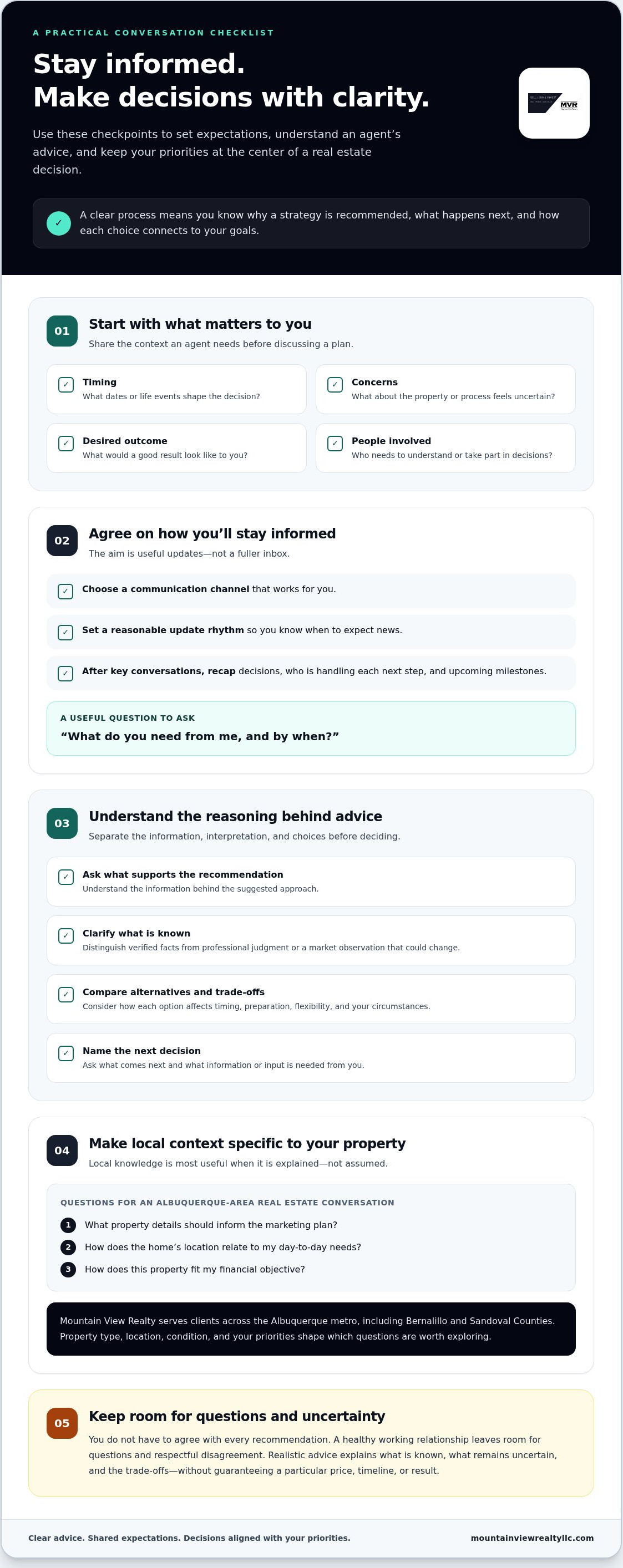
- Timing: What dates or life events shape the decision?
- Concerns: What about the property or process feels uncertain?
- Outcome: What would a good result look like to you?
- People involved: Who needs to understand or take part in decisions?
Trust means advice that fits your priorities
Useful advice connects recommendations to the goals you’ve shared. If a suggested selling approach affects timing, preparation, or flexibility, the agent should explain those trade-offs and how they relate to your circumstances. You can then decide whether the approach fits, ask for clarification, or consider another path.
Trust is clear advice, honestly explained, and aligned with the priorities you’ve shared.
What trust does not mean
A strong working relationship doesn’t require you to agree with every recommendation. It should leave room for questions and respectful disagreement. An agent can offer an informed perspective, but no one can responsibly guarantee a particular price, timeline, or result. Realistic guidance distinguishes what’s known from what remains uncertain, helping you make a decision with open eyes rather than relying on a promise.
Pay attention to how concerns are handled. Does the agent answer directly, explain the reasoning, and make space for your decision? That response can tell you more about the relationship than persuasive language alone. With a clear understanding of your options, you can move forward at a pace and in a direction that reflects your goals.
How clear communication and local knowledge build confidence in Albuquerque
Clear communication makes a complex transaction easier to follow. You should know how to reach your agent, when to expect updates, and what decisions or tasks are coming next. Those details matter whether you’re selling a home, considering a purchase, or coordinating a property decision with family members.
What useful updates look like
At the start, agree on a communication channel and a reasonable update rhythm. After a key conversation, your agent can recap decisions, identify who is handling each next step, and note upcoming milestones. The aim isn’t to fill your inbox. It’s to keep you informed enough to make decisions without guessing what happens next.
Ask directly when something is unclear. You might say, “What does this term mean for my decision?” or “What do you need from me, and by when?” If you receive feedback about a property, ask what it’s based on and whether it’s a verified fact, the agent’s professional judgment, or a market observation that could change. The U.S. Bureau of Labor Statistics outlines the duties of real estate agents, but your communication plan should reflect your needs and the decisions involved in your transaction.
Why Albuquerque context should be explained, not assumed
Local knowledge is most useful when an agent explains how it relates to your property and goals, rather than leaning on broad claims about an area. Mountain View Realty serves clients across the Albuquerque metro, including Bernalillo and Sandoval Counties. Property type, location, condition, and your priorities all shape the questions worth exploring.
For example, a seller might ask which property details should inform a marketing plan. A buyer could ask how a home’s location relates to day-to-day needs. An investor may want to discuss how a property fits a financial objective. In each case, the agent should explain the information behind a recommendation, distinguish confirmed details from professional interpretation, and be clear when conditions may shift.
- What information supports this recommendation?
- Which parts are confirmed, and which are your professional judgment?
- What alternatives should I consider, and what trade-offs come with each?
- What is the next decision, and what do you need from me?
These conversations make working with a real estate agent you trust more practical. You can assess whether the guidance is understandable, relevant to your situation, and responsive to your questions. If a conversation would help you clarify a plan, you can grab a time on Robb's calendar for a no-pressure discussion about your next move.
How to compare an agent's advice with a standard, client-first approach
A recommendation is easier to assess when you can see the reasoning behind it. Compare not only what an agent suggests, but how the advice connects to your goals, what information supports it, and whether you have room to weigh alternatives. The Realtor Code of Ethics describes professional standards for Realtors. In your conversations, look for clear explanations and respect for your decisions.
| What you notice | Pressure-based approach | Client-first approach |
|---|---|---|
| How advice is presented | One route is framed as the only sensible choice, with little explanation. | The recommendation is tied to your stated priorities and the information behind it. |
| How trade-offs are discussed | Possible drawbacks or alternatives receive little attention. | Benefits, limitations, and uncertainties are explained so you can compare options. |
| How decisions are handled | You’re urged to agree before your questions are addressed. | You’re given clear answers and space to decide whether the plan fits. |
For a seller, the options might include a traditional listing or another path, such as Renovate & Sell or Sell & Stay. Each raises different questions about preparation, timing, and personal priorities. A useful discussion explores what each route involves and which trade-offs may matter to you. It doesn’t promise that one option will deliver a particular result. For a deeper comparison of approaches, explore these Albuquerque home selling options.
Questions that reveal the reasoning behind a recommendation
Ask what facts support the advice and what assumptions remain. Then explore the benefits, limitations, timing considerations, and possible alternatives. A clear answer should help you make a decision, not make you feel you must agree. If the explanation uses unfamiliar terms, ask for plain language or a written recap you can review.
- What information led you to recommend this approach?
- What could change the recommendation?
- What are the main trade-offs and other paths to consider?
- How does this fit the priorities I’ve shared?
Signs that advice is aligned with your goals
Advice is more likely to fit when it reflects what you’ve said matters most, whether that’s flexibility, limiting preparation, or weighing a property decision alongside other financial considerations. A client-first agent can outline more than one possible path when appropriate and explain what each asks of you. You stay involved in choosing the approach.
A supported recommendation explains its reasoning; it does not guarantee an outcome. That distinction helps you evaluate guidance without expecting certainty from a process shaped by individual circumstances.
How to set expectations and work well with your real estate agent
A productive working relationship starts with a shared understanding of what matters to you and how you’ll make decisions together. Before focusing on individual tasks, talk through your priorities, constraints, and preferred level of involvement. This gives your agent useful context and gives you a practical way to assess advice as plans develop.
Start with goals, constraints, and decision-making needs
Different situations call for different conversations. An estate decision may involve family members with different views. A senior transition may bring personal timing and changing needs into focus. An investor may be weighing a property against broader financial priorities. Be clear about who should participate in important discussions and how you’d like decisions to be handled.
Use this sequence to establish a shared plan:
- Clarify your goal. Describe the outcome you’re working toward and what would make a decision feel right for you.
- Share your constraints. Discuss timing preferences, property concerns, personal commitments, and any non-negotiables that affect your options.
- Identify decision-makers. Let your agent know who needs to be included, especially when family or estate matters are involved.
- Agree on communication. Choose preferred channels and discuss how you’d like important updates, questions, and decisions recorded.
- Review and revisit advice. Ask how a recommendation supports your priorities. Return to the plan if your circumstances or preferences change.
Keep the working relationship open as plans evolve
Plans may need another look as circumstances shift. Raise concerns early, and ask for a plain-language explanation if a recommendation or next step is unclear. A change in timing or priorities can prompt a fresh discussion of available strategies. Honest feedback helps keep the conversation useful. You shouldn’t feel pressured to stick with a plan that no longer reflects your needs.
Keep a shared written record of the essentials. After a meaningful discussion, note the question at hand, the decision reached, who is responsible for each next step, and anything that still needs clarification. This can be a concise email or another agreed format. The goal is to reduce confusion, not create extra paperwork. Before a key decision, review the notes together so everyone has the same understanding.
Working with a real estate agent you trust means you can speak openly about what has changed and ask to reconsider the approach. You remain part of the decision-making process, while your agent helps explain available paths and their trade-offs. Clear expectations won’t control the outcome, but they can make the process more considered and easier to follow.
Schedule a no-pressure planning conversation with Robb
How Mountain View Realty makes trust part of the real-estate process
At Mountain View Realty LLC, guidance starts with your priorities, not a preset path. Robb Krautbauer takes an educational, strategic approach, helping clients understand choices and the trade-offs behind them. That matters when a real estate decision involves a home, a financial plan, or a major life change. Working with a real estate agent you trust should leave you better informed, not pushed toward a transaction.
An investor's eye and an educator's patience
Robb brings 15 years of real-estate investing experience and 10 years as a licensed agent. Investment experience can inform conversations about the financial questions connected to a property, while clear explanations help clients weigh options in light of their circumstances. It can’t guarantee a particular financial result. The focus stays on candid guidance, calm discussion, and the priorities you’ve shared.
Mountain View Realty LLC has helped 200+ families and investors buy and sell across the Albuquerque metro. That experience reflects work with clients facing different goals, not a promise that every transaction will follow the same course. Your property, timing, and preferred level of involvement should shape the discussion.
For sellers, the conversation may include strategic pricing, pre-market preparation, luxury marketing, or alternative selling paths. These are considerations, not a one-size-fits-all formula. A traditional listing may suit one homeowner’s plans, while another may want to discuss options such as Renovate & Sell or Sell & Stay. The useful question is how each path fits your goals and what trade-offs it involves. No approach can guarantee a specific price, timeline, or result.
Proof of experience without promises
A documented luxury marketing example offers a concrete view of campaign reach. For a $1.7 million Jemez Pueblo estate, a campaign generated 35,000+ video views and 18,000+ ad impressions. Those figures describe that particular campaign. They aren’t a forecast for another property, since each home and marketing plan is different.
Trust is built through the work of explaining options, listening to concerns, and keeping recommendations connected to what you’ve said matters. You can expect a conversation that makes room for questions and considers more than one possible route when appropriate. The aim is to help you understand the decision in front of you, then choose a direction that reflects your circumstances.
If you’re considering a move or sale in the Albuquerque area, you can grab a time on Robb's calendar for a no-pressure plan for your next move.
Make your next real estate decision with clarity
Your next step doesn’t have to be a major commitment. Start by naming the decision in front of you and the information you still need. A thoughtful conversation can help you organize your priorities, consider your options, and decide what you’re ready to do next.
Working with a real estate agent you trust should give you room to ask questions and make choices at your own pace. You don’t need every detail settled before you begin. A clear first discussion can help turn uncertainty into a practical plan, whether you’re considering a move, sale, or another property decision.
With the right guidance, you can take the next step with greater confidence and keep your goals at the center of the process.
Robb Krautbauer, Owner & Qualifying Broker
Frequently Asked Questions
Can a real estate agent guarantee what my home will sell for?
No. An agent can offer a pricing opinion based on available information, but the final sale price depends on the property, buyer interest, and negotiations. Treat a promised price as a reason to ask for more detail. Ask what information supports the estimate, what could affect it, and how you’ll review the strategy if new information becomes available before you decide to sell.
Should I trust an agent who recommends a lower price than I expected?
Not automatically, but don’t dismiss the recommendation without hearing its reasoning. Ask the agent to explain the property comparisons, differences in condition or features, and assumptions behind the suggested price. You can also explain what shaped your expectation, such as past improvements or a value estimate you received. A useful discussion should address the gap with specific information, not just ask you to accept a number.
Is an online home value estimate enough to decide on a sale price?
It can be a starting point, but it shouldn’t be the only input for a major pricing decision. An online estimate may not account for a home’s current condition, distinctive features, or details that are difficult to capture in a basic listing record. Ask for a property-specific review and a clear explanation of how the estimate compares with relevant information about similar homes.
What should I do if my priorities change after working with an agent?
Tell your agent what changed and why. A new job timeline, family decision, or shift in plans for the property may affect which next step makes sense. Ask which parts of the current plan remain useful and which should be reconsidered. If you’ve already agreed on tasks or dates, review them together and record any updated decisions so you can move forward with the same understanding.
How can I tell the difference between a fact and an agent's opinion?
Ask what supports the statement. A fact should connect to a source, document, or verifiable detail about the property or transaction. An opinion is the agent’s interpretation, such as how a feature may influence buyer interest. A market observation describes a pattern that may change. Try asking, “What information is this based on, and what part is your judgment?”
Is it reasonable to ask an agent for more than one selling strategy?
Yes. It’s reasonable to discuss more than one route and compare what each would involve. For example, a traditional listing, CashOffer+, or Renovate & Sell may raise different questions about preparation, flexibility, and your preferred process. Ask which options fit your circumstances, what trade-offs to consider, and what information would help you choose. Working with a real estate agent you trust should support an informed choice, not require you to select every option presented.

Article by
Robb Krautbauer
Robb Krautbauer is the Owner and Qualifying Broker of Mountain View Realty, serving Albuquerque, Rio Rancho, Santa Fe, and surrounding New Mexico communities. With more than a decade of real estate experience, Robb specializes in luxury homes, strategic home marketing, and helping homeowners navigate important life transitions with confidence.
Known for combining luxury-level marketing, AI-powered technology, and innovative selling strategies, Robb helps clients maximize their home's value while creating a smooth, personalized selling experience. Whether assisting luxury homeowners, retirees, families downsizing, or real estate investors, his focus is always on delivering expert guidance, honest advice, and exceptional results.
When he's not helping clients achieve their real estate goals, Robb enjoys studying market trends, emerging technology, and investment strategies that keep Mountain View Realty at the forefront of the industry.
Disclaimer
**Disclaimer:** The information provided in this article is for general educational purposes only and should not be considered legal, tax, financial, or professional advice. Real estate laws, market conditions, and regulations change over time and may vary based on your individual circumstances. Before making any real estate decision, consult with qualified legal, tax, or financial professionals. If you have questions about buying or selling real estate in New Mexico, contact Mountain View Realty for guidance specific to your situation. © 2026 Mountain View Realty. All rights reserved. The content on this website may not be reproduced without written permission.


