
Understanding Seller Concessions in Real Estate: A Strategic 2026 Guide
What if a seller concession could help close a sale without cutting the agreed purchase price? For Albuquerque homeowners, understanding seller concessions in real estate means looking beyond the offer: a closing credit can reduce a buyer’s upfront costs, but it can also affect your net proceeds and require careful attention to the appraisal.
It’s reasonable to worry that a concession could quietly chip away at your equity. The right amount and structure depend on the buyer’s loan, eligible closing costs, and whether the home appraises at the purchase price. This guide explains how concessions work, outlines current limits for common loan types, and shows why a negotiated credit is not the same as a price reduction.
You’ll also learn how to weigh concessions as part of a strategic pricing conversation in Albuquerque, from North ABQ Acres to High Desert. Depending on your goals, you may choose to negotiate a credit, hold firm on price, or explore how concessions can be avoided or used within the CashOffer+ framework. The aim is a clear, informed decision that protects your equity while keeping the transaction on solid ground.
Key Takeaways
- Understanding seller concessions in real estate starts with comparing the buyer’s cash-to-close needs against your expected net proceeds.
- Closing cost credits and mortgage rate buy-downs can serve different buyer needs; confirm eligible costs and terms before negotiating.
- Loan type affects contribution limits, and the appraisal can influence whether a concession structure works.
- Use days on market and buyer response to guide whether a closing cost credit may support your pricing strategy.
- Compare a negotiated concession with alternatives, including whether CashOffer+ better fits your goals in Albuquerque.
What Are Seller Concessions and Why Do They Matter?
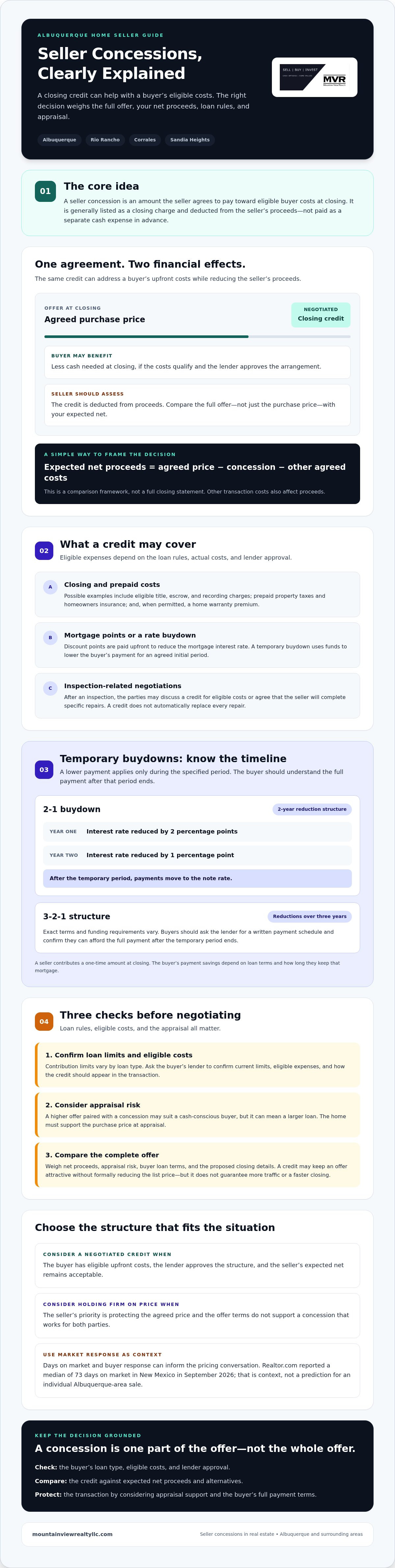
A seller concession is an amount the seller agrees to pay toward eligible buyer costs at closing. It may cover certain closing costs or prepaid expenses, subject to the buyer’s loan rules and actual costs. These credits are also called seller’s points (or seller contributions), and may help with expenses such as rate buydowns.
For sellers, the key question is not just the gross sale price, but the net amount left after agreed costs. A concession is typically shown as a charge at closing and deducted from the seller’s proceeds, rather than paid as a separate cash expense in advance. That’s why understanding seller concessions in real estate means comparing the full offer and its terms, not focusing on price alone.
For a visual overview, watch this introduction to seller concessions:
In 2026, higher interest rates can make buyers more sensitive to upfront expenses, while longer market times may give them more room to negotiate. Realtor.com reported a median of 73 days on market in New Mexico in September 2026. That’s market context, not a guarantee that a concession will be needed or accepted in every Albuquerque-area sale.
The Buyer’s Perspective: Reducing Cash-to-Close
A credit can reduce the buyer’s cash needed at closing. For a first-time buyer in Rio Rancho, that flexibility may help manage upfront costs, provided the expenses qualify and the lender approves the arrangement. A higher offer with a concession may suit a cash-conscious buyer better than a lower offer with no credit. But the higher price can mean a larger loan, and the home must support that price at appraisal.
The Seller’s Perspective: A Tool for Market Momentum
A closing-cost credit may help keep an offer attractive without formally reducing the list price, but it doesn’t guarantee more traffic or preserve momentum on its own. In a Sandia Heights transaction, for example, buyer and seller might discuss a credit toward eligible costs after an inspection concern rather than assume the seller must complete every repair. A concession can also be negotiated alongside a target closing date, though the credit itself doesn’t ensure a faster closing. Compare the net proceeds, appraisal risk, and buyer’s loan terms before agreeing.
Common Types of Seller Concessions in New Mexico Transactions
Concessions can address different parts of a buyer’s costs, but not every fee or expense qualifies under every loan. Common possibilities include eligible title, escrow, and recording charges; prepaid property taxes and homeowners insurance; and, when permitted, a home warranty premium. The buyer’s lender must confirm which costs can be covered and how the credit should appear in the transaction.
Mortgage points and rate buydowns are another option. Discount points are paid upfront to reduce the mortgage interest rate, while a temporary buydown uses funds to lower the buyer’s payment for an agreed initial period. These arrangements are subject to loan rules and lender approval. Review the current seller concession limits with the lender before making an offer or accepting terms.
The Strategic Mortgage Rate Buy-Down
A 2-1 buydown generally lowers the interest rate by two percentage points in the first year and one in the second, before payments move to the note rate. A 3-2-1 structure applies reductions over three years. Exact terms and funding requirements vary, so buyers should ask the lender for a written payment schedule and confirm they can afford the full payment once the temporary period ends.
For a Corrales seller, a buydown may make a home more appealing to a buyer focused on early cash flow, including in the luxury market. But it isn’t guaranteed to attract a particular buyer, and the buyer’s total savings depend on the loan terms and how long they keep that mortgage. The seller contributes a one-time amount at closing; the buyer receives lower payments only during the specified period. Compare that cost with other ways to structure the offer.
Inspection and Repair Credits
After an inspection, parties may discuss a credit for eligible costs or agree that the seller will complete specific repairs. For a roof, stucco, or HVAC concern in Albuquerque, the choice can depend on the issue, timing, documentation, and lender requirements. A credit isn’t the same as a completed repair. If a condition affects safety or the property’s ability to meet loan requirements, the lender may require repairs rather than accept a credit.
The Renovate & Sell approach reflects a useful decision: assess whether completing work before sale makes sense, or whether a clearly documented credit is a better fit for the transaction. Either way, confirm the plan with the buyer’s lender and put agreed terms in writing. Understanding seller concessions in real estate means looking at both the buyer’s immediate needs and the seller’s net proceeds.
Mountain View Realty can help sellers weigh repair work against a credit as part of a strategic pricing discussion. Learn more about local selling options.
The Math: Contribution Limits and Net Proceeds
A seller credit can reduce your proceeds, but the amount allowed depends on the buyer’s loan program and eligible costs. A negotiated figure isn’t automatically usable in full: total concessions generally can’t exceed the buyer’s actual allowable closing costs. The lender must confirm the rules before you rely on a credit in your pricing strategy.
Net Sale Price = Gross Price minus Concessions and Credits. This is a useful shorthand, not the seller’s final walk-away amount. To estimate that, start with the gross sale price, then subtract concessions, commissions, mortgage payoffs, and other transaction costs shown on a net sheet. Ask that the estimate reflect the actual contract terms and applicable charges.
Concession Limits by Loan Type
- Conventional: For a primary or second home, seller contributions are capped at 3% of the sale price with less than 10% down, 6% with 10% to 24.99% down, or 9% with 25% or more down. Investment-property contributions are capped at 2%.
- FHA: The cap is 6% of the lesser of the sale price or appraised value. It applies to eligible costs, not an unrestricted payment to the buyer.
- VA: Sellers may pay standard closing costs without a set percentage cap. Separately, certain concessions, including seller-paid buyer debt, are subject to a 4% limit based on the home’s reasonable value. The lender can clarify which payments fall into each category.
These 2026 limits are summarized in Rocket Mortgage’s guide to seller concession limits. They are program limits, not a target for every negotiation. Understanding seller concessions in real estate means checking both the loan cap and the buyer’s allowable costs with their lender.
The Appraisal Trap and a Practical Net Sheet
A concession doesn’t lower the contract price. If the offer price is higher because it includes a credit, the appraisal still needs to support the purchase price. If it doesn’t, the buyer and seller may need to revisit the terms, and financing could be at risk. That matters in Bernalillo and Sandoval County, where each property and comparable sale deserves individual review.
Consider a hypothetical $10,000 concession. On a net sheet, show it as a deduction from the seller’s proceeds, alongside commissions, loan payoff, and other costs. Then compare that result with an offer at a lower price and no credit. Don’t assume the buyer can pocket unused credit; the allowed amount is tied to actual eligible costs.
New Mexico transaction estimates may include service-related tax or other charges. Rather than applying a blanket gross receipts tax figure, ask the relevant service provider and closing professionals how any applicable tax is handled and shown. A precise net sheet gives you a clearer walk-away number than the gross offer alone.
Strategic Negotiation: When to Offer (or Ask for) Concessions
Days on market (DOM) can help guide a negotiation, but it isn’t a verdict on a home’s value or the seller’s willingness to negotiate. A listing that has been available longer may invite questions about price, condition, or terms. Compare it with similar homes, recent buyer activity, and the seller’s timing before deciding whether to request or offer a credit.
Realtor.com reported a statewide median of 73 days on market in New Mexico in September 2026. That offers market context, not an Albuquerque neighborhood benchmark. Rio Rancho and High Desert properties can attract different buyers and respond differently to pricing, condition, and competition. Look at comparable listings and property-specific feedback rather than assuming one area is automatically more concession-friendly.
Seller Strategies for Stagnant Listings
A seller might compare a $5,000 closing-cost credit with a $10,000 price reduction, but neither option is automatically better. A credit may help a buyer manage cash due at closing, while a price cut changes the contract price. The right choice depends on buyer eligibility, allowable costs, appraisal support, and your net proceeds. Confirm MLS rules before advertising a credit in remarks, and make sure the offer terms clearly state what it covers.
Some buyers value a negotiated credit because it addresses a specific need, which can make the offer feel more workable. That’s different from assuming buyers will accept a deal just because they feel they “won.” Mountain View Realty’s List with a Twist offers a flexible path for sellers to consider alongside pricing and marketing choices. Keep the focus on net proceeds and the strength of the full offer.
Buyer Strategies in a 2026 Competitive Market
A buyer who needs help with upfront costs might request an eligible closing credit or ask whether a lender-approved rate buydown could fit, rather than seeking only a lower price. A credit doesn’t guarantee a lower long-term borrowing cost, so compare the lender’s payment estimates, total loan terms, and cash needed at closing. Keep the offer aligned with the property’s appraisal and the loan program’s limits.
In a multiple-offer situation, removing or reducing a concession request may make terms more appealing to a seller, but it also means the buyer must be comfortable with the resulting cash-to-close. Don’t waive a useful request just to compete without understanding the trade-off. For local context, consult a local real estate agent in Albuquerque who can help assess the listing and seller’s stated priorities. Understanding seller concessions in real estate is ultimately about matching the terms to both parties’ goals.
Protecting Your Equity: The Mountain View Realty Approach
Protecting equity starts with seeing the full picture, not just the offer price. Robb Krautbauer brings an investor’s perspective shaped by 15 years of investing experience and 10 years as a licensed agent. That lens helps frame concessions as one part of a larger decision: what you may net, what the buyer needs, and which path fits your priorities.
Honest. Strategic. Educational. That means explaining the trade-offs plainly, even when a concession sounds appealing at first. A credit may help a buyer move forward, but it affects seller proceeds and must fit the buyer’s loan rules and eligible costs. Understanding seller concessions in real estate also means asking whether a traditional sale with negotiated terms or the CashOffer+ option better aligns with your goals. Each path deserves a clear comparison, not assumptions.
A Strategic Guide to Your 2026 Move
A luxury estate in North ABQ Acres or High Desert may call for a different pricing and marketing conversation than a starter home. Property condition, buyer needs, and the seller’s priorities all matter. Strong lifestyle storytelling can help buyers understand a home’s features and setting, but it can’t guarantee a particular price or replace sound market analysis.
Mountain View Realty LLC’s home selling options in Albuquerque outline different paths to consider. Reviewing those choices alongside likely costs and possible concessions can make the decision more manageable, whether you’re selling a home, planning a move, or considering another transition.
Confidential Consultation and Planning
For estate sales, downsizing, and senior transitions, timing and personal priorities can shape the right plan. Mountain View Realty LLC has helped more than 200 families navigate complex transitions. A practical equity review can bring together the expected sale terms, potential credits, and estimated costs so you can compare options with more confidence. Robb’s approach is direct: share the trade-offs clearly, then help you decide what fits.
If you’re weighing a concession against another selling path, a conversation about your priorities can help clarify the next step.
Robb Krautbauer, Owner & Qualifying Broker
Make Your Next Move With a Clear Equity Strategy
Understanding seller concessions in real estate means looking past the offer price. A credit can help a buyer manage eligible closing costs, but it also affects your proceeds and must fit the buyer’s loan terms. Compare the full offer, confirm the appraisal can support the price, and use a net sheet to see how each option may affect your bottom line.
Concessions are one tool in a broader strategic pricing conversation. The right approach may differ for a luxury property, a starter home, or a complex life transition. Mountain View Realty offers perspective shaped by 15 years of real estate investing experience and has helped more than 200 families across Albuquerque. The team specializes in luxury real estate and complex transitions, with guidance grounded in clear, practical trade-offs.
You don’t need to settle on a strategy before you understand your options. An informed plan can help you move forward with greater confidence.
Frequently Asked Questions
Are seller concessions the same as a price reduction?
No. A price reduction changes the agreed purchase price; a seller concession is a credit toward costs that the buyer’s loan program allows. The credit doesn’t automatically lower the price used to determine the loan amount or appraisal. Review how each option affects the contract and estimated proceeds with the lender and closing professionals. Rocket Mortgage’s seller concession guide explains the distinction and common uses.
Can seller concessions be used for the buyer’s down payment?
Usually, no. Seller concessions generally cover eligible closing costs and prepaid expenses rather than the buyer’s down payment. The allowable uses depend on the loan program and the lender’s review of the transaction. Before relying on a credit, ask the lender to identify which charges it can cover and how the contribution will be documented. Loan-program concession guidance can provide background, but the lender should confirm the buyer’s specific terms.
What happens if the home appraises for less than the purchase price with concessions?
A low appraisal may affect the amount a lender is willing to finance. The buyer and seller may need to discuss options, such as revisiting the price or other contract terms, but the available choices depend on the loan and agreement. The buyer should contact the lender promptly to understand the appraisal’s effect on financing. The Consumer Financial Protection Bureau’s appraisal overview explains why appraisals matter in a home purchase.
Is there a limit to how much a seller can contribute in New Mexico?
Yes, but there isn’t one limit for every buyer. The amount depends on loan type, down payment, and eligible costs. For example, conventional limits vary with the buyer’s down payment, while FHA and USDA generally allow up to 6% under their respective rules. VA treatment differs for standard closing costs and certain concessions. See Rocket Mortgage’s loan-type summary, then have the buyer’s lender verify current program requirements.
Can I use seller concessions to pay off my credit card debt at closing?
Don’t assume a seller credit can pay off a credit card. Most concession funds are limited to eligible transaction costs, while VA rules allow certain seller concessions, including some debt payments, subject to program limits and lender approval. Ask the lender whether the specific debt payment qualifies and how it would be treated. The Department of Veterans Affairs’ closing-cost guidance is a useful reference for VA transactions.
Do seller concessions affect the real estate agent’s commission?
Not automatically. A seller credit and agent compensation are separate contract matters, and the effect depends on the written agreements and transaction terms. Ask the real estate professionals involved and the closing team to explain how each amount will appear in the documents and estimated proceeds. The National Association of REALTORS® offers a consumer guide to written buyer agreements; review your own agreement for its specific terms.
How do I know if I should offer a concession or just lower my asking price?
Compare the likely net proceeds and consider what the buyer needs. A credit may address eligible closing costs, while a price reduction changes the contract price. Ask the lender to confirm the credit’s allowable use, then compare both scenarios on a net sheet. Your decision should also account for the property, buyer response, and appraisal support. A local real estate professional and closing team can help you assess the terms without assuming one option is always better.

Article by
Robb Krautbauer
Robb Krautbauer is the Owner and Qualifying Broker of Mountain View Realty, serving Albuquerque, Rio Rancho, Santa Fe, and surrounding New Mexico communities. With more than a decade of real estate experience, Robb specializes in luxury homes, strategic home marketing, and helping homeowners navigate important life transitions with confidence.
Known for combining luxury-level marketing, AI-powered technology, and innovative selling strategies, Robb helps clients maximize their home's value while creating a smooth, personalized selling experience. Whether assisting luxury homeowners, retirees, families downsizing, or real estate investors, his focus is always on delivering expert guidance, honest advice, and exceptional results.
When he's not helping clients achieve their real estate goals, Robb enjoys studying market trends, emerging technology, and investment strategies that keep Mountain View Realty at the forefront of the industry.
Disclaimer
**Disclaimer:** The information provided in this article is for general educational purposes only and should not be considered legal, tax, financial, or professional advice. Real estate laws, market conditions, and regulations change over time and may vary based on your individual circumstances. Before making any real estate decision, consult with qualified legal, tax, or financial professionals. If you have questions about buying or selling real estate in New Mexico, contact Mountain View Realty for guidance specific to your situation. © 2026 Mountain View Realty. All rights reserved. The content on this website may not be reproduced without written permission.


