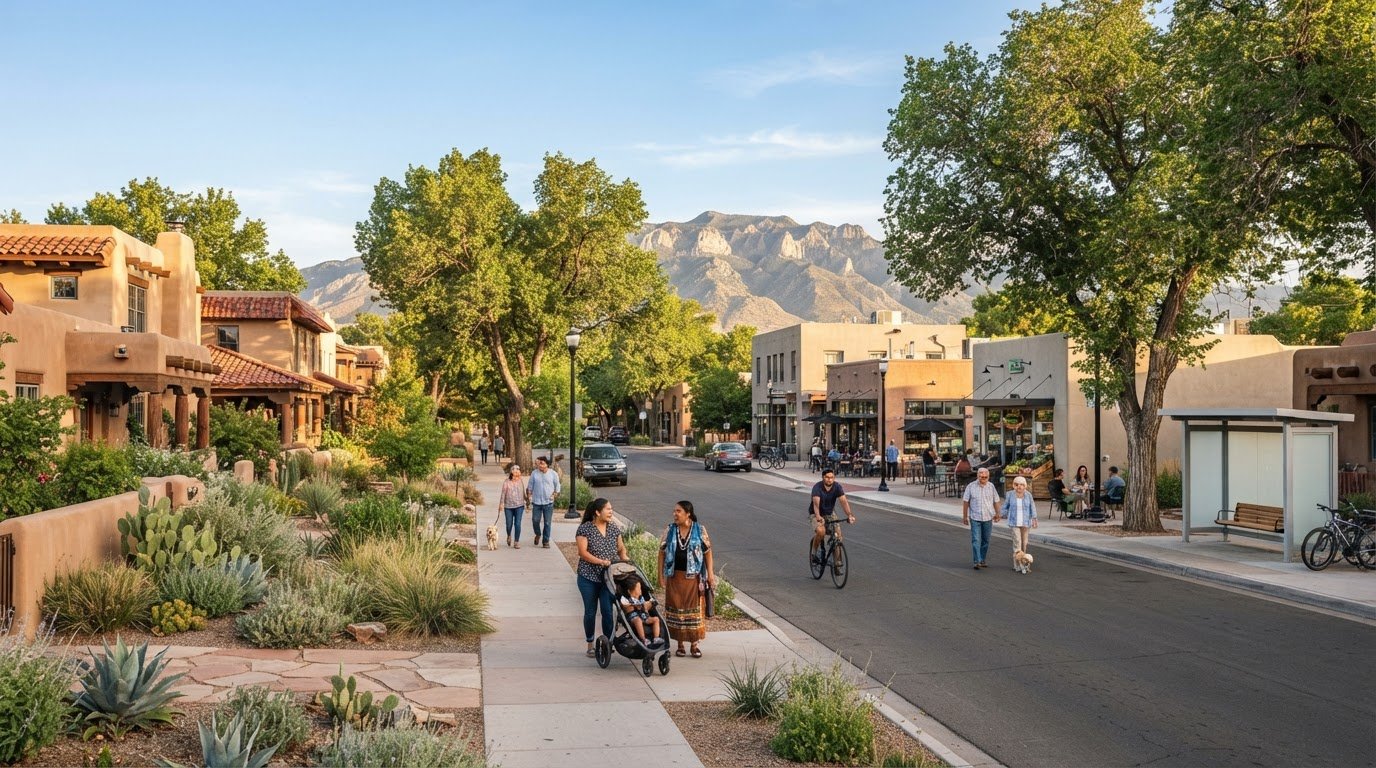
Walkable Neighborhoods in Albuquerque: A Practical 2026 Guide
What if the Albuquerque area with the strongest walkability reputation isn’t the best fit for your daily routine? The walkable neighborhoods Albuquerque buyers consider, from Nob Hill and University Heights to Downtown and Uptown, offer different mixes of nearby errands, parks, services, and transit options. The right fit depends on the routes you’d actually use.
It’s reasonable to want more than a neighborhood label or a single score. Those can help you narrow the search, but they don’t show whether the walk to a grocery store feels comfortable or whether a bus stop suits your commute. A few blocks can change the experience.
This guide compares Albuquerque areas through everyday routines, transit access, and street-level comfort. You’ll find a practical way to assess a home’s immediate surroundings, explore areas that may match your priorities, and balance walkability with commute, home type, and outdoor space. The goal is a focused shortlist based on how you want to live, not a broad ranking.
Key Takeaways
- Compare Downtown Albuquerque, Old Town, Nob Hill, and the University area as places to explore, not as a ranked list.
- Use Walk Score as an initial reference, then assess destination access, route quality, transit, and personal fit separately.
- Build a shortlist of walkable neighborhoods Albuquerque by mapping the errands, services, and parks that matter to your household.
- Walk candidate routes at the times you expect to use them, then weigh what you observe against your commute, home, and outdoor-space priorities.
- Turn your observations into clear, address-specific priorities to guide a more focused home search.
What Walkability Means for Everyday Life in Albuquerque
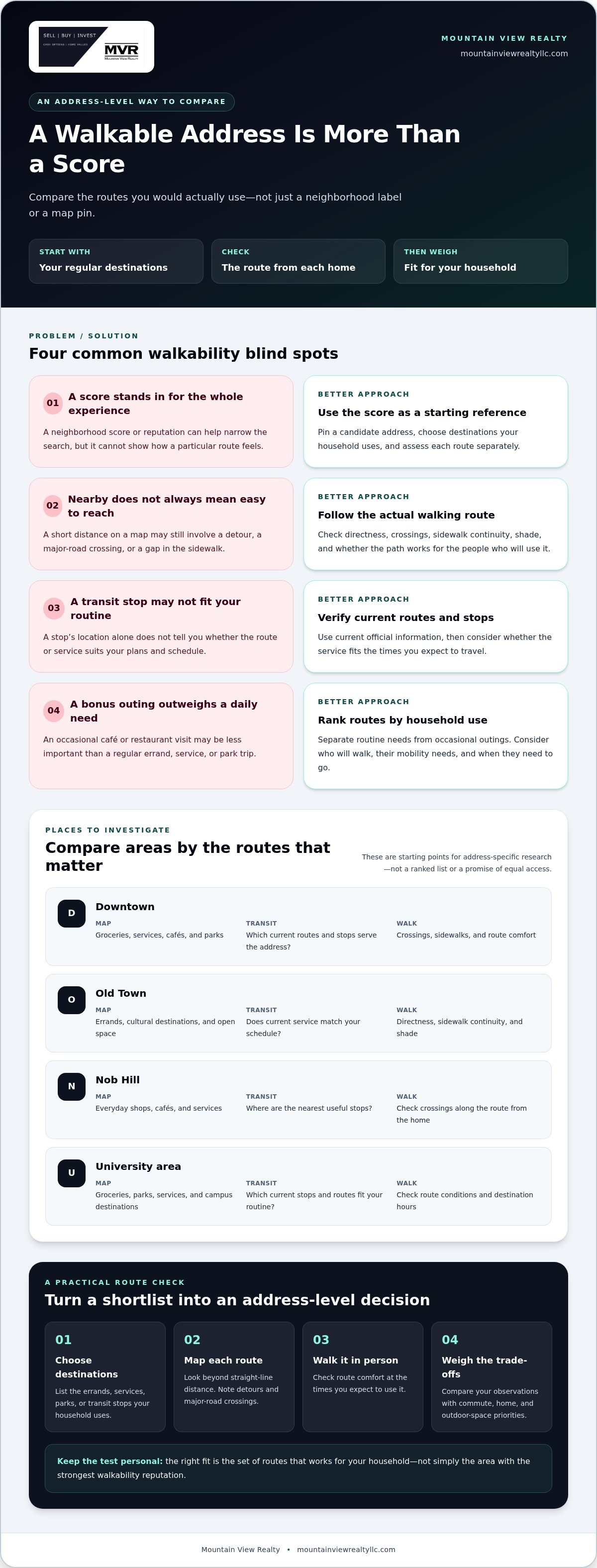
A neighborhood can look compact on a map and still feel difficult to navigate on foot. A nearby destination matters only if the route works for the person walking it, at the time they need to go. That’s why a useful home search starts with your routines, not a neighborhood label or a single score.
Albuquerque’s geography and history help shape how its neighborhoods developed. The Albuquerque, New Mexico Wikipedia page offers general background, but the practical test is closer to home: what can you reach from a specific property, and how comfortable is the route?
For a visual overview of Albuquerque neighborhoods, watch this video:
Walkability is how comfortably and directly a person can reach the places they use on foot from a particular home; a neighborhood’s general reputation or score can’t show the full experience of those routes. This distinction keeps the focus on real trips rather than a broad impression. A score can help with an initial comparison, but it can’t tell you whether a crossing, sidewalk, or stretch without shade suits your needs.
Assess access in separate categories. Errands might include groceries or a café. Parks and open spaces serve a different purpose from health care, schools, or other services. Transit is another consideration: a stop’s usefulness depends on its location and whether the route fits your plans. These factors can vary by block, road crossing, distance, shade, and time of day. Treat them as parts of the picture, not interchangeable measures.
Which everyday destinations matter most to your household?
Start with places you visit regularly, such as groceries, cafés, parks, schools, or a transit stop. Separate routine needs from occasional outings. A restaurant you visit now and then may be a welcome bonus, but it shouldn’t outweigh a daily trip that matters more. Consider who will use each route, their mobility needs, and the household’s schedules.
Why a neighborhood label does not tell the whole story
Access can change across a single block or from one side of a major road to the other. A map may show a destination nearby, yet the walking route could require a detour or a crossing that feels uncomfortable to you. For example, two homes may appear equally close to a store, while one route follows a direct sidewalk and the other involves a longer path. Check the route itself before drawing a conclusion.
For each candidate home, consider:
- Which destinations would you visit on foot most often?
- Does the mapped route provide a direct, usable path?
- Would the route work for the people who will use it, at the times they need it?
This practical view gives you a clearer basis for comparing walkable neighborhoods Albuquerque buyers may be considering. It also helps reveal which trade-offs matter before you narrow your home search.
Albuquerque Areas to Explore for a More Walkable Routine
Downtown Albuquerque, Old Town, Nob Hill, and the University area are useful starting points for a home search focused on getting around on foot. They’re places to investigate, not a ranked list or a promise that every home nearby offers the same experience. A walkable neighborhoods Albuquerque shortlist becomes more useful when you compare actual routes from individual properties.
Start by pinning a candidate address and the destinations your household would use. The City of Albuquerque’s Walking & Bicycling Information provides local context on walking and city efforts. For a property-level assessment, look beyond straight-line distance: follow the route and note crossings, sidewalk continuity, shade, and any detours. Transit details can change, so verify routes, stops, and service through current official information rather than relying on a general neighborhood description.
What to investigate around Downtown and Old Town
Map the errands and destinations you’d actually use from each address. Downtown and Old Town are distinct areas, so don’t assume a destination convenient from one property will be practical from another. Trace the walking route, including major-road crossings and any gaps in the sidewalk. If transit matters, compare the address with current official route and stop information, then consider whether the service fits your schedule.
How to assess Nob Hill and the University area
Use Central Avenue and the University of New Mexico as mapping reference points, not as proof that every nearby block meets your needs. Plot your likely destinations from candidate homes, then walk the routes and check current conditions in person. Confirm destination hours through reliable, up-to-date sources, especially if your routine depends on early or late visits.
The comparison below is a prompt for address-specific research, not a claim that any destination or transit service sits within walking distance of every home in these areas.
| Area to explore | Routine destinations to map | Transit questions | On-the-ground checks |
|---|---|---|---|
| Downtown | Groceries, services, cafés, parks | Which current routes and stops serve the address? | Crossings, sidewalks, route comfort |
| Old Town | Errands, cultural destinations, open space | Does current service match your schedule? | Directness, sidewalk continuity, shade |
| Nob Hill | Everyday shops, cafés, services | Where are the nearest useful stops? | Crossings along the route from the home |
| University area | Groceries, parks, services, campus destinations | Which stops and routes fit your routine? | Route conditions and destination hours |
Each area includes different blocks and housing options. A home’s position relative to a major road, the condition of its walking route, and the destinations that matter to you can change the day-to-day experience. Visit at the times you expect to walk, and compare what you observe with your commute, property, and outdoor-space priorities. If you’d like help turning those priorities into a focused search, explore Albuquerque home-search guidance.
How to Compare Albuquerque Walkability Without Overtrusting a Score
A walkability score can help you scan areas and decide which properties deserve a closer look. It can’t tell you whether the routes you’ll use feel comfortable, whether a crossing works for your household, or whether nearby destinations fit your schedule. Treat the score as one input, then compare the actual experience of each candidate address.
For a useful comparison, keep four dimensions separate: access to the destinations you need, the quality of the walking routes, transit options, and personal fit. One property may be near shops but require a route you wouldn’t want to walk regularly. Another may be less convenient for errands but better suited to your commute or mobility needs. The best fit depends on the routines you value most.
What a walkability score can and cannot tell you
A score is a screening tool, not a guarantee of comfortable everyday walking. Before citing or relying on a result, review the scoring tool’s current methodology and make sure it applies to the exact property address, not just a broad neighborhood label. Then trace the routes on a map and visit the location. A neighborhood score summarizes an area; it cannot establish the quality of every walking route from a specific home.
That distinction matters in Albuquerque, where a short mapped distance may not reflect a direct or usable pedestrian path. A score also won’t tell you whether a destination’s hours match your routine or whether you’re comfortable walking a route at the time you expect to use it.
Compare routes, transit, and destinations side by side
Use a simple comparison table for each property on your shortlist. Record what you verify, not what you assume. If transit is important, check current Albuquerque Rapid Transit and ABQ RIDE route, stop, and service information through official sources. Note a major-road crossing or an indirect route only after reviewing the map and, where practical, walking it yourself.
| Comparison point | Property A | Property B |
|---|---|---|
| Regular destinations | List verified places and route lengths or directions | List verified places and route lengths or directions |
| Walking route | Record crossings, sidewalk continuity, and observed conditions | Record crossings, sidewalk continuity, and observed conditions |
| Transit | Note current routes, stops, and service that fit your plans | Note current routes, stops, and service that fit your plans |
| Personal fit | Describe how the route works for your household | Describe how the route works for your household |
Keep notes specific. “Close to groceries” is less useful than naming the store, recording the route you checked, and noting whether you’d use it for a regular trip. This approach makes comparisons across walkable neighborhoods Albuquerque more grounded in your own priorities, rather than dependent on a score that can’t capture every block or routine.
Use scores to narrow the field, maps to plan your checks, and in-person visits to judge how the routes feel. That gives each number a proper role without asking it to answer questions only your household can answer.
A Practical Albuquerque Home-Search Checklist for Walkability
A consistent process makes it easier to compare homes without letting one appealing route or first impression dominate. Use the same steps for each address, beginning with your household’s real routines and ending with a clear record of trade-offs. Check current maps and public information, then confirm what you can on foot. Conditions and services can change, so keep your notes tied to the address and date you reviewed it.
- Define your routines. List recurring trips, who makes them, and when. Separate regular needs from occasional outings so the checklist reflects your actual week.
- Map the destinations. Starting at the property entrance, map the places you might reach on foot. Follow the pedestrian route rather than relying only on a distance shown between two points.
- Review the route. Note sidewalks, crossings, lighting, shade, and whether the path appears direct. Use current maps and public information for details that may change.
- Visit at relevant times. Walk or review the route at the times your household expects to use it. A morning trip and an evening trip may feel different, and Albuquerque’s sun exposure and shade can affect comfort across the day and seasons.
- Compare and decide. Record what worked, what didn’t, and what you’d want to investigate further. Compare the same factors for every address.
Test the routes you expect to use
Begin at the actual property entrance, not a nearby intersection or the center of a map pin. Follow the route to a priority destination and note where sidewalks continue or stop, how you would cross roads, and whether lighting and shade suit your needs. Consider the route in the conditions and at the times you’d use it. Your notes should reflect what you observed, not an assumed safety rating.
Balance walkability with the rest of your home criteria
Walkability is one part of a home decision. Compare it with commute needs, property layout, outdoor space, and the priorities of everyone in the household. Decide which trade-offs feel acceptable before narrowing your shortlist. A home with a preferred layout may involve a different walking routine than one closer to daily destinations. Neither is automatically the better choice; the right balance depends on how you plan to live.
Use this printable-style checklist for each candidate address:
- Property address and date of review
- Household’s regular walking destinations
- Routes checked from the property entrance
- Notes on crossings, sidewalk continuity, lighting, and shade
- Times and conditions when you reviewed the routes
- Commute, home layout, outdoor space, and other trade-offs
- Questions or details to revisit before comparing homes
Keep a separate copy for each home. That simple habit helps distinct blocks and impressions stay clear as your search develops, and it turns walkable neighborhoods Albuquerque into an address-by-address decision rather than a broad label.
Build an Albuquerque Home Search Around the Way You Live
Your route notes can do more than describe a walk. They can shape a focused home search. Group what you learned into essentials, preferences, and acceptable compromises, then use those priorities to compare specific properties instead of relying on a general neighborhood reputation. That keeps the search grounded in how you want to live.
Turn lifestyle priorities into a focused local search
Begin with three categories. Essential destinations are the places you want to reach regularly. Preferred routes describe the kind of walking experience you’d value, such as a direct path or comfortable shade. Acceptable compromises are the trade-offs you could live with, perhaps driving for some errands in exchange for a certain home layout or outdoor space.
Share these priorities alongside your commute needs, preferred property type, and target areas. An advisor can compare homes against the same criteria across Albuquerque and nearby communities, including Bernalillo and Sandoval Counties. The goal isn’t to declare one area best for everyone. It’s to identify which addresses align most closely with your needs and where you may need to adjust expectations.
For example, you might value a regular walk to a park more than access to cafés, while another household may prioritize transit and daily errands. Making that distinction early helps keep walkable neighborhoods Albuquerque on your shortlist for the right reasons, rather than because of a broad label.
Make the next step a clear conversation, not a rushed decision
Before reviewing options, bring a simple summary of your preferred routines, target areas, property needs, and the compromises you’re open to considering. Address-specific notes help keep the discussion practical. They also make it easier to distinguish a must-have from a feature that would simply be nice to have.
Robb Krautbauer brings 10 years of licensed real estate experience and 15 years of real estate investing experience to these conversations. That investor perspective can help frame property and location trade-offs, while an educational approach gives you room to weigh options without pressure. Mountain View Realty LLC has helped more than 200 families and investors buy and sell across the Albuquerque metro. That experience informs the guidance, but no two searches or outcomes are the same.
A useful next step is a conversation about how you want your week to work, which locations you’re considering, and how walkability fits with your other priorities. From there, you can refine the search at a pace that feels right and decide which properties merit a closer look.
Let Your Priorities Shape the Next Step
Your home search can start with a simple question: which parts of your everyday routine would you most like your next address to support? Keep that answer at the center as you compare options. The right fit among walkable neighborhoods Albuquerque offers will depend on your household, your preferred property, and the trade-offs you’re comfortable making.
You don’t need to settle every detail before exploring. A focused conversation can help turn your priorities into a practical plan, whether you’re still considering locations or ready to look at specific homes. Take the time you need to weigh the choices and decide what feels right for your next move.
A thoughtful search starts with your needs. The next step can be just as considered.
Frequently Asked Questions
Is Albuquerque walkable without a car?
Some Albuquerque routines can be handled on foot, but living without a car depends on where you live and what you need to reach. Walkability is concentrated in central areas, while many daily trips elsewhere may require driving. Think through your regular destinations, work schedule, and backup transportation before deciding. A household that can walk to a few key places may still need a car for other needs.
Which Albuquerque neighborhoods should I explore if I want to walk more?
Consider exploring Downtown, Old Town, Nob Hill, and the University area. Each offers a different setting, so start with the places you want nearby rather than choosing by reputation alone. For walkable neighborhoods Albuquerque buyers can investigate, compare a few specific home addresses and the routes to destinations that matter to them. A property near a district’s center may offer a different routine from one on its edge.
How reliable is Walk Score for choosing a home in Albuquerque?
Walk Score can help you identify areas for further research, but it can’t tell you whether a route suits your needs. Before relying on a result, check the tool’s current method and use the exact property address. Then review the mapped path yourself. For example, a score won’t tell you whether a route’s crossings or sidewalk conditions feel workable for a family member with limited mobility.
Can walkability vary from one block to another?
Yes. A home’s position relative to a major road, a crossing, or a destination can change the route you’d take. Two nearby properties may have different paths to the same place, even if a map makes them appear similarly close. Check the route from each property entrance and consider who will use it. That detail can matter for children, older adults, or anyone carrying groceries.
Does Albuquerque Rapid Transit serve every walkable neighborhood?
No. Albuquerque Rapid Transit operates along its designated corridor, so it won’t serve every area where walking is practical. Check current ART routes and stops through official ABQ RIDE information, then see how the nearest stop connects with the home and the trips you make. Transit may be useful for one commute while doing little for errands in another direction, so assess each trip separately.
Do walkable Albuquerque neighborhoods always cost more?
No. A walkable location doesn’t guarantee a higher price for every property, and homes in the same area can differ in condition, size, layout, and setting. Rather than assume a premium, compare homes that meet your needs and consider the full value of each location. You might decide that nearby daily destinations matter more than extra interior space, or that another property trade-off better fits your budget and lifestyle.

Article by
Robb Krautbauer
Robb Krautbauer is the Owner and Qualifying Broker of Mountain View Realty, serving Albuquerque, Rio Rancho, Santa Fe, and surrounding New Mexico communities. With more than a decade of real estate experience, Robb specializes in luxury homes, strategic home marketing, and helping homeowners navigate important life transitions with confidence.
Known for combining luxury-level marketing, AI-powered technology, and innovative selling strategies, Robb helps clients maximize their home's value while creating a smooth, personalized selling experience. Whether assisting luxury homeowners, retirees, families downsizing, or real estate investors, his focus is always on delivering expert guidance, honest advice, and exceptional results.
When he's not helping clients achieve their real estate goals, Robb enjoys studying market trends, emerging technology, and investment strategies that keep Mountain View Realty at the forefront of the industry.
Disclaimer
**Disclaimer:** The information provided in this article is for general educational purposes only and should not be considered legal, tax, financial, or professional advice. Real estate laws, market conditions, and regulations change over time and may vary based on your individual circumstances. Before making any real estate decision, consult with qualified legal, tax, or financial professionals. If you have questions about buying or selling real estate in New Mexico, contact Mountain View Realty for guidance specific to your situation. © 2026 Mountain View Realty. All rights reserved. The content on this website may not be reproduced without written permission.


