
Buy Before You Sell in Albuquerque and Plan Your Move
Closing doesn’t always mean moving out that day. In Albuquerque, a rent-back agreement can let you stay in your home after selling it and pay the new owners rent for an agreed period, giving you time to plan your next move. It’s one option to consider when deciding how to buy a house before selling in Albuquerque.
It’s understandable to want your next home lined up before putting your current one on the market. The timing can feel like a puzzle, but there are several ways to approach it, each with different financial and moving considerations.
This guide explains how to plan your purchase and sale, compare bridge financing with mortgage options, and coordinate a move between homes. You’ll also learn what a rent-back can make possible, so you can choose a path that fits your timeline and priorities.
Key Takeaways
- Compare a contingent offer with other purchase plans, and coordinate your sale and closing dates before committing to a move.
- A bridge loan may help fund a down payment before your current home sells, but weigh its interest rate and fees against your other options.
- Mortgage pre-approval can help clarify your budget and which loan options may fit your purchase.
- A rent-back agreement may let you stay in your sold home for an agreed-upon period, while temporary housing can mean an extra move and added costs.
- Estimate the cash available for your purchase by accounting for your home equity, sale proceeds, mortgage payoff, closing costs, and carrying expenses.
Albuquerque homebuying process
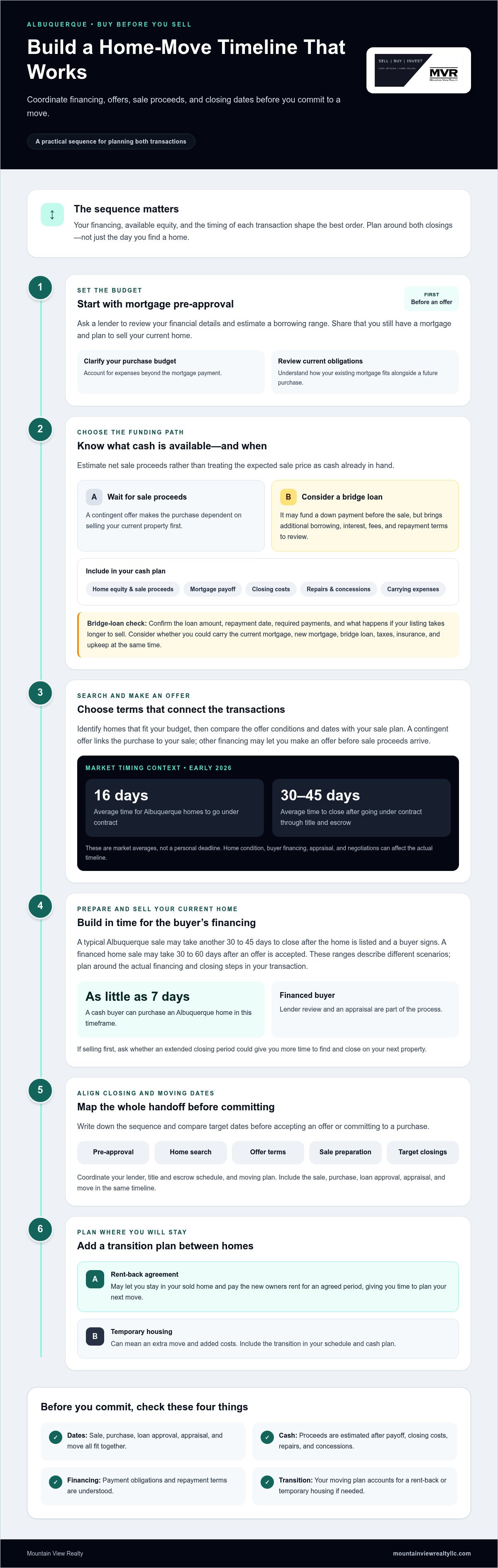
Planning how to buy a house before selling in Albuquerque starts with mortgage pre-approval and a clear timeline. You can make a contingent offer, arrange funds before selling, or negotiate a later closing date for your current Albuquerque home. Your financing, available equity, and the timing of each transaction shape the best sequence.
Start by defining your purchase budget with a lender, then identify homes that fit it. If you need proceeds from your current home, a contingent offer makes the purchase dependent on selling that property first. This condition links the transactions, but your offer also needs a workable closing date. Before making an offer, map out how the sale, purchase, loan approval, appraisal, and move might fit together.
Nicole Rueth’s video outlines four ways to approach buying before selling, including financing and moving considerations.
Build the schedule around both closings, not just the day you find a home. In early 2026, Albuquerque homes averaged 16 days to go under contract, followed by 30-45 days to close through title and escrow. Those are market averages, not a personal deadline. A home’s condition, buyer financing, appraisal, and negotiations can affect the actual timeline.
Your sale also needs time. A typical Albuquerque home sale may take another 30 to 45 days to close after the home is listed and a buyer signs. A financed home sale may take 30 to 60 days after an offer is accepted. These ranges describe different scenarios, so use the expected financing and closing steps in your own transaction when planning.
Consider how the buyer’s financing affects your plan to sell my house. A cash buyer can purchase an Albuquerque home in as little as 7 days, while a financed purchase involves lender review and an appraisal. If you’re selling first, ask whether you can negotiate an extended closing period. That may give you more time to find and close on your next property.
Write down the sequence: pre-approval, home search, offer terms, sale preparation, and target closing dates. Compare the dates before accepting an offer or committing to a purchase. For example, a contingent offer ties your purchase to the sale, while an extended closing can give you more time after accepting a buyer’s offer. In New Mexico, coordinate your lender, title and escrow schedule, and moving plan before setting the final date.
Bridge financing for a down payment
A bridge loan can provide short-term financing for a down payment before your Albuquerque home sells. It may help you make an offer without waiting for sale proceeds, but it adds borrowing to a transaction that already includes your current mortgage. Bridge loans may carry higher interest rates and fees, so compare the full repayment obligation with your expected sale proceeds.
Ask a lender to review your income, credit, current mortgage, and proposed purchase. Find out how the bridge loan is funded, when repayment is due, and what happens if your listing takes longer to sell. Clarify whether you’ll need to make payments on the bridge loan, your existing mortgage, and the new mortgage at the same time. These obligations affect your monthly cash needs while you own both homes.
Before making an offer on a Nob Hill property or elsewhere in Albuquerque, map out the funding steps. Confirm the down payment source, estimate the net proceeds from your current home, and align the expected sale with the bridge loan’s repayment terms. The sale price alone doesn’t show how much cash you’ll have available. Mortgage payoff, closing costs, repairs, and negotiated concessions can all reduce your proceeds.
Use this checklist to compare bridge financing with waiting for your sale:
- Loan amount: Identify how much of the down payment the bridge loan covers and what funds you must provide yourself.
- Repayment: Confirm how the balance is repaid and how the terms relate to your home sale.
- Carrying costs: Include the existing mortgage, new mortgage, bridge loan payments, taxes, insurance, and upkeep in your cash plan.
- Sale assumptions: Build the plan around a realistic listing and offer process, rather than treating expected proceeds as cash already in hand.
For example, if you buy before your current home has a signed offer, you could carry both properties longer than planned. If your home sells first, the proceeds may help repay the bridge loan, subject to its terms. Compare both sequences on paper, including the cash required at closing and the funds left afterward. This makes the financing decision clearer than focusing only on the purchase price.
Bridge financing may suit buyers who need to act before selling and can manage overlapping obligations. It may be less suitable if a second loan would strain the household budget or if the purchase depends on receiving a specific amount from the sale. A conventional mortgage pre-approval and a bridge loan solve different problems, so review them as separate parts of your financing plan.
Before signing, make sure the lender’s repayment terms, your listing strategy, and the purchase closing date work together. A local Albuquerque sale-and-purchase plan can help you consider how the sale sequence fits your next move.
Mortgage pre-approval and loan options
Mortgage pre-approval gives Albuquerque buyers an early view of their borrowing range. It typically starts the homebuying process, before you make an offer or coordinate a sale. A lender reviews your financial details and estimates what loan amount may fit. Use that figure to set a purchase budget, then account for expenses beyond the mortgage payment.
Pre-approval can help you understand how a future purchase fits alongside your current housing costs. Tell the lender if you still have a mortgage and plan to sell your current home. The lender can assess how those obligations affect your purchase plan. Be ready to explain your expected down payment source, including whether sale proceeds will be available before closing.
Albuquerque buyers may consider conventional, FHA, or VA loans. These are distinct loan options, not interchangeable labels. A lender can explain how each option fits your finances and the property you want to buy. Ask what documents are needed for the review, how the lender treats your existing home, and what steps remain before final loan approval.
- Conventional loan: Discuss the lender’s requirements, down payment source, and how current housing expenses affect the application.
- FHA loan: Ask the lender to explain this option’s terms and how the property review fits your planned purchase.
- VA loan: If this option applies to you, ask the lender to outline its requirements and timing for your transaction.
Pre-approval helps you prepare an offer, but the specific home matters too. A lender may need to review the property and its appraisal as part of the financing process. If the appraisal or inspection raises concerns, discuss the next steps and possible effects on your budget. Repairs, for example, may affect your cash plan if you’re also preparing your current home for listing.
Share your purchase timeline with your real estate agent and lender before making an offer. Clarify how a sale contingency or a down payment that depends on sale proceeds could affect the transaction. Even when sellers accept an offer with a financing condition, the dates and documents need close coordination. In Bernalillo County, keep the lender updated if your sale status, expected proceeds, or target closing date changes.
Bring a written question list to lender discussions. Ask which funds must be available at purchase closing, what ongoing costs to include, and how a delayed sale could affect your plan. If you want to sell your current home before relying on its equity, compare that sequence with buying first. A useful comparison considers loan terms, timing, and cash flow, not just the purchase price.
Temporary housing between selling and buying
New Mexico property taxes are paid in arrears and vary by assessed value and location; the state, Albuquerque, and Bernalillo County impose no real estate transfer tax.
Temporary housing can bridge a gap between selling and buying, but it may mean moving twice and paying extra costs. Compare it with a rent-back agreement, which lets you stay in your sold home after closing and pay rent to the new owners for an agreed period. This can give you time to move directly into your next Albuquerque home.
Start with the dates for both transactions. Match the sale closing date to the purchase timeline, then decide how much time you need to pack, transfer utilities, and move. If the dates don’t line up, ask your realtor to discuss a rent-back with the buyer or plan temporary housing before signing a contract. Put the move-out date clearly in your written plans.
A rent-back depends on the buyer agreeing to the arrangement. Before accepting, clarify the agreed period, rent, move-out date, and responsibilities for the home during your stay. These details matter if the new property needs repairs before you move in or your purchase closing shifts. Don’t schedule movers based on an assumption that you can stay after closing; plan around the agreed terms.
Temporary housing may be a better fit when a rent-back doesn’t work with the buyer’s plans or your move requires a longer gap. Compare furnished and unfurnished options, storage needs, commute, and access to daily essentials. A short stay with family may reduce some housing expenses, while a rental can offer more privacy. Either way, include the extra move and storage in your transition plan.
If you’re selling an inherited Albuquerque home, allow time to organize belongings and coordinate the move with other family members. Decide what will move with you, what needs storage, and what can be handled before listing. A written inventory can help prevent rushed decisions between closing and moving into your next home.
Use this sequence to keep the transition organized:
- Compare the sale and purchase dates, including each closing date.
- Choose a rent-back or temporary housing plan before finalizing moving arrangements.
- Set aside funds for housing, storage, insurance, and overlapping home expenses.
- Confirm access, move-out timing, and utility arrangements for both properties.
Review your homeowners insurance needs for both the current and new home as dates change. Add maintenance and any possible HOA fees to the new-home budget. A clear plan for the contract, belongings, and move-in date helps you avoid unnecessary disruption.
How much cash and equity do Albuquerque buyers typically need to buy before selling?
There isn’t one cash figure that fits every Albuquerque buyer. The amount depends on your loan’s down payment, purchase closing costs, and whether sale proceeds arrive before your new home closes. If you buy first, plan around funds available now, not just equity you expect to receive later.
Equity is the difference between your home’s likely sale price and the mortgage payoff, minus selling costs and any repairs or concessions. It may look substantial on paper, but it can’t fund a down payment until the sale closes or another financing arrangement makes the money available. Ask your lender to distinguish usable cash from projected proceeds when reviewing your purchase plan.
For context, Albuquerque’s median sale price was approximately $365,000 in early 2026. Your own net proceeds require a separate calculation using your expected sale price, mortgage payoff, commissions, closing costs, and any negotiated repairs or credits. Don’t treat the median estimate as a personal quote.
Build a cash worksheet before making an offer. Include the funds needed at purchase, then account for costs that may continue while you own both homes. A useful framework is:
- Purchase funds: The down payment and buyer closing costs required by your loan and purchase contract.
- Sale proceeds: Expected sale price minus mortgage payoff, selling costs, and agreed repairs or concessions.
- Overlap expenses: Payments and upkeep for both homes during any period between purchase and sale.
- Cash reserve: Funds set aside for moving, maintenance, and unexpected timing changes.
Next, compare the worksheet with your lender’s pre-approval. Ask which funds must be documented, when they must be available, and how the lender counts your existing mortgage. If your plan relies on equity, consider how a lower sale price or repair request would change the amount left for your purchase. This stress test shows whether the plan still works without relying on an ideal sale.
For example, a buyer with significant equity but limited liquid savings may need a different sequence from a buyer with funds available for both closings. The first buyer may weigh a sale contingency or short-term financing; the second may have more flexibility to purchase before listing. Compare the actual cash required at each closing, not just the estimated equity in your current home.
Set your purchase budget only after subtracting planned transaction costs and carrying expenses from accessible funds. This gives you a clearer view of how much equity can support your next home and how much cash must remain available through the move.
Mountain View Realty: CashOffer+
Mountain View Realty LLC offers CashOffer+ as a home-selling option to consider when coordinating a sale with your next purchase. If relying on sale proceeds or managing two homes feels difficult, discuss how this option fits your priorities and timeline. Compare it with a traditional listing by considering the certainty you need, your preferred moving sequence, and how much flexibility matters.
CashOffer+ isn’t a mortgage or a substitute for lender pre-approval. It’s a selling option to consider alongside your purchase financing and moving plan. Reviewing your choices can help you decide which sale approach best supports your next step.
Contact Mountain View Realty LLC to discuss your Albuquerque home-selling and purchase plans.
Choose a move plan that fits your priorities
Planning how to buy a house before selling in Albuquerque starts with deciding what matters most in your transition. You might prioritize coordinating the sale and purchase, having time to prepare your home, or staying in it after closing. Let those priorities guide your next conversation, rather than choosing a path based only on convenience.
Mountain View Realty can help you consider whether CashOffer+, Home Trade-In, or Renovate & Sell aligns with your selling goals. Each option supports a different approach to selling. A discussion about your home, timing, and next-step plans can help clarify which direction deserves closer consideration.
A thoughtful plan can make the transition more manageable. Take the next step when you’re ready, with a clear view of the choices ahead.
Frequently Asked Questions
How does the Albuquerque housing market affect my options?
Local pace and available homes affect how much time you have to coordinate a purchase and sale. In an Albuquerque market snapshot updated October 3, 2026, homes had a median of 44 days on the market. Use current neighborhood activity to shape your offer strategy: a home with strong buyer interest may leave less room for a sale condition, while a longer search can give you more time to coordinate dates.
How does a bridge loan work for buying a home before selling?
A bridge loan provides short-term financing for a down payment before your current home sells. It can make funds available for a purchase while you arrange the sale, but it adds another loan obligation. If your existing mortgage remains in place after you buy, include both housing payments and the bridge loan terms in your budget. Compare the repayment plan with your expected sale proceeds and timing.
Can you use a HELOC or home equity loan to buy another house before selling?
A HELOC or home equity loan can let a homeowner borrow against equity for a purchase, subject to the lender’s terms. A HELOC provides access to a credit line, while a home equity loan provides borrowed funds under a loan agreement. Either option adds debt tied to your current home. Ask how the payment affects your purchase qualification and how repayment fits your sale plan.
How does a home sale contingency work when buying a home in Albuquerque?
A home sale contingency makes your purchase dependent on selling your current property first. The purchase contract sets out the condition and relevant deadlines, so understand what must happen before the purchase can proceed. For instance, if your Albuquerque home isn’t under contract by the agreed date, the next steps depend on the terms you accepted. Review the timing alongside your lender’s requirements and planned move.
What are the qualifying requirements for a mortgage while carrying two homes?
The lender evaluates whether your finances support the new mortgage while accounting for your existing home obligations. Be prepared to discuss income, credit, current debts, housing payments, and funds available for the purchase. If you expect to sell your current home, explain its status and timing. A home that is listed but not sold affects your financial picture differently from completed sale proceeds.
What are the steps and timeline for buying before selling in Albuquerque?
Start with mortgage pre-approval, then set a purchase budget and decide how the sale will fit into your plan. Search for a home, make an offer with terms that suit your situation, and coordinate the lender’s property review with the sale. Then align both closing dates and your move. Albuquerque timelines vary with financing, appraisal, negotiations, and property readiness, so track milestones rather than relying on one fixed schedule.

Article by
Robb Krautbauer
Robb Krautbauer is the Owner and Qualifying Broker of Mountain View Realty, serving Albuquerque, Rio Rancho, Santa Fe, and surrounding New Mexico communities. With more than a decade of real estate experience, Robb specializes in luxury homes, strategic home marketing, and helping homeowners navigate important life transitions with confidence.
Known for combining luxury-level marketing, AI-powered technology, and innovative selling strategies, Robb helps clients maximize their home's value while creating a smooth, personalized selling experience. Whether assisting luxury homeowners, retirees, families downsizing, or real estate investors, his focus is always on delivering expert guidance, honest advice, and exceptional results.
When he's not helping clients achieve their real estate goals, Robb enjoys studying market trends, emerging technology, and investment strategies that keep Mountain View Realty at the forefront of the industry.
Disclaimer
**Disclaimer:** The information provided in this article is for general educational purposes only and should not be considered legal, tax, financial, or professional advice. Real estate laws, market conditions, and regulations change over time and may vary based on your individual circumstances. Before making any real estate decision, consult with qualified legal, tax, or financial professionals. If you have questions about buying or selling real estate in New Mexico, contact Mountain View Realty for guidance specific to your situation. © 2026 Mountain View Realty. All rights reserved. The content on this website may not be reproduced without written permission.


