Calculating Cash Flow on a Rental Property in Albuquerque
A rental property's asking rent isn't its cash flow. Calculating cash flow on a rental property in Albuquerque means subtracting operating costs and mortgage payments from rent, while setting aside money for vacancy and future repairs. The 50% rule can help estimate potential cash flow, but it’s a guideline, not a substitute for accounting for the property’s actual costs.
It’s easy to focus on rent and the mortgage payment, but taxes, insurance, maintenance, management, and capital expenses also affect what remains each month. A realistic estimate shows how those costs shape the investment before you decide whether the numbers work for you.
This article explains how to estimate rental income in Albuquerque, account for expenses and mortgage payments, and calculate cash-on-cash return. You’ll also see how vacancy, repairs, and reserves can change a projection, helping you assess a rental property’s potential monthly cash flow more clearly.
Key Takeaways
- Estimate rent from comparable leases in the same neighborhood, then account for vacancy before treating rent as income.
- Include operating expenses, mortgage payments, and reserves to build a more realistic picture of monthly cash flow.
- Use cash-on-cash return to compare annual cash flow with the money invested upfront.
- See how financing, maintenance, vacancy, and property condition can shift a rental’s projected results.
- Understand when selling may be worth considering if a property’s costs or demands no longer fit your investment goals.
What is the Average Cash Flow on a Rental Property?
No single average fits every Albuquerque rental. Start with rent, subtract operating expenses and reserves, then account for financing.
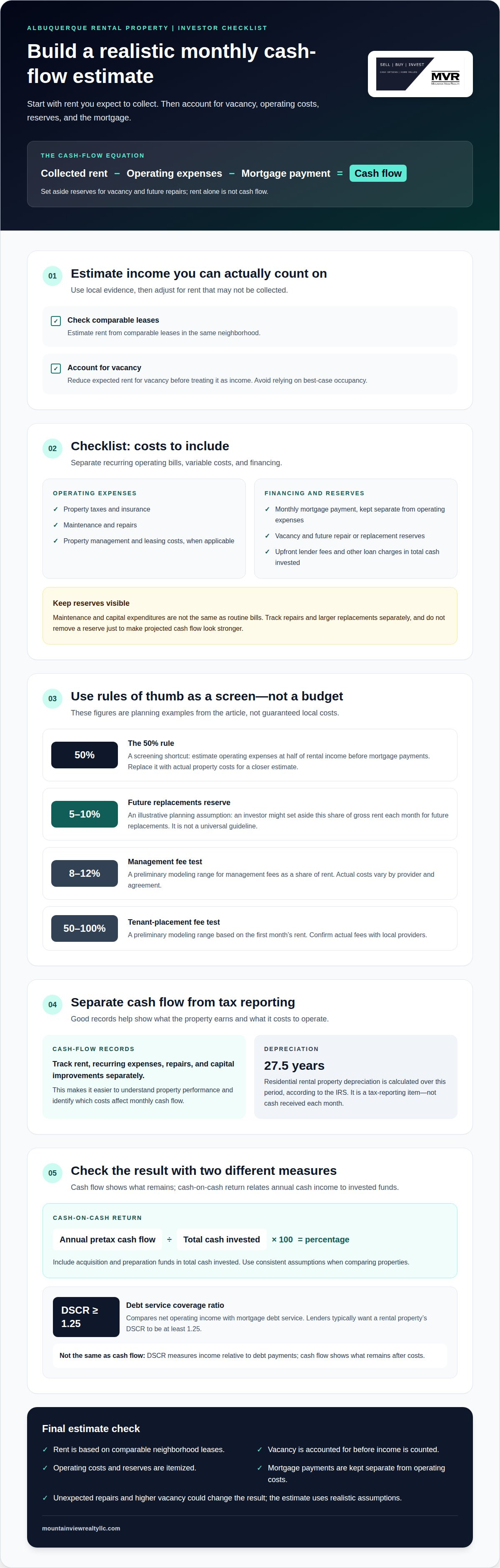
The 50% rule offers a screening shortcut: estimate operating expenses at half of rental income before mortgage payments. For a closer view, separate recurring bills from repairs, leasing costs, and longer-term replacements.
Operating Expense Categories
Operating expenses are recurring costs of running a rental. Maintenance and capital expenditures cover repairs and larger replacements. Track them separately to see which costs affect monthly cash flow and which call for a reserve.
As an illustrative planning assumption, not a universal guideline, an investor might set aside 5-10% of gross rent each month for future replacements. These categories make the estimate more useful than rent minus the mortgage alone.
Rental Income and Tax Deductions
Rental income is the money collected from tenants; operating expenses are the costs of earning that income. Record rent, recurring expenses, repairs, and capital improvements separately to understand property performance and keep tax reporting organized.
Residential rental property depreciation is calculated over 27.5 years, according to the Internal Revenue Service. Depreciation is a tax-reporting item, not cash received each month, so keep it separate from cash-flow calculations. The tax treatment of individual expenses can depend on their nature, making careful records important.
Income and Expense Optimization
Optimizing rental income means improving earnings while managing costs without neglecting upkeep. Compare expected rent with local comparable leases, then assess the property using realistic assumptions for vacancy, taxes, insurance, and repairs.
Review expenses by category instead of relying only on a broad rule. The 50% rule can provide an initial screen, while a more detailed budget identifies costs that may be controlled through timely maintenance or better planning. Don’t remove a reserve simply to make projected cash flow look stronger.
Management Fees and Leasing Costs
Property management and leasing costs pay for ongoing oversight and tenant placement, and they reduce the income available to cover other expenses. For preliminary modeling only, an investor might test management fees of 8-12% of rent and tenant-placement fees of 50-100% of the first month’s rent; actual fees vary by provider and agreement. An agent’s fee to fill a vacancy may also vary.
These figures are planning examples, not a guaranteed Albuquerque quote. Confirm costs with local providers and include management and leasing costs when they apply, rather than treating all collected rent as available cash.
Mortgage payments and monthly cash flow
Mortgage payments turn a property’s operating result into its monthly cash position. Rent must cover expenses and debt service before cash remains, so financing terms matter.
Mortgage Debt Service
Mortgage debt service is the amount paid toward a property loan over a stated period. Even a property with positive operating income can have negative cash flow after its mortgage payment.
The mortgage payment is a financing cost, separate from operating expenses such as taxes, insurance, and repairs. Keep these categories distinct to see what rent needs to cover.
Financing also affects the cash needed before the first rent arrives. Lender fees and other loan charges add to upfront investment, while the scheduled mortgage payment affects monthly cash flow. Include upfront amounts in total cash invested and use the actual loan terms for monthly projections. A lower payment may improve cash flow, but the amount borrowed, interest rate, and loan term all shape the result.
That figure shows why rent alone is not a reliable measure of performance. A monthly estimate should account for collected rent after vacancy, operating costs, and the mortgage payment. An appliance failure or other repair may require cash beyond the regular monthly budget.
Cash Flow After Mortgage Payments
Cash flow after mortgage payments is what remains after operating expenses and debt service are deducted from rental income. This amount indicates whether rent can support the property’s ongoing costs.
This is a narrow margin: an unexpected expense or higher vacancy can erase it. Base the estimate on realistic costs, not best-case occupancy.
Debt service coverage ratio, or DSCR, compares net operating income with mortgage debt service. Lenders typically want a rental property’s DSCR to be at least 1.25. This measure is different from cash flow: it assesses income relative to debt payments, while a cash-flow estimate shows what remains after costs.
When calculating cash flow on a rental property in Albuquerque, list loan charges, monthly payments, vacancy, and operating expenses separately. This makes it easier to identify whether a projected shortfall comes from financing, property costs, or reduced rent collection.
Cash-on-cash return
Cash-on-cash return helps investors assess a property’s cash income relative to the funds committed to it. Treat it as one decision-making tool, not a stand-alone verdict on a purchase.
Cash-on-Cash Return Basics
Calculate the return by dividing annual pretax cash flow by total cash invested, then multiplying by 100. The result is a percentage that describes income relative to invested cash, rather than the property’s total value.
Define inputs consistently before comparing opportunities. Annual cash flow should use the same operating assumptions as the rest of your analysis. Total cash invested should include funds committed to acquiring and preparing the property. If one estimate includes acquisition costs and another omits them, the percentages are not directly comparable.
Financing affects both the cash invested and the income left after debt service. As a result, two properties with similar operating performance can have different return percentages. Compare the assumptions behind each estimate, not just the final percentage.
Average Rental Cash Flow Returns
No single average return determines whether an Albuquerque rental is a sound investment. The result depends on the property, financing, rental income, operating costs, and the investor’s cash commitment.
Instead of treating a market benchmark as a promise, assess whether the projected return fits your objectives and tolerance for variable income. Test how it changes if rent collection falls short, expenses rise, or the property needs more work. A return that depends on every assumption going perfectly offers less confidence than one that remains workable under less favorable conditions.
For a useful comparison, keep assumptions and time periods consistent across properties, and record why projections differ. This makes each percentage easier to interpret and helps distinguish a stronger opportunity from one based on more optimistic inputs.
Target-Return Purchase Price
A target-return analysis works backward from the return an investor wants to evaluate. It helps set a disciplined limit on the cash committed, rather than letting the asking price dictate the decision.
Use expected annual cash flow and the chosen target percentage to estimate the total cash investment that fits the goal. Then consider how the purchase structure, financing, and preparation needs affect the upfront amount. This estimate is not automatically the property’s purchase price: cash commitment and purchase price are different measures.
Revisit the analysis when an offer, loan structure, or property condition changes. If projected return falls below your target, review the price and assumptions. The calculation provides a consistent framework for deciding whether the investment merits further consideration.
Estimating market rent from comparable leases
Market rent is an estimate, not a guarantee of rental income. Comparable leases can offer Albuquerque landlords local evidence to help assess a property.
Comparable Lease Estimates
A comparable-lease estimate uses rents from similar homes to gauge what tenants may pay. This matters because an overly optimistic rent assumption can make a weak purchase appear profitable.
As an unsourced screening heuristic, you might look for at least 3 leases signed within the last 6 months, in the same neighborhood, with the same bedroom count. Then consider differences in condition, features, and included services. Adjust the estimate to reflect meaningful differences rather than assuming every nearby listing earns the same rent.
For example, a home with updated appliances may not be comparable to an older property with the same number of bedrooms. Start with the closest lease matches, then explain any adjustments in your estimate. This ties projected income to neighborhood evidence rather than an asking rent that may not reflect a completed lease.
The 1% rule is an unsourced screening heuristic for a quick rent-to-price comparison: monthly rent equals 1% of the total purchase price, including necessary repairs or renovations. A property costing $100,000 including initial repairs would need $1,000 in monthly rent to meet that screening threshold. Treat this as an initial filter, not proof of positive cash flow. Taxes, insurance, vacancy, maintenance, capital needs, and mortgage payments still affect the result.
A gross rent multiplier, or GRM, compares purchase price with gross annual rental income. Divide the purchase price by annual gross rent to calculate it. GRM can help compare properties, but it excludes operating costs and financing, so it cannot show monthly cash flow on its own.
Rent Changes and Market Rates
A rent-increase policy sets how a landlord adjusts rent over time. A transparent, predictable policy aligned with market rates and local regulations can help rental income keep pace with changing property costs.
Use comparable leases to assess whether the current rent still fits the neighborhood. If similar homes support a different amount, consider the property’s condition, features, and tenant experience before adjusting rent. An increase without comparable evidence may weaken the property’s position; a well-supported adjustment can better align income with market conditions.
For an Albuquerque property, update the rent estimate when new comparable leases become available. Recalculate projected income using the revised rent, then reassess expenses and financing. A rent adjustment that appears positive may not improve returns if vacancy or operating costs also change.
Factors affecting rental property cash flow
Cash flow changes when rent, vacancy, operating costs, or financing assumptions change. For an Albuquerque investment property, testing these factors together gives a more useful estimate than relying on purchase price or advertised rent alone.
Vacancy reduces collected rental income even when the listed rent stays constant. For planning purposes, you could test a vacancy allowance of 5-10% of gross rent and a more conservative scenario of 10-15%; these are assumptions, not guaranteed local averages. You might also test a scenario in which it takes 30 to 60 days to secure a tenant, allowing for costs before rent begins.
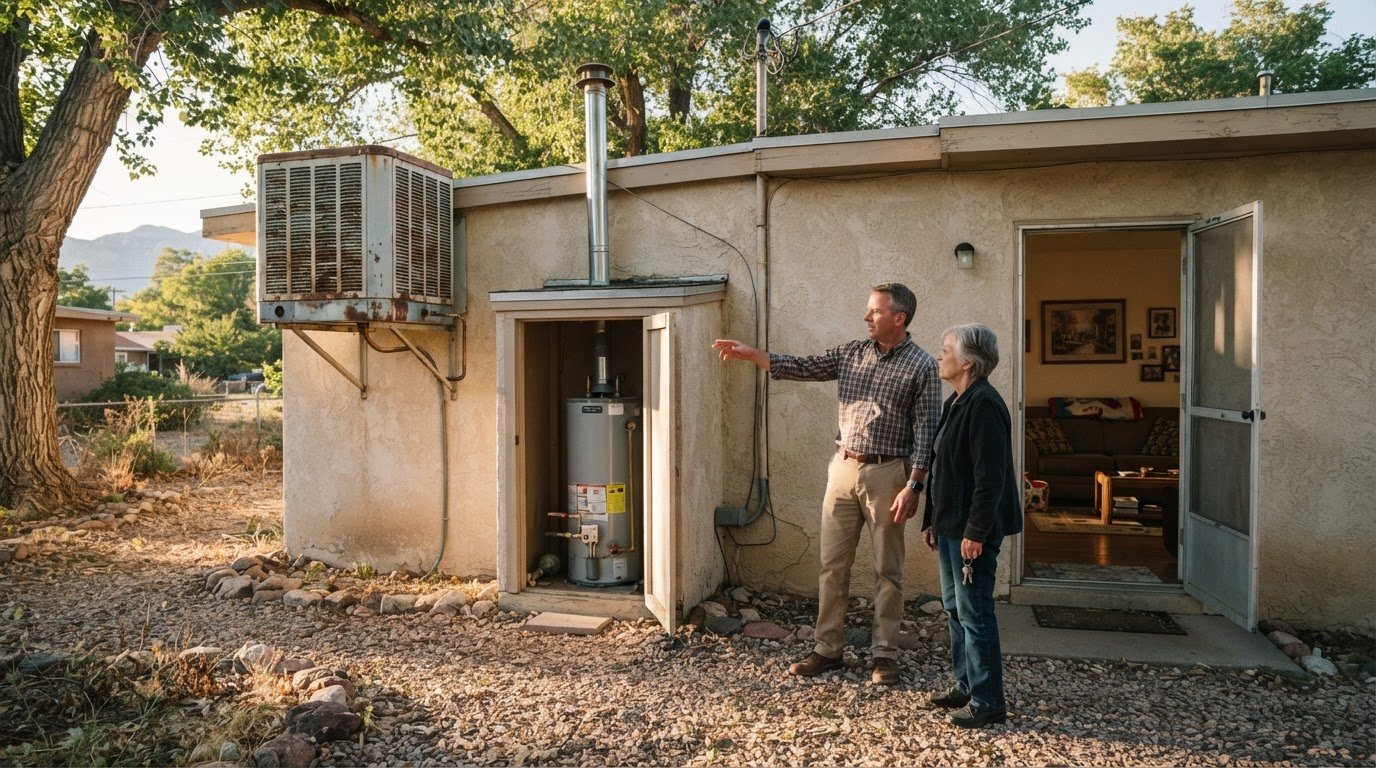
Property condition shapes maintenance and capital costs. For planning purposes, you could estimate replacement every 10 to 20 years for roofs, HVAC systems, and water heaters, but actual lifespans depend on the component and its condition. A reserve scenario of $300-$1,000+ per unit per year can help model potential costs; the appropriate amount depends on the property’s age and condition. Recording the property’s condition helps connect this reserve to likely future work, instead of treating it as surplus cash.
Rental strategy changes the expense profile. For an initial projection, you could test long-term rental operating expenses at 45-55% of gross rent before the mortgage payment and short-term rental expenses at 55-70% of gross revenue. Treat these as modeling assumptions, not established local averages. A strategy that generates higher gross income does not automatically produce higher cash flow; cleaning, turnover, and other operating demands must also be accounted for.
Property features can affect both income and costs. New amenities may increase income, but weigh installation and ongoing upkeep against the added rent. A feature adds value only when its income outweighs its costs.
Albuquerque landlord laws and rental regulations can affect operating costs by shaping lease terms, rent changes, maintenance, and administration. Budget for the work and timing those obligations involve, and base rent projections on a policy aligned with market rates and applicable local regulations.
For a useful comparison, hold rent and financing assumptions steady while changing one factor at a time. Test vacancy, repairs, and rental strategy separately, then combine realistic assumptions in a final projection. This shows which costs most affect the result and whether the purchase price still fits your investment goals.
Mountain View Realty: CashOffer+
Mountain View Realty LLC’s CashOffer+ gives owners a selling option when a rental property no longer fits their financial plans. Cash-flow estimates can help clarify whether ongoing costs, maintenance demands, or financing still align with your goals. If you’re weighing a sale against holding the property, Mountain View Realty LLC can help you consider an approach suited to your priorities. Other options include Home Trade-In and Renovate & Sell, depending on your needs.
Contact Mountain View Realty LLC to discuss your property and the next step that fits your plans.
Choose the Next Step That Fits Your Property
A rental property decision can affect more than your monthly budget. Use your cash-flow outlook to consider how ownership fits your time, priorities, and plans for the future. Calculating cash flow on a rental property in Albuquerque can inform that decision, but your next step also depends on what you want the property to make possible.
If you’re weighing whether to keep or sell, a focused conversation can help you clarify your priorities and decide which direction suits your circumstances.
There’s value in choosing deliberately. Give yourself room to weigh the options and move forward with a plan that reflects what matters to you.
Frequently Asked Questions
How is cash-on-cash return calculated?
Divide annual pretax cash flow by total cash invested, then multiply by 100. For a meaningful result, use a consistent investment period and include the same types of upfront funds in every comparison. If you compare an Albuquerque property with another opportunity, keep financing and operating assumptions aligned. Otherwise, the percentages may reflect different methods rather than a true difference in performance.
How do you calculate monthly cash flow for a rental property?
Build a month-by-month projection using the rent you expect to collect and the timing of cash leaving the property. Spread annual bills across the months they cover, even if you pay them as a lump sum. Keep the actual payment date visible, too: a property may show a reasonable annual result while facing a short-term cash gap in a costly month.
What rental expenses should be included in a cash flow calculation?
Include each cost the owner pays to operate and preserve the property, and record it in a consistent category. Keep invoices and payment dates with the projection so you can compare estimates with actual spending. Separate money reserved for future work from money already spent. This helps identify recurring cost increases and update the forecast without confusing planned reserves with completed repairs.
What are average rents for Albuquerque rentals by property type and neighborhood?
No single rent figure accurately represents every Albuquerque property type and neighborhood. Detached homes, condominiums, and small multifamily units can attract different tenants and rental expectations. Location, layout, condition, and included features also shape likely rent. For an investment decision, use an estimate specific to the property rather than applying a broad citywide figure to every address.
What are typical Albuquerque property taxes, insurance, and maintenance costs for rentals?
Costs depend on the property and its condition, so use property-specific records rather than a generic estimate. Review the current tax bill, insurance terms, and inspection findings together. Age, past repairs, and the condition of major systems can explain why maintenance needs differ between Albuquerque homes. Update the projection when a renewal or new inspection changes the expected cost.
What vacancy rate and rent collection loss should Albuquerque landlords budget for?
Track vacancy and unpaid rent as separate risks in the projection. Vacancy means a unit produces no rent while unoccupied; collection loss means rent was due but not received. Test how each affects expected income without treating them as the same event. Reviewing actual lease turnover and payment records can make future assumptions more relevant to that property.
What risks can reduce rental property cash flow in Albuquerque?
Unexpected repairs, longer gaps between tenants, delayed rent, and changes to recurring bills can strain an Albuquerque rental’s cash position. Property condition and the timing of costs matter as much as the annual total. Consider whether available cash can cover a large repair while regular bills continue. Investors should also assess how a financing change might affect their ability to hold the property.
Robb Krautbauer, Owner & Qualifying Broker

Article by
Robb Krautbauer
Robb Krautbauer is the Owner and Qualifying Broker of Mountain View Realty, serving Albuquerque, Rio Rancho, Santa Fe, and surrounding New Mexico communities. With more than a decade of real estate experience, Robb specializes in luxury homes, strategic home marketing, and helping homeowners navigate important life transitions with confidence.
Known for combining luxury-level marketing, AI-powered technology, and innovative selling strategies, Robb helps clients maximize their home's value while creating a smooth, personalized selling experience. Whether assisting luxury homeowners, retirees, families downsizing, or real estate investors, his focus is always on delivering expert guidance, honest advice, and exceptional results.
When he's not helping clients achieve their real estate goals, Robb enjoys studying market trends, emerging technology, and investment strategies that keep Mountain View Realty at the forefront of the industry.
Disclaimer
**Disclaimer:** The information provided in this article is for general educational purposes only and should not be considered legal, tax, financial, or professional advice. Real estate laws, market conditions, and regulations change over time and may vary based on your individual circumstances. Before making any real estate decision, consult with qualified legal, tax, or financial professionals. If you have questions about buying or selling real estate in New Mexico, contact Mountain View Realty for guidance specific to your situation. © 2026 Mountain View Realty. All rights reserved. The content on this website may not be reproduced without written permission.


