
Closing Costs for Buyers in Albuquerque: How Much to Budget
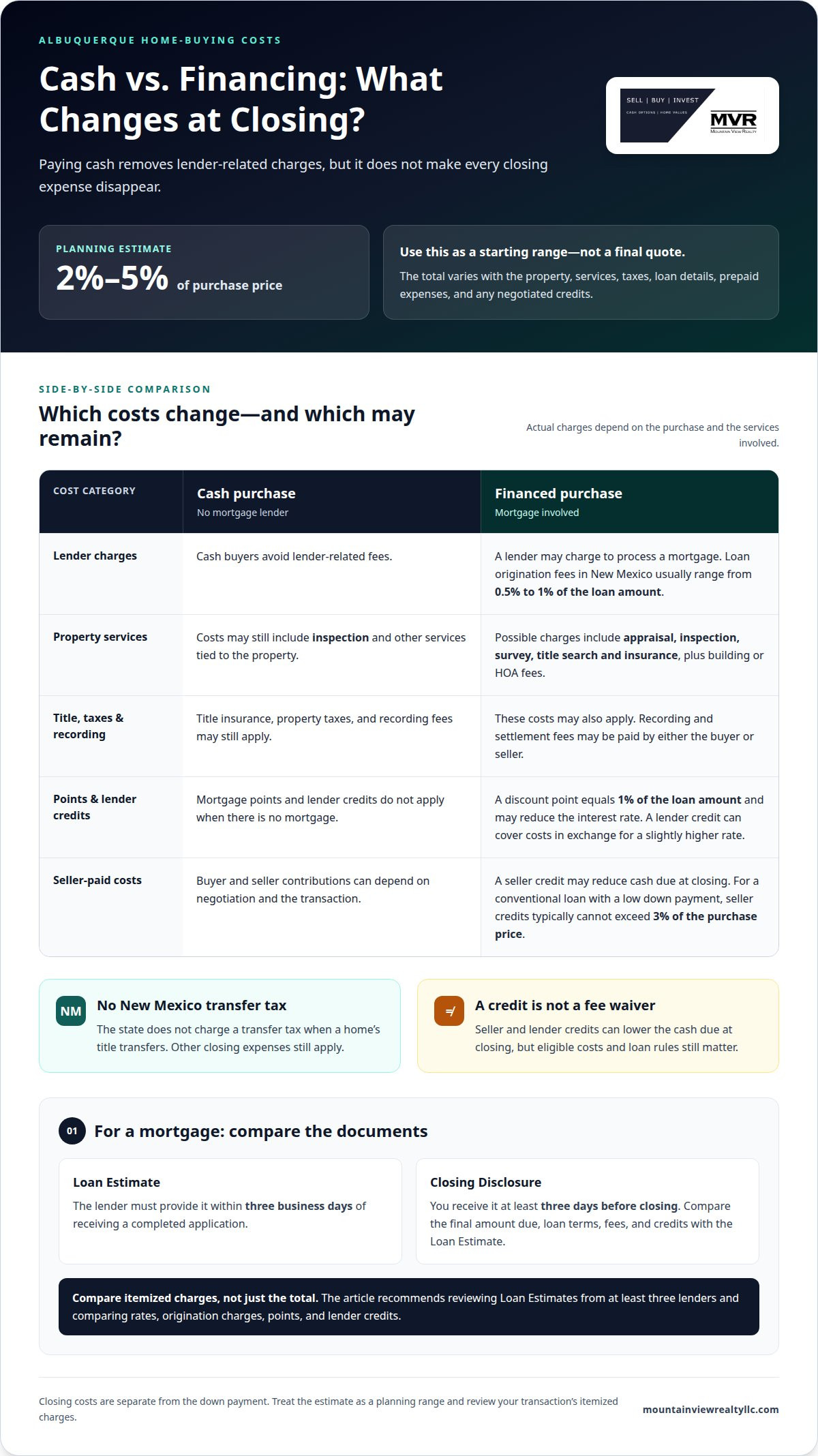
Paying cash doesn’t make closing costs disappear. As a general planning estimate, buyers may budget 2% to 5% of the purchase price for closing costs, depending on services, taxes, and financing. Cash buyers avoid lender-related fees, but may still pay costs such as title insurance, property taxes, inspection fees, and recording fees.
It’s easy to focus on the down payment and overlook the other expenses due at closing. For buyers in Albuquerque, closing costs depend on the purchase, the services involved, and whether you’re financing or paying cash.
This guide explains which fees and prepaids to expect, what may be negotiable, and how a cash purchase changes the costs. You’ll also learn how to read your loan documents and plan for the amount due at closing.
Key Takeaways
- Build your closing budget separately from your down payment, and expect the total to vary with the purchase and loan details.
- Use your Loan Estimate and Closing Disclosure to understand how lender, appraisal, inspection, and title charges contribute to the final total.
- Negotiations may shift some buyer costs to the seller, but loan rules can limit seller credits.
- Plan for prepaid expenses, including interest, property taxes, and homeowners insurance, which affect the cash due at closing.
- A cash purchase removes lender-related charges, while other transaction costs may still apply.
How much are closing costs?
Albuquerque buyers typically budget 2% to 5% of the purchase price for closing costs. The final amount depends on the property, loan, and expenses collected through escrow.
Typical Buyer Cost Range
Closing costs are the transaction expenses buyers pay beyond the purchase price and down payment. Treat a percentage as a planning range, not a quote: loan terms and prepaid expenses can change the amount. Conventional loans may also have different charges from other financing options.
Regional Cost Differences
Albuquerque metro buyers typically budget 2% to 5% of the purchase price, while the specific mix of fees varies by property and transaction. A home’s location can affect government and recording charges, and the services used also shape the total.
Buyers and sellers may both contribute, depending on negotiations and the transaction. New Mexico sellers usually pay existing liens, real estate brokerage commissions, and mortgage payoff penalties. Seller costs typically range from 8% to 10% of the sale price, while buyer costs reflect their own loan and closing expenses.
Budgeting With the Calculator
A closing-cost calculator applies an estimated percentage to a purchase price to create a starting budget. Enter the expected price and compare the result with the 2% to 5% range. The estimate is not a final settlement figure; loan terms, escrow deposits, and negotiated credits affect the total.
For a mortgage, the lender must provide a Loan Estimate within three business days of receiving a completed application. The Consumer Financial Protection Bureau says buyers receive the Closing Disclosure at least three days before closing. Compare it with the Loan Estimate, focusing on the final amount due, loan terms, fees, and credits.
Eligible New Mexico buyers may use the Mortgage Finance Authority’s FIRSTHome, FIRSTDown, and HOMENow programs to help with closing costs or down payment requirements. Eligibility and assistance depend on the buyer and the terms of each program.
Transfer and Mortgage Taxes
New Mexico does not charge a transfer tax when a home’s title transfers. That removes a tax commonly tied to changing ownership, but other closing expenses still apply. Mortgage costs, including lender charges, are separate from a transfer tax and may affect a financed purchase.
Lender, appraisal, inspection, and title fees
A financed purchase can include charges from the lender, property professionals, and title services. Reviewing each estimate separately helps you distinguish loan costs from property-related expenses.
Lender and Property Service Fees
A lender may charge to process a mortgage, while property services support valuation, inspection, and title transfer. In New Mexico, buyer expenses can include title search and insurance, appraisal, inspection, survey, and building or HOA fees.
Recording and settlement fees may be paid by either the buyer or seller. These are separate service charges, not one combined lender fee.
Points and Origination Fees
Origination fees compensate the lender for processing a loan, while discount points are optional upfront payments that can reduce the interest rate. A New Mexico loan origination fee usually ranges from 0.5% to 1% of the loan amount.
One mortgage point equals 1% of the loan amount. Compare the upfront cost of points with the possible interest savings over the time you expect to keep the mortgage.
Financing Costs and Lender Credits
Financing closing costs means adding eligible expenses to the mortgage instead of paying them all at closing. This can reduce the cash needed upfront, but you’ll pay interest on financed costs over the loan’s life.
A lender credit works in the opposite direction: it can cover closing costs in exchange for a slightly higher interest rate. Compare the credit and rate with how long you expect to keep the home. The right fit depends on whether lower cash due now outweighs the added interest over time.
Shopping and Comparing Fees
Compare Loan Estimates from at least three lenders to assess rates, origination charges, points, and lender credits side by side. Also compare services such as title insurance and appraisals where you can select a provider. Consumer Financial Protection Bureau guidance gives lenders a 10% tolerance for third-party services they recommend.
Review fee names and amounts, not just the estimated total. Under the fee protections described for Loan Estimates, lenders have zero tolerance for changes to their own administrative fees. Comparing itemized fees can help you identify costs to discuss before closing.
Seller Credits and Fee Negotiations
Some charges may be negotiable. Buyers can negotiate lender origination fees, and a purchase offer can ask the seller to cover some buyer closing costs. Seller contributions depend on the agreement and loan rules.
For a conventional loan with a low down payment, seller credits typically cannot exceed 3% of the purchase price. A seller credit can reduce cash due at closing, but it does not erase the fee. Compare the proposed credit with the total eligible costs and the loan’s limits before relying on it.
Negotiable costs and seller concessions
Albuquerque buyers can ask sellers to cover some buyer closing costs, subject to the purchase agreement and loan limits. Buyers generally pay their own transaction expenses; sellers usually pay existing liens, brokerage commissions, and mortgage payoff penalties. Government charges, for example, aren’t negotiable.
Negotiating Seller-Paid Costs
A seller concession is an agreed contribution toward eligible buyer costs at closing. It can reduce the cash you need to bring, which may matter when upfront funds are central to your buying plan.
Include the request in your offer and state the credit clearly in the purchase terms. Your estimate can show which costs it may offset, such as lender charges or prepaid expenses. The seller can accept, reject, or counter the request along with other terms, including the purchase price and closing date.
For a conventional loan with a low down payment, seller credits typically have a 3% purchase-price cap. The loan’s applicable rules and the buyer’s eligible costs still shape how much credit can be used.
A seller credit isn’t automatically the best option. Compare it with changes to the offer price and the seller’s expected proceeds. A credit may reduce cash due at closing, while a price adjustment affects the amount financed and other calculations.
Allocating Buyer and Seller Fees
Fee allocation identifies who pays each transaction cost. The purchase agreement can assign some expenses differently, but buyers commonly cover costs tied to their loan and chosen services, including appraisal, inspection, and lender charges. Sellers usually pay existing liens, mortgage payoff penalties, and their own brokerage commissions.
Commission terms are negotiable case by case, and that approach has applied since August 2024. Sellers may also contribute toward a buyer’s agent fees or other negotiated costs. The agreement should make each contribution clear, rather than leaving the parties to infer responsibility from an estimate.
Separate negotiable service fees from fixed government charges. Buyers may negotiate lender origination fees or compare providers for services such as an appraisal. Government fees aren’t negotiable, and their amounts depend on the region where the home is purchased. Points and other loan terms can also affect your total, so consider them alongside any proposed credit.
For a practical review, compare the purchase agreement’s cost allocation with the lender’s estimate. Confirm that requested credits appear in the terms and align with eligible costs. This shows how the agreed responsibilities translate into cash due at closing for both buyer and seller.
Prepaid interest, property taxes, and homeowners insurance
Some closing expenses cover costs that begin after ownership transfers, rather than lender or title services. These prepaids and escrow deposits affect the cash due at closing and can vary with the loan type and closing date.
Prepaid Interest and Escrow Items
Prepaid expenses are collected at closing for costs that will come due later, while escrow holds funds for future bills. The closing statement may include both current charges and deposits toward upcoming payments.
Mortgage interest generally accrues between closing and the start of regular payments, so the closing date affects prepaid interest. Closing on the 30th rather than the 5th can reduce the prepaid interest due at closing. Property tax escrow deposits may cover 2 to 8 months, depending on the transaction’s timing and requirements.
Homeowners insurance may also be paid in advance or collected through escrow. The lender’s estimate and final disclosure show which expenses are prepaid and which funds are deposited for later bills. Separate line items make it easier to understand the total due at closing.
Property Tax Proration
Property tax proration divides tax responsibility between buyer and seller according to their ownership periods. A tax bill may cover time both before and after the sale.
In Albuquerque and Bernalillo County, the closing statement accounts for the applicable property tax period and allocates the amount between the parties. The seller’s share generally covers the seller’s ownership period, while the buyer assumes responsibility after closing. The settlement calculation may use available tax information and show a credit or charge to balance the allocation.
Review the property tax line alongside the closing date and any escrow deposit. Proration assigns responsibility between buyer and seller; escrow sets funds aside for a future payment. Both may appear in the closing figures, so read each entry separately.
Insurance and Mortgage Insurance
Homeowners insurance protects the property under the policy, while mortgage insurance protects the lender’s loan interest. Insurance premiums and loan terms affect both closing funds and later payments.
For conventional loans, many lenders require mortgage insurance when the down payment is less than 20%. The premium may appear as a closing or ongoing loan cost, depending on the arrangement. A larger down payment can change whether mortgage insurance applies.
Loan type also shapes insurance-related charges. FHA loans require an upfront mortgage insurance premium, while VA loans may include a funding fee. Review homeowners insurance, mortgage insurance, property tax escrow, and prepaid interest as separate items in the estimate. Together, these details explain why cash due at closing differs from the down payment alone.
Closing costs for cash purchases
A cash purchase removes mortgage-related charges, but not the expenses of transferring ownership. The key difference is which costs remain when there’s no lender.
Without a mortgage, buyers generally avoid lender application, origination, and underwriting fees, along with mortgage points and other lender-related charges. There’s no interest rate affecting loan costs either. But title services, property taxes, inspection fees, and recording costs may still apply. The final amount depends on the property, services, and agreement between buyer and seller.
Think of a cash purchase as two separate budgets: the purchase funds and the settlement expenses. The purchase price pays for the property; closing expenses cover services and charges tied to transferring ownership and completing the sale. Keep these categories distinct when planning the funds needed to close.
Some costs can still be discussed. In New Mexico, the buyer or seller may pay recording fees and the settlement fee, depending on the agreement. Buyers may also negotiate who covers certain eligible expenses or request a seller contribution in the offer. A seller credit can reduce cash due, but the agreed terms and applicable loan rules determine whether it applies. Without a mortgage, lender credits and lender fee negotiations aren’t part of the cash transaction.
Property-related expenses still matter without financing. You may choose an inspection to understand the home’s condition, while title services support the ownership transfer. Property taxes may be prorated between the parties, and recording charges may remain. Review each settlement statement line to see who pays it and why; a cash offer doesn’t automatically assign every cost to the buyer or seller.
In New Mexico, buyers typically pay closing costs on closing day, usually by cashier’s check or wire transfer to the title or escrow company. Confirm the amount and payment instructions through the transaction’s established process. Cash avoids mortgage costs, not the need to budget for settlement expenses. Compare the total cash required for the purchase with the separate charges listed for closing.
Mountain View Realty
Mountain View Realty LLC can help you consider how a home sale and purchase fit together as you plan your next move. If you’re weighing cash proceeds, timing, or whether to sell before buying, options include CashOffer+, Home Trade-In, Renovate & Sell, and Sell & Stay. Each addresses different selling priorities, so the conversation starts with your plans and the decisions ahead, not a one-size-fits-all approach.
Understanding closing expenses is one part of the decision. Looking at your sale and purchase together can help you assess the transition and the choices available.
Contact Mountain View Realty LLC to discuss your real estate plans.
Make your next move with a clear plan
A clear budget for closing costs for buyers in Albuquerque is one part of a larger decision: how your purchase fits your financial priorities. Consider how much flexibility you want to keep after closing, which trade-offs matter most, and how your moving timeline affects your plans. This perspective can help you weigh a home’s appeal against the resources you want available for the next stage.
You don’t have to make every decision at once. Start with the priorities that matter most, then let them guide your next choices. A thoughtful plan can make a complex transaction more manageable and help you move forward with confidence.
Your next move can start with a conversation about what matters to you.
Frequently Asked Questions
Who pays what?
Buyers generally pay costs tied to their mortgage and purchase, while sellers usually cover existing liens, brokerage commissions, and mortgage payoff penalties. The purchase agreement can assign some expenses differently. For example, New Mexico recording fees and the settlement fee may be paid by either party. Review the agreed allocation alongside the closing figures so each charge has a clear payer.
Does New Mexico require paying for a real estate attorney?
No. New Mexico doesn’t require buyers or sellers to hire a real estate attorney for a home purchase. Some people may still choose legal advice for a transaction with unusual contract terms, an estate, or other complex circumstances. Attorney fees are separate from required transaction charges, so consider whether legal guidance fits your situation and the questions you need answered.
What is typically the most expensive closing cost?
There isn’t one cost that is always the largest. The total depends on the loan, property, and services involved. For a buyer choosing discount points, the upfront point charge can be substantial because each point equals 1% of the loan amount. Prepaid expenses and title services can also affect the total, so compare line items rather than assuming one fee will dominate.
What are typical buyer closing costs in Albuquerque, New Mexico?
Albuquerque-area buyers typically budget closing costs of 2% to 5% of the purchase price, separate from the down payment. The estimate changes with loan terms, services, prepaids, and negotiated credits. Cash buyers avoid lender-related fees, but still face transaction expenses such as title, inspection, tax, and recording charges.
What are the main buyer closing cost line items in New Mexico?
Common buyer expenses include loan application and origination charges, discount points, appraisal and inspection costs, title search and insurance, survey or building fees, and prepaid taxes or insurance. Which items apply depends on the property and financing. For example, a condominium purchase may include HOA-related fees. Separate service charges from prepaid expenses to understand what each line covers.
How much are title insurance, escrow, and recording fees in Albuquerque?
These charges vary with the transaction and services performed. Title costs can include searching ownership records and issuing insurance; escrow or settlement charges cover transaction handling, while recording fees relate to public records. In New Mexico, the agreement may assign recording and settlement fees to either buyer or seller. Review the itemized closing figures to see each specific charge and who pays it.
What are typical lender fees and appraisal costs for Albuquerque homebuyers?
A New Mexico loan origination fee usually ranges from 0.5% to 1% of the loan amount. Lender charges may also include an application fee or discount points, depending on the loan terms. Compare those items separately: the appraisal evaluates the property, while origination charges relate to processing the mortgage.
Robb Krautbauer
Owner & Qualifying Broker

Article by
Robb Krautbauer
Robb Krautbauer is the Owner and Qualifying Broker of Mountain View Realty, serving Albuquerque, Rio Rancho, Santa Fe, and surrounding New Mexico communities. With more than a decade of real estate experience, Robb specializes in luxury homes, strategic home marketing, and helping homeowners navigate important life transitions with confidence.
Known for combining luxury-level marketing, AI-powered technology, and innovative selling strategies, Robb helps clients maximize their home's value while creating a smooth, personalized selling experience. Whether assisting luxury homeowners, retirees, families downsizing, or real estate investors, his focus is always on delivering expert guidance, honest advice, and exceptional results.
When he's not helping clients achieve their real estate goals, Robb enjoys studying market trends, emerging technology, and investment strategies that keep Mountain View Realty at the forefront of the industry.
Disclaimer
**Disclaimer:** The information provided in this article is for general educational purposes only and should not be considered legal, tax, financial, or professional advice. Real estate laws, market conditions, and regulations change over time and may vary based on your individual circumstances. Before making any real estate decision, consult with qualified legal, tax, or financial professionals. If you have questions about buying or selling real estate in New Mexico, contact Mountain View Realty for guidance specific to your situation. © 2026 Mountain View Realty. All rights reserved. The content on this website may not be reproduced without written permission.


