
CLUE Reports in Real Estate: How Claims History Can Affect a Purchase
A home’s insurance history can reveal details that aren’t visible during a showing: a CLUE report records claims tied to a property. That’s what a CLUE report in real estate is, a claims-history record insurers may consider when underwriting homeowners coverage. Entries can include a loss date, its cause, and amounts paid. A clean report doesn’t prove the home has never had problems.
Before making a major purchase, it’s reasonable to want a clear picture of the property. Buyers can ask the current owner to share the home’s CLUE report, but they can’t request it directly themselves. The report is one part of due diligence, alongside the home’s condition and other records, not a substitute for them.
This guide explains what a CLUE report can show, how homeowners can request their own copy, and how claims history may factor into insurance decisions. You’ll also learn how to interpret a past claim without treating it as an automatic reason to walk away. For Albuquerque-area buyers and sellers, understanding the report’s limits can help make a real estate decision more informed.
Key Takeaways
- Use a property’s claims history as one part of your purchase review, not as a substitute for assessing the home’s condition.
- As a buyer, ask the current owner to share the property’s report; buyers can’t request it directly.
- Homeowners can request their own report from LexisNexis and review it for inaccurate information.
- Understand what a claim entry records before considering how it may affect insurance underwriting or your decision to buy.
- If claims history affects your plans to sell, compare the available sale strategies and choose the approach that fits your priorities.
What Are CLUE Reports?
A CLUE report records insurance loss history associated with a person or property. Sellers can review listed claims, dispute inaccurate entries, or contact LexisNexis to add an explanation.
Buyer and Seller Uses
Buyers and sellers use a property report as one source of information during a home sale. A buyer can consider an entry alongside inspection findings and the seller’s account, while a seller can prepare context about a recorded loss. This gives both sides a shared record to discuss instead of relying on assumptions about what happened.
A report doesn’t replace a home inspection. For example, a listed water loss can prompt a buyer to ask about the affected area and what the inspection finds. The report doesn’t establish whether repairs were completed or whether damage remains. Likewise, no reported claim doesn’t prove the property has never had problems.
LexisNexis says C.L.U.E. Property draws on public-record and commercially available data, but it isn’t the original source or a comprehensive compilation. An entry reflects information in the report, not a complete account of every event or repair. Buyers and sellers can use it to frame questions, then consider the answers alongside other property information.
CLUE was created in 1992. Its role in a transaction is practical: it can help identify a recorded insurance loss for discussion. A buyer might note a claim’s reported cause, then compare that information with what the seller shares and what the inspection reveals. Each source answers a different question, so keeping them distinct supports a more grounded review.
Effects on Home Insurance
Homeowners insurance companies consider a property’s past insurance claims when deciding coverage costs. A recorded loss may therefore matter to a buyer considering insurance for a home. The report provides claims-history information; it doesn’t describe the home’s current condition or, by itself, determine the buyer’s decision.
A seller who reviews a claim before listing can prepare a clear response to buyer questions. If details seem wrong, contact LexisNexis to dispute the information or add context. Buyers can compare the record with inspection findings and information shared during the sale. This keeps the report in perspective while bringing specific questions into the purchase discussion.
LexisNexis identifies C.L.U.E. Property as a consumer reporting agency product that may only be accessed in compliance with the Fair Credit Reporting Act, 15 U.S.C. 1681, et seq. A report can inform real estate and insurance discussions, but its entries shouldn’t be treated as a complete property history. Buyers and sellers can use it as one part of a broader review.
How homeowners can request a report
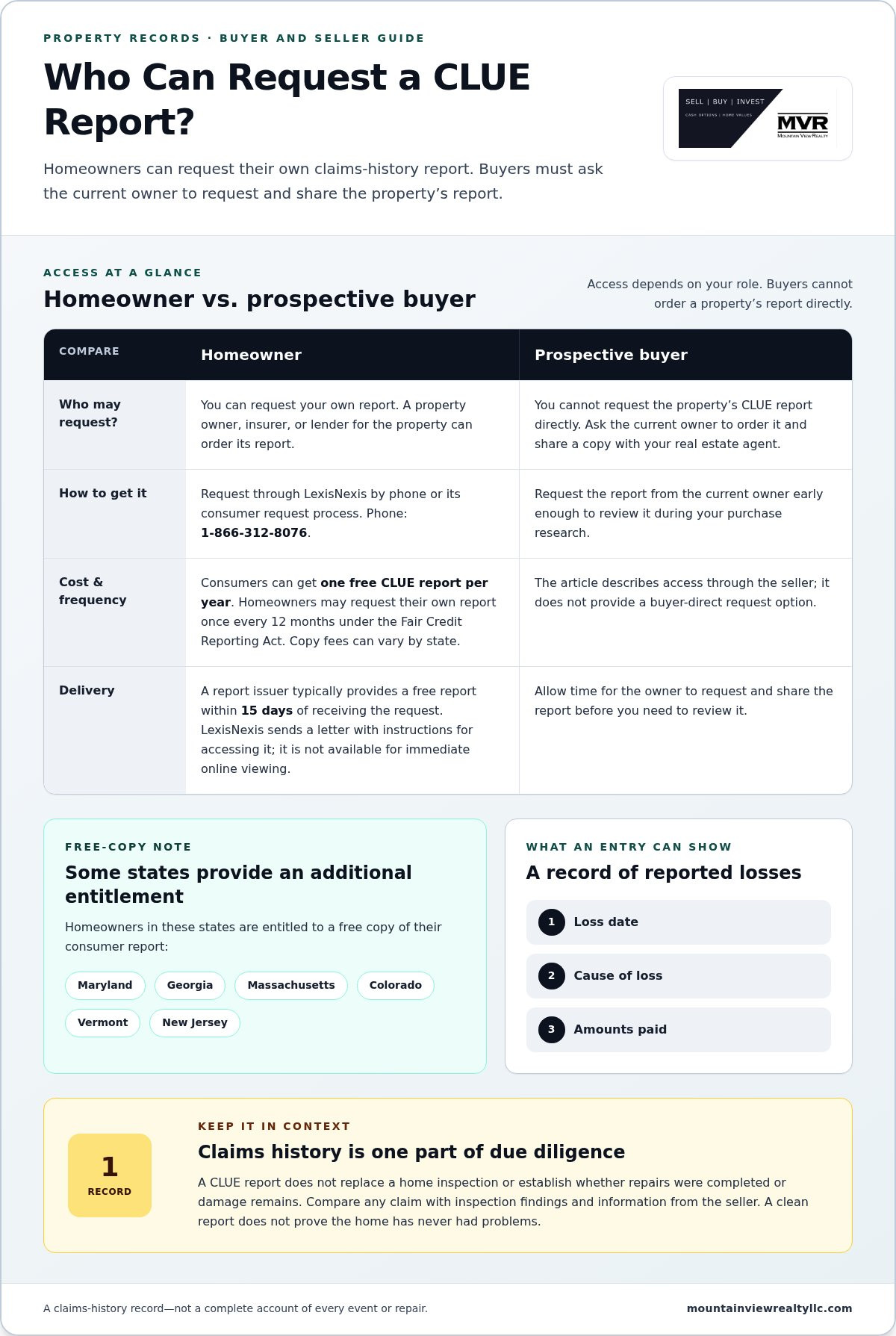
Homeowners can request their own CLUE report from LexisNexis by phone or through its consumer request process. Buyers should ask the current owner to request the property’s report and share a copy with their real estate agent.
LexisNexis provides consumers one free CLUE report per year under the Fair and Accurate Credit Transactions Act.
Requesting Your Own Report
U.S. homeowners can call LexisNexis at 1-866-312-8076 to request a report. Under the Fair Credit Reporting Act, homeowners may request their own report once every 12 months. Have identifying information ready so LexisNexis can process the request for the correct person and property.
LexisNexis says report issuers typically provide a free report within 15 days of receiving a homeowner’s request. The company sends a letter with instructions for accessing the requested report, so it isn’t available for immediate online viewing. Allow for that delivery period if you want to review claims before listing your home or discussing homeowners insurance.
LexisNexis says homeowners can request an electronic or mailed copy of their report. The fee for a copy can vary by state. Homeowners in Maryland, Georgia, Massachusetts, Colorado, Vermont, and New Jersey are entitled to a free copy of their consumer report.
Buyers Requesting a Seller-Provided Report
According to LexisNexis’s report-access rules, prospective buyers can’t request a property’s CLUE report directly. Ask the current owner to order it and provide a copy to your real estate agent. The property owner, an insurer, or a lender for the property can order its report.
Request the report early enough to review it during your purchase research. For example, a reported water-damage claim gives you a specific event to discuss alongside inspection findings and repair information. The report doesn’t replace an inspection or establish the home’s present condition.
Why Request a Report?
Homeowners may request a report before listing, after a claim, or while reviewing insurance records. Reviewing it before a sale gives time to identify an unfamiliar entry and contact LexisNexis about incorrect information. Consumers can dispute inaccurate details or add an explanation to provide context for a claim.
For buyers, a seller-provided report is another record to consider during purchase research. Keep it with other transaction documents and note entries that need follow-up. Requesting the report gives homeowners and buyers a way to review recorded claims history and identify questions for the sale process.
Claims history database and insurance underwriting
A CLUE report brings recorded insurance losses into underwriting and property research. CLUE reports are used for U.S. homes, though access depends on who requests the property’s information.
Claims History Database
The Comprehensive Loss Underwriting Exchange, or C.L.U.E., is a database of insurance loss history used during underwriting. A report can cover claims from the past seven years for a homeowner’s home and vehicles. Insurers can consider this record of prior losses, while buyers can use property information to understand reported claims during a purchase review.
According to LexisNexis, C.L.U.E. Property reports use claims data provided by more than 90% of insurers that write homeowners coverage. LexisNexis also says C.L.U.E. Property matches search criteria against personal property claims to identify property losses. That makes the database useful for underwriting, but it doesn’t turn the report into a full history of a home’s condition.
Claims and Policy Details
LexisNexis C.L.U.E. Property records can include a policyholder’s name, date of birth, policy number, claim number, and insurance company. For a reported loss, the report can also show the date, cause, and amount paid. These details help readers identify the policy and claim connected with an entry, rather than treating every loss as the same kind of event.
For example, a water-loss entry with a date and payment amount gives an insurer information for underwriting. A buyer can use those details to frame questions about the property’s recorded loss history. The entry doesn’t explain repair quality or establish whether damage remains, so treat it as claims data, not a condition assessment.
Insurer-Reported Claims
When a policyholder files an insurance claim, insurers can report the loss date, loss type, amount paid, and related policy details. According to LexisNexis, C.L.U.E. Property reports draw on information supplied by insurers and use matching criteria to identify property losses. Insurers aren’t supposed to report questions customers ask about a policy or deductible as claims.
Insurers typically consider claims when setting rates for three to five years. That period can differ from the report’s seven-year claims history, so an older entry doesn’t necessarily carry the same weight in every insurance decision. A CLUE record informs underwriting; the insurer considers claim details alongside other factors when evaluating an application and setting coverage terms.
For a buyer, the practical distinction is between the database record and how an insurer uses it. A claim may appear in a longer history even when the insurer’s rate review focuses on a shorter period. The loss date and type clarify what’s recorded, but the underwriting decision is separate from the home’s physical condition.
Information included in a CLUE report
A CLUE report focuses on insurance loss information, not every detail about a home or its owner. Reviewing each entry helps consumers distinguish recorded claim facts from questions that require separate property research.
What the Report Shows
LexisNexis C.L.U.E. Property loss-history reports can include a loss date, its cause, and amounts paid. These details describe the reported insurance event, but they don’t establish the full repair cost, the quality of completed work, or the home’s condition today. A payment entry, for instance, identifies a reported claim but can’t show whether a repair resolved the underlying damage.
Read each entry as a record with a specific scope. The date places the event in time, and the cause identifies the type of reported loss. The payment amount adds context about the claim, but it isn’t a complete estimate of damage. Compare an entry with relevant repair records or inspection findings to understand what it does, and doesn’t, tell you.
The report doesn’t include credit history or criminal records. CLUE is a claims-history record, not a broad background report, and it doesn’t document every incident at a property. Damage that never led to an insurance claim may not appear, so a clear report alone can’t establish that a home has never experienced damage.
Claims information may matter to insurers reviewing risk and premiums, but the report isn’t a premium quote. A recorded loss provides underwriting context; it doesn’t describe every factor an insurer considers. Buyers can make the report more useful during purchase research by separating recorded facts from assumptions.
Reviewing and Disputing Incorrect Information
Homeowners can review their CLUE report for errors before listing or discussing a home’s insurance history. Compare an unfamiliar claim with your policy and claim records. Check whether the reported event, date, and payment details match what you know. A mismatch is a reason to seek a correction, not to assume what caused the error.
Consumers can contact LexisNexis to dispute incorrect CLUE report information or add an explanation. Identify the entry in question and describe what seems inaccurate or needs context. Keep copies of the report and related records, such as claim correspondence, so you can explain the issue clearly. Focus the dispute on the specific entry rather than asking generally to change the entire report.
For example, if an entry lists a loss you don’t recognize, compare its details with your insurance paperwork before contacting LexisNexis. If the claim is accurate but important context is missing, you can ask to add an explanation. Reviewing the report before a sale gives homeowners time to address a specific record and share clearer information with prospective buyers.
Using a CLUE report in real estate
A CLUE report is useful when buyers and sellers connect its entries to practical decisions. It can frame questions about a home’s insurance history, guide follow-up during an inspection, and help sellers prepare clear explanations. Treat each entry as a starting point, not proof of current damage or completed repairs.
Turn Entries Into Specific Questions
Start with the report’s loss date, cause, and amount paid. A water-loss entry, for example, can prompt questions about the affected area, repairs, and related records. Compare those details with the home inspection instead of assuming the claim describes the property today. The report records insurance information; an inspection assesses visible conditions at the time of inspection.
For a buyer, comparing the report with other information helps separate three things: what the report records, what the seller says happened, and what the inspection observes now. If the accounts differ, identify the gap and ask for relevant documentation. A past claim doesn’t establish that a defect remains, and a clear report doesn’t replace an inspection or other property research.
Consider Insurance Alongside the Purchase
Claims history can inform an insurer’s underwriting review when a buyer applies for home insurance. A buyer can use a reported loss to raise focused questions about coverage needs and the home’s history. The report doesn’t quote a premium or state what coverage an insurer will offer. Keep those questions distinct from the home’s sale price and physical condition.
For example, if a report lists a prior roof-related loss, note the entry and compare it with inspection findings and available repair information. This gives the buyer a clearer basis for understanding the record when discussing insurance. A CLUE report can inform that discussion, but it doesn’t show whether a policy will cover future damage.
Prepare a Clearer Sale Conversation
A seller can review the report before listing and prepare context for entries that may prompt buyer questions. For an accurate claim, gather relevant records and explain the known timeline plainly. If an entry appears wrong, contact LexisNexis to dispute it or add an explanation. Clear documentation keeps discussion focused on the record rather than assumptions.
In Albuquerque, a seller can use a report entry to prepare for questions about a past loss, while a buyer considers it alongside inspection findings and insurance needs. The practical takeaway is simple: use the report to identify what needs discussion, then evaluate each point with the right information. It supports a more informed real estate decision, but doesn’t replace a property inspection, repair documentation, or an insurance policy.
Mountain View Realty: CashOffer+
Mountain View Realty LLC’s CashOffer+ gives sellers another path to consider if a home’s claims history raises questions during a sale. A CLUE report can clarify the property’s recorded insurance history, while your priorities help shape the selling strategy. If repairs or presentation concerns also affect your plans, Renovate & Sell may be another option. Home Trade-In can suit sellers considering a move between homes.
These options address different selling needs; they don’t change what a CLUE report records. Use the report to understand the claims history, then consider which sale approach fits your circumstances. A conversation can help you weigh your priorities against the available options.
Contact Mountain View Realty LLC to discuss your home sale.
Make Your Next Move With Clarity
Knowing what a CLUE report in real estate can and can’t tell you helps keep one record in perspective. The next step is to connect that information to your priorities, whether you’re considering a purchase, preparing to sell, or weighing a move. A claims entry may shape what you want to understand, but it doesn’t define the whole decision.
Before you act, write down the questions that matter most. A buyer might consider how a reported loss relates to inspection findings and insurance planning. A homeowner preparing to sell may want a strategy that reflects the property’s condition and personal goals. Clear priorities make conversations more useful and help you compare options thoughtfully.
Mountain View Realty can help sellers consider an approach that fits their circumstances. Start with a conversation about what matters to you, not assumptions based on a single report. Take the next step at a pace that feels right.
Clear priorities can help you move forward with greater confidence.
Frequently Asked Questions
Can I check or correct it?
Yes. Homeowners can request their own CLUE report and review its entries for errors. If a claim seems unfamiliar or contains incorrect details, contact LexisNexis to dispute the information or add an explanation. For example, compare the reported event with your insurance correspondence before describing the issue. Keeping the report and related records together helps you explain which entry needs attention.
What doesn’t get reported?
A CLUE report doesn’t include credit history or criminal records, and insurers aren’t supposed to report general questions about a policy or deductible as claims. It also doesn’t capture every problem at a property. Damage that never led to an insurance claim may not appear. Buyers should consider the report alongside other property information, rather than treating it as a complete account.
What is C.L.U.E.?
C.L.U.E. is the claims-history database associated with LexisNexis C.L.U.E. Property reports. It organizes information about reported insurance losses for underwriting. The database can include home and vehicle claim history, so a consumer’s report isn’t limited to one house. In a real estate transaction, property information can help buyers understand recorded losses tied to the home they’re considering.
What does CLUE stand for in real estate and home insurance?
CLUE stands for Comprehensive Loss Underwriting Exchange. The name describes its role: organizing loss information that insurance providers use when reviewing risk. In real estate, “CLUE report” usually refers to a property’s recorded insurance claims history. It isn’t an inspection or a complete repair record, so buyers should understand its limits before drawing conclusions about a home.
What information appears on a CLUE property report?
A property report can show claim dates, causes of loss, amounts paid, and related policy details. For example, an entry might identify a water loss and an insurer’s payment. Those fields describe reported insurance activity; they don’t confirm repair quality or current conditions. Use an entry to identify a specific point for follow-up, then compare it with available property and repair information.
How many years of insurance claims does a CLUE report show?
A CLUE report can record a homeowner’s insurance claims history for up to seven years. Car insurance claims can also remain visible for up to seven years. Insurers can consider this record of prior losses during underwriting. When reviewing a property purchase, focus on the dates and details shown rather than assuming every listed claim has the same relevance today.
How can a homebuyer request a CLUE report, and who is allowed to access it?
A homebuyer should ask the current owner to request the property report and share a copy with the buyer’s real estate agent. Buyers can’t order a report directly for a property they don’t own. Property owners, insurance providers, and a lender for the property can request reports. Buyers should raise the request with the seller during purchase discussions.
How does a CLUE report affect homeowners insurance quotes and premiums?
Insurance companies consider a property’s claims history when underwriting homeowners insurance. Insurers typically consider claims when setting rates for three to five years. A recorded loss can inform an insurance quote, but the report itself doesn’t provide a quote or set a premium. Buyers can use claim details to frame questions about the home’s history while reviewing coverage options with an insurer.

Article by
Robb Krautbauer
Robb Krautbauer is the Owner and Qualifying Broker of Mountain View Realty, serving Albuquerque, Rio Rancho, Santa Fe, and surrounding New Mexico communities. With more than a decade of real estate experience, Robb specializes in luxury homes, strategic home marketing, and helping homeowners navigate important life transitions with confidence.
Known for combining luxury-level marketing, AI-powered technology, and innovative selling strategies, Robb helps clients maximize their home's value while creating a smooth, personalized selling experience. Whether assisting luxury homeowners, retirees, families downsizing, or real estate investors, his focus is always on delivering expert guidance, honest advice, and exceptional results.
When he's not helping clients achieve their real estate goals, Robb enjoys studying market trends, emerging technology, and investment strategies that keep Mountain View Realty at the forefront of the industry.
Disclaimer
**Disclaimer:** The information provided in this article is for general educational purposes only and should not be considered legal, tax, financial, or professional advice. Real estate laws, market conditions, and regulations change over time and may vary based on your individual circumstances. Before making any real estate decision, consult with qualified legal, tax, or financial professionals. If you have questions about buying or selling real estate in New Mexico, contact Mountain View Realty for guidance specific to your situation. © 2026 Mountain View Realty. All rights reserved. The content on this website may not be reproduced without written permission.


