
Deed in Lieu of Foreclosure: What It Means for Debt and Credit
Could transferring your home to the lender settle your mortgage and help you avoid foreclosure? A deed in lieu of foreclosure is a voluntary transfer of the home to the lender, who must agree to accept it. If you’re asking what is a deed in lieu of foreclosure, the key point is that giving up ownership doesn’t automatically erase any remaining mortgage balance.
It’s understandable to hope this option will bring a clear end to a stressful mortgage situation. The terms matter: a written agreement can say whether the lender releases you from further liability, while the transfer may still affect your credit and future mortgage eligibility.
This guide explains how the process works, what to know about a possible deficiency balance, and how a deed in lieu may compare with foreclosure as you consider your next housing move. For homeowners in Albuquerque, understanding what the agreement resolves can clarify the trade-offs before you decide.
Key Takeaways
- A deed in lieu transfers ownership to the lender, but only if the lender agrees to accept it.
- Before considering this option, understand how the agreement treats any remaining mortgage balance and whether it releases you from further liability.
- The Federal Trade Commission says a foreclosure can remain on a borrower’s credit report for 7 years; a deed in lieu can also affect future mortgage eligibility.
- Learn what lenders may review, including sale efforts and property title, and how those factors can shape the decision.
- If selling the home is part of your next step, Mountain View Realty offers options such as Short Sale, CashOffer+, and Renovate & Sell.
Deed in Lieu of Foreclosure: Is It Right for You?
Rules vary by state. The lender must agree, and the transfer is documented in land records. Costs depend on title issues and negotiated terms, so the agreement should specify who pays each expense.
Transfer of Home Ownership
A deed in lieu transfers the homeowner’s ownership interest to the lender by agreement. The homeowner signs a deed, and the lender accepts the property instead of continuing toward foreclosure. This changes who owns the home, but it does not automatically settle every debt tied to it.
That distinction matters. The written agreement should state whether the lender releases the borrower from further mortgage liability. The homeowner also gives up the property and any chance to benefit from a later increase in its market value. Review the terms before signing.
Lender Qualifications and Sale Attempts
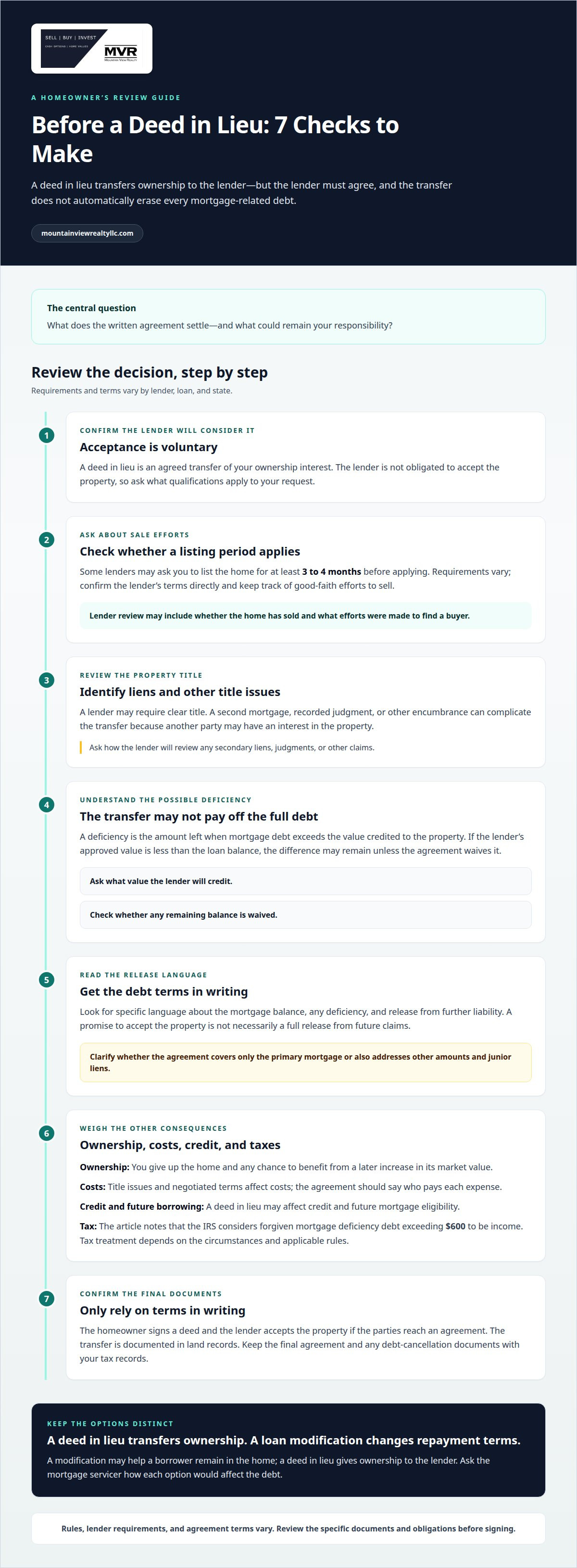
Each lender sets its own qualifications for reviewing a deed-in-lieu request. Ask your lender what it requires; some lenders may ask homeowners to list the property for at least 3 to 4 months before applying. Requirements vary by lender and loan, so confirm the applicable terms directly.
Title matters, too. A lender may require clear title, without secondary liens, judgments, or other encumbrances. A second mortgage or recorded judgment can complicate the transfer because another party may have an interest in the property. The lender can explain how it will review the home and its title.
Reasons Lenders May Accept a Request
A lender may consider a deed in lieu when mortgage payments have become unmanageable and the home has not sold. Accepting the property can give the lender ownership without continuing through foreclosure. Depending on the circumstances, foreclosure may involve court proceedings, legal fees, and court costs; a negotiated transfer may offer a more direct resolution.
Cooperation can also help make the arrangement workable. A homeowner who has made good-faith efforts to sell and can transfer clear title may present a clearer path for the lender to take ownership. The lender still weighs the property and agreement terms. Acceptance is voluntary, not an automatic right.
Reasons Lenders May Reject a Request
A lender can reject the request because it is not obligated to accept the property. Unresolved secondary liens, judgments, or other title encumbrances can complicate a clear transfer. If the lender has a listing-period requirement, a shorter period may affect its review, particularly if the homeowner has not shown a good-faith effort to find a buyer. Ask the lender which requirements apply to your request.
The lender may also decide that the proposed agreement does not resolve its concerns about the property or the debt. If the parties cannot agree on the transfer terms or how to handle remaining liability, the request may not proceed. Get the lender’s decision and terms in writing before signing documents or relying on a proposed resolution.
For Albuquerque homeowners, the central questions are whether the lender will accept the home and what the written agreement settles. Weigh the loss of ownership against the specific debt relief offered, and consider how the transfer fits your next housing plans.
Mortgage debt and possible deficiency balance
A deed transfer and mortgage payoff are related, but they are not automatically the same thing. The borrower’s remaining mortgage debt depends on the written agreement, the lender’s approved property value, and any release the lender grants. Without a clear release, transferring the home may leave a balance to resolve.
How a deficiency balance can remain
A deficiency is the amount left when the mortgage debt exceeds the value credited to the property. For example, if the lender’s approved value is less than the loan balance, the difference may remain a debt unless the agreement waives it. Look for specific language addressing both a deficiency and any further liability.
Junior liens create another issue. A borrower may remain responsible for debts secured by a second mortgage or another junior lien, even after transferring the home. The deed-in-lieu agreement should clarify which obligations the lender releases and which may remain. A general promise to accept the property is not the same as a full release from future claims.
What to settle in the agreement
Before signing, review the proposed terms for the mortgage balance, any deficiency, and the lender’s release. If the lender agrees to waive a remaining balance, get the waiver in writing. The signed documents should identify whether the settlement covers only the primary mortgage or also addresses other amounts tied to the loan.
Financial hardship can make it difficult to keep up with mortgage payments, but a deed in lieu is not the only option to discuss. A loan modification may change the loan terms and help a borrower remain in the home. The key difference is that a modification addresses repayment, while a deed in lieu transfers ownership. Ask the mortgage servicer to explain how each option affects the debt.
Tax treatment of forgiven debt
Forgiven mortgage debt can have tax consequences. The IRS considers forgiven mortgage deficiency debt exceeding $600 to be income. That does not, by itself, explain the tax result for every borrower or settlement; the treatment can depend on the circumstances and applicable tax rules.
Keep the final agreement and any debt-cancellation documents with your tax records. A tax professional or attorney can assess how the specific release and forgiven amount may affect your return. Do not assume that a lender’s written waiver also settles tax obligations. The debt agreement and tax treatment are separate matters, and both deserve attention before the transfer is complete.
Credit-report and mortgage-eligibility effects
A deed in lieu can affect your credit record and plans to buy another home. The credit reporting entry and the lender’s written resolution of the debt are separate parts of the outcome.
Credit-Report Effects
A foreclosure can remain on a borrower’s credit report for 7 years, according to the Federal Trade Commission. A deed in lieu also affects credit, but it may be slightly less damaging than foreclosure and may allow a borrower to buy another home sooner. Neither outcome erases the payment history that led to the transfer.
Bank of America reports deed-in-lieu transfers to major credit reporting agencies as a deed received in lieu of foreclosure on a defaulted mortgage. The entry can indicate that mortgage payments stopped and the home transferred to the lender. Review your credit reports after the transfer for accurate account status, balance information, and any reported deficiency. If the written agreement released the mortgage debt, keep that document with your records.
Credit impact can also shape everyday borrowing. A lender reviewing an application may consider the deed-in-lieu entry along with other credit information. For example, a borrower with late payments and unresolved mortgage debt may receive a different assessment from one whose agreement documents a full release. The report is one part of the picture, not a substitute for the settlement terms.
Mortgage Eligibility Effects
A deed in lieu may affect when you can qualify for another mortgage. The waiting period and approval decision depend on the mortgage program and your circumstances. A deed-in-lieu transfer may allow a new purchase sooner than foreclosure, but it does not guarantee eligibility or a specific approval date.
Before planning a purchase, identify the transfer date, the status of the mortgage debt, and whether the lender granted a full release. Then review your current credit report to see how the account is reported. These details help frame conversations about future financing and prevent assumptions based only on the date you left the home.
Payment history after the transfer also matters to your broader financial profile. Consistent payments on remaining accounts can demonstrate responsible credit use, while unresolved deficiency debt can complicate your financial picture. Keep copies of the deed-in-lieu agreement, release documents, and lender correspondence together. If a credit report conflicts with those records, dispute the specific entry with the reporting agency and provide relevant documentation.
For Albuquerque homeowners weighing a future move, separate two questions: what the credit report shows and what a mortgage program will allow. The first concerns reported account history; the second concerns eligibility criteria. Understanding both can help you set a realistic path toward purchasing again without assuming that the deed alone determines the result.
Definition of a deed in lieu of foreclosure
A deed in lieu of foreclosure is an agreement in which a homeowner transfers real estate ownership to the mortgage lender. The transfer is voluntary, and the lender must agree to accept the property. It can give a borrower facing financial hardship a way to avoid the foreclosure process. The homeowner gives up the home, so the decision affects both housing plans and finances.
The deed records a change in ownership, not an ordinary home sale. Instead of transferring the property to a buyer for a purchase price, the homeowner signs documents transferring it to the lender. The lender then takes ownership under the agreement. The transfer is documented in land records, so it is not entirely private, even if the parties see it as a more cooperative resolution than foreclosure.
The phrase “in lieu” means the transfer is offered instead of continuing through foreclosure. In foreclosure, the lender uses legal channels to regain control of the property. A deed in lieu depends on the lender accepting the homeowner’s proposed transfer. That difference matters: a homeowner cannot make the lender accept the deed simply by signing a document or giving up possession.
The deed and the mortgage balance are related, but they are not automatically the same. For example, the home may transfer to the lender while some mortgage debt remains, depending on the agreement. A full release must specify whether the borrower remains liable for a deficiency. The signed documents should explain what happens to the loan, any remaining balance, and other obligations tied to the property.
A deed in lieu also differs from a short sale. In a short sale, the home is sold to a buyer, and the lender may accept the sale proceeds under negotiated terms. In a deed in lieu, ownership transfers directly from the homeowner to the lender. Both options involve the home and mortgage debt, but the transfer process differs. The lender’s written agreement defines what the deed resolves.
In practical terms, this is a property transfer with financial consequences, not a simple handover of keys. The homeowner gives up ownership, the lender accepts the deed, and land records document the transfer. The agreement determines whether the remaining mortgage balance is released. Understanding these separate elements helps clarify what the deed changes and what it leaves unresolved before signing.
How a deed in lieu of foreclosure works
The process starts with a request to the mortgage lender or servicer. A homeowner facing hardship can ask about a deed in lieu before foreclosure proceedings begin. The lender may discuss other ways to address missed payments, including options that could let the homeowner stay in the home. The deed transfer can proceed only if the lender agrees.
The lender reviews the property and the proposed transfer. A listing history can matter: some lenders may ask the homeowner to try to sell the home for 3 to 4 months, but requirements vary by lender and agreement. The lender may also require clean title, without secondary liens, judgments, or other encumbrances. These factors help determine whether the lender can take ownership.
If the lender is willing to proceed, both sides work through the agreement. The terms should explain what happens to the mortgage debt, whether the borrower receives a full release, and whether any deficiency is waived. Read those provisions closely. The word “accept” alone does not explain whether the agreement releases all financial liability.
Once the parties finalize the agreement, the borrower signs and transfers the deed to the lender. The deed documents the change in ownership, and the transfer is recorded in land records. This is the central step: the homeowner voluntarily gives up the property, and the lender accepts ownership under the agreed terms.
Moving arrangements also belong in the timeline. The agreement may allow up to 30 calendar days to relocate, but the period depends on the agreement and applicable rules. Some lenders offer relocation assistance through private programs sometimes called “cash-for-keys.” The terms and timing should be written into the agreement rather than assumed.
The practical takeaway is to treat the deed, debt release, and move-out terms as separate parts of one negotiated resolution. Before signing, make sure the written agreement explains what happens to the mortgage balance and any remaining liability. If the lender rejects the request, ask about other loss-mitigation options. A deed in lieu is voluntary and does not replace every possible solution.
Mountain View Realty
Mountain View Realty LLC helps Albuquerque homeowners consider home-sale options alongside a deed-in-lieu discussion. A sale may be worth exploring if you want to understand alternatives before transferring ownership to a lender. The right path depends on your priorities, the property, and the lender’s position.
A deed in lieu requires the lender’s acceptance. Real estate sale options follow a different path: they involve selling or transitioning the home rather than transferring it directly to the lender. Mountain View Realty LLC helps sellers assess these options and how each may fit their housing plans. The lender’s written agreement still determines what happens to mortgage debt.
For homeowners weighing a sale, available options include:
- CashOffer+: A cash-offer option to consider as you evaluate a sale.
- Home Trade-In: An option for homeowners considering a transition to another home.
- Renovate & Sell: A path to consider when preparing a home for sale involves renovation.
These options address different selling priorities. For instance, a homeowner focused on moving to another property may explore Home Trade-In, while a seller considering improvements may look at Renovate & Sell. CashOffer+ offers another route to consider, with an off-market cash offer and no repairs, cleaning, or showings required. These are real estate options, not lender approval or a promise to forgive mortgage debt.
It can make sense to speak with a real estate professional while reviewing a lender’s proposed terms or considering a sale. A conversation can help clarify your home-sale priorities and which available path aligns with them. Keep the lender’s agreement central to any deed-in-lieu decision, especially its terms for mortgage debt and release from liability. A real estate sale strategy can inform your housing decision, but it does not replace legal or tax guidance about debt consequences.
For sellers in Albuquerque, Rio Rancho, Santa Fe, Corrales, and nearby communities, the decision may involve both the home and the next move. Mountain View Realty LLC can discuss the available selling approaches and help you think through how each relates to your priorities. There is no need to treat one option as right for every homeowner. The useful next step is a clear conversation about your property and the sale path you’re considering.
Choose a Next Step That Fits Your Plans
Understanding what a deed in lieu of foreclosure means can help you make a more deliberate housing decision. Next, consider what you want from the home and how a sale or move might fit your plans. If you’re weighing a sale, Mountain View Realty offers CashOffer+, Home Trade-In, and Renovate & Sell as different paths to consider.
These real estate options do not replace the lender’s decision or determine how mortgage debt is treated. They can help you explore choices for the property while keeping your broader plans in view. A thoughtful conversation can focus on your priorities, whether you are considering a sale, preparing the home, or planning a transition.
You do not need to have every decision settled before discussing your next move. Start with the outcome you hope to achieve, then consider which path best supports it. The right plan should reflect your circumstances and provide a clearer way forward.
A considered next step can help you move forward with greater clarity and confidence.
Frequently Asked Questions
What is a deed in lieu of foreclosure?
It’s a lender-approved resolution involving a homeowner’s property and mortgage default. The deed transfer and the loan’s status are separate records and decisions. For example, a property transfer may appear in land records while the lender reports the mortgage account separately. Understanding both helps you avoid assuming that a change in ownership ends every related obligation.
How does a deed in lieu of foreclosure work?
The homeowner begins by contacting the mortgage servicer, ideally before foreclosure proceedings start. The servicer can explain whether other options might let the homeowner stay in the property. This early conversation matters if staying is the homeowner’s priority. Asking about a deed in lieu does not commit either party; the homeowner and lender still need to agree on the proposed resolution.
What are the eligibility requirements for a deed in lieu of foreclosure?
Eligibility depends on the lender’s review and the homeowner’s circumstances. A HUD-approved housing counseling agency can help homeowners understand available choices and plan next steps. This may be useful when comparing a transfer with options that could preserve homeownership. A counselor can also help organize questions about the lender’s review, so the homeowner understands what each proposed path means.
What steps are involved in completing a deed in lieu of foreclosure?
Alongside reviewing the lender’s documents, clarify the move-out arrangements before finalizing plans. Ask the lender or servicer whether relocation-expense assistance is available through a private program sometimes called “cash-for-keys.” Treat that as a separate question from the property transfer and loan terms. Discussing move-out expectations early can help your household plan its next housing arrangements.
How does a deed in lieu compare with foreclosure, a short sale, and loan modification?
Chapter 13 bankruptcy is another possible route for some homeowners facing missed payments. An eligible homeowner may use a repayment plan to catch up on late mortgage payments while continuing regular house payments. That approach focuses on keeping the home, unlike options centered on transferring or selling it. The available path depends on the homeowner’s situation, so compare the intended outcome, not just the names of the options.
What happens to a mortgage deficiency after a deed in lieu of foreclosure?
Ask for the lender’s final accounting and keep it with the signed settlement papers. This gives you a record of how the account was closed and what amount, if any, the lender says remains. If later correspondence conflicts with the agreement, these records can help identify the precise issue. Keep lender notices and account statements together with the deed documents for future reference.
How does a deed in lieu affect credit scores and future homebuying?
For federally backed mortgages, the research provided states that the Federal Home Loan Administration instructs issuers to disqualify applicants whose deeds in lieu are less than four years old. This makes the transfer date relevant when considering a future purchase. Keep a copy of the recorded deed and completion documents, since a future mortgage application may require a clear account of the prior housing event.
What are the risks and tax consequences of a deed in lieu of foreclosure?
Besides debt and credit effects, consider the practical cost of leaving the property and arranging another place to live. Ask the servicer whether relocation assistance through a private “cash-for-keys” program is available, and clarify any move-out terms in writing. Forgiven debt can also raise tax questions. Keep the completed settlement records organized so a tax professional can review the transaction details.

Article by
Robb Krautbauer
Robb Krautbauer is the Owner and Qualifying Broker of Mountain View Realty, serving Albuquerque, Rio Rancho, Santa Fe, and surrounding New Mexico communities. With more than a decade of real estate experience, Robb specializes in luxury homes, strategic home marketing, and helping homeowners navigate important life transitions with confidence.
Known for combining luxury-level marketing, AI-powered technology, and innovative selling strategies, Robb helps clients maximize their home's value while creating a smooth, personalized selling experience. Whether assisting luxury homeowners, retirees, families downsizing, or real estate investors, his focus is always on delivering expert guidance, honest advice, and exceptional results.
When he's not helping clients achieve their real estate goals, Robb enjoys studying market trends, emerging technology, and investment strategies that keep Mountain View Realty at the forefront of the industry.
Disclaimer
**Disclaimer:** The information provided in this article is for general educational purposes only and should not be considered legal, tax, financial, or professional advice. Real estate laws, market conditions, and regulations change over time and may vary based on your individual circumstances. Before making any real estate decision, consult with qualified legal, tax, or financial professionals. If you have questions about buying or selling real estate in New Mexico, contact Mountain View Realty for guidance specific to your situation. © 2026 Mountain View Realty. All rights reserved. The content on this website may not be reproduced without written permission.


