
Gift of Equity When Selling to a Relative: How Price and Taxes Work
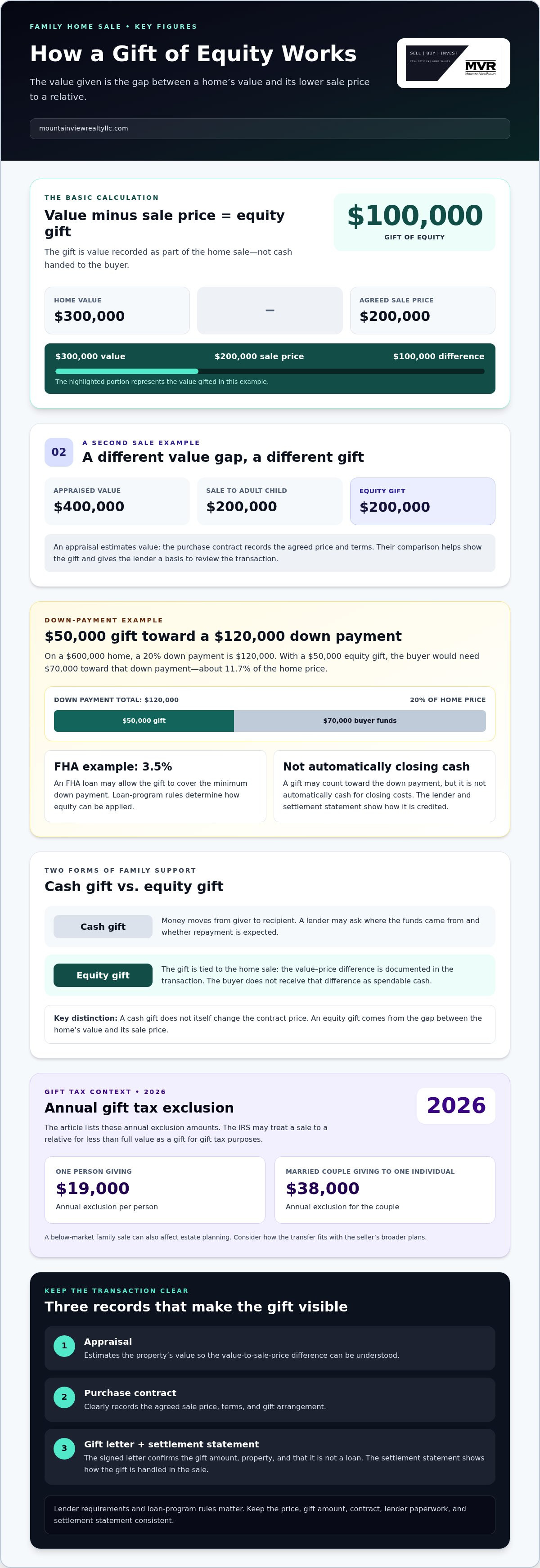
If you sell a home worth $300,000 to a family member for $200,000, the $100,000 difference can be treated as a gift of equity when selling to a relative. The gift can help the buyer meet down-payment requirements without receiving that amount as cash. The sale price, gift amount, and loan details all matter.
A gift of equity when selling to a relative can help keep a home in the family, but tax and paperwork questions may make the arrangement feel complicated. Understanding how the gift is calculated is a useful first step.
This guide explains how the sale price and equity gift fit together, how gift tax and estate planning may come into play, and what a gift letter and settlement statement do. You’ll get a clearer picture of the decisions to discuss as you plan a family sale.
Key Takeaways
- Compare the home’s appraised value with the agreed sale price to understand how much equity is being gifted.
- Equity applied to the purchase differs from cash given directly to a relative, and the distinction can affect the transaction paperwork.
- The IRS may treat a sale below full value as a gift for gift tax purposes, so consider how the transfer fits into broader estate planning.
- For 2026, the annual gift tax exclusion is $19,000 per person or $38,000 for a married couple giving to one individual.
- A signed gift letter and a settlement statement documenting the gift help show how the equity is handled in the sale.
What Is a Gift of Equity?
A gift of equity is the difference between a home’s value and its lower sale price to a relative. In one example, a homeowner sells a $300,000 home for $200,000, giving the buyer $100,000 in equity.
The equity isn’t cash handed to the buyer. It’s recorded as part of the home sale and can reduce the amount the relative needs to bring to the transaction. A gift of equity when selling to a relative can also affect the appraisal, purchase contract, mortgage approval, and tax treatment.
Appraisal and Contract Requirements
An appraisal estimates the property’s value, while the purchase contract records the agreed sale price and terms. The comparison helps show the equity being gifted and gives the lender a basis for reviewing the transaction. For example, if a home appraises at $400,000 and sells to an adult child for $200,000, the gift is $200,000. The contract should clearly reflect the agreed price and gift arrangement.
Lender and Loan Program Rules
Gift-of-equity financing may be available with conventional, adjustable-rate, FHA, and VA loans. The program matters because its rules determine how the equity can be applied and what the lender needs for approval. An FHA loan may allow the gift to cover the minimum 3.5% down payment. A buyer may also need to provide documents such as one year’s worth of tax returns during mortgage approval.
The gift can count toward the buyer’s down payment, but it is not automatically cash for closing costs. The lender’s requirements and the settlement statement show how the gift is credited in the transaction. For example, a $600,000 home has a 20% down payment of $120,000. A $50,000 equity gift would leave the buyer needing $70,000, about 11.7%, toward that down payment.
Risks of Below-Market Family Sales
A below-market sale can create tax, financing, and family-planning complications if the price and gift aren’t clearly documented. The Internal Revenue Service says a property sale to a relative for less than its full value may be considered a gift for gift tax purposes. An appraisal that differs from the family’s expected value can also change the calculated equity and affect the buyer’s loan review.
Families can keep the transaction clear by agreeing on the price, arranging an appraisal, documenting the gift in the contract, and coordinating the lender’s paperwork and settlement statement. A $100,000 difference between value and sale price, for example, should be consistently reflected in the transaction records. Clear terms also help relatives understand the financial arrangement before the sale closes.
Differences between equity gifts and cash gifts
A cash gift transfers money to a relative; an equity gift transfers value through a home sale. For example, a parent might give an adult child funds separately or sell them a home below its value and treat the difference as gifted equity. Both approaches provide financial help, but they’re handled differently in the transaction.
With cash, the buyer receives money to use according to the gift terms and lender requirements. With equity, the seller and buyer agree on a sale price, and the difference between that price and the home’s value represents the gift. The buyer doesn’t receive that difference as spendable cash. Instead, it may reduce the funds needed for the purchase.
The distinction can affect mortgage paperwork. For a cash gift, a lender may require documentation showing where the funds came from and whether repayment is expected. For an equity gift, the settlement statement should list the gift, and a signed letter should confirm its amount, the property, and that it isn’t a loan. These records clarify the source and purpose of the support.
- Cash gift: Money moves from the giver to the recipient, with the transfer documented as required for the purchase.
- Equity gift: The gift is tied to the home sale and reflected in the transaction paperwork.
- Purchase price: Cash assistance doesn’t itself change the contract price; an equity gift arises from the gap between value and sale price.
- Buyer’s funds: Either type may support a buyer, but the lender’s rules and closing documents shape how the funds count.
Consider two ways a relative might help with a purchase. In one, the buyer receives money separately and brings it into the transaction as the lender allows. In the other, the seller sets a lower price and documents the equity gift as part of the sale. The second approach ties the help directly to the property; the first keeps the money transfer separate from the seller’s price decision.
Neither structure should be treated as an informal family favor. Before agreeing, relatives can decide whether the support should reduce the contract price or arrive as separate funds, then align the contract and lender paperwork with that choice. If you’re weighing a family transfer alongside broader New Mexico home sale planning, clear records can help keep the transaction understandable for everyone involved.
That difference can be easier to see in a down-payment example: a 10% gift of equity can reduce the buyer’s required cash down payment to 10% when the lender requires 20% down. The gift still comes through the sale rather than as cash handed to the buyer, so the parties should make sure the transaction documents show how it is being applied. A buyer comparing the options can ask the lender how each form of help will be treated before settling on a price or arranging a separate transfer.
Estate planning and keeping property in the family
A family home can have personal meaning as well as practical value, so consider what you may need after transferring it. For example, a seller moving from an Albuquerque home should weigh how the sale affects available funds, housing plans, and timing. These priorities can help determine whether a reduced-price sale supports the seller’s broader plans.
Start by identifying what you want to retain control over. Do you want to leave the home soon, stay involved in decisions, or make a clean transition to the new owner? Naming your preference helps frame discussions with your relative and the professionals advising you. It also clarifies whether the arrangement fits your next stage of life.
Consider how your plans might change. A seller expecting to relocate may later need a different timeline or more flexibility, while a relative planning to live in the home may have different expectations. Discussing these possibilities before settling on terms helps both parties understand what they’re agreeing to, rather than assuming family closeness will resolve practical questions later.
- Define your priorities: Write down your goals for timing, future housing, and the role you want after the transfer.
- Consider changing needs: Identify what might affect your decision, such as a delayed move or a change in the buyer’s plans.
- Separate personal hopes from transaction terms: Be clear about which expectations belong in the sale agreement and which are broader family intentions.
- Review the plan as a whole: Consider how the transfer fits with your other financial and estate-planning goals.
For instance, a homeowner may want a relative to live in the family home while also needing proceeds to support a future move. Those goals can conflict. Thinking through both before agreeing on a sale structure gives the seller a clearer basis for deciding how much flexibility to preserve.
Before finalizing the plan, write a brief summary of the decision. Include the purpose of the transfer, the seller’s next housing goal, and the expectations that matter most to both parties. Use it to guide conversations with the professionals involved in the estate plan and sale. This keeps the family’s broader intentions in view as everyone considers the practical choices ahead.
Gift tax exclusions and gift tax returns
In 2026, the annual gift tax exclusion is $19,000 per person, per recipient. A married couple can give one recipient up to $38,000 under that exclusion. These amounts matter when a home sale includes a gift, because the equity transferred may exceed the applicable exclusion. The exclusion is not a home-price limit. It is an annual gift amount for an individual recipient.
For a gift of equity, the person transferring the property must file a gift tax return. Filing documents the gift; it doesn’t mean the buyer received cash. Transaction records should show the home, agreed sale price, and equity treated as a gift. Keep the appraisal, contract, and settlement statement together so the transfer can be understood in the context of the sale.
For example, consider an equity gift of $50,000 to one recipient in 2026. That amount is greater than the $19,000 annual exclusion for one person, or the $38,000 exclusion available to a married couple giving to that recipient. The comparison helps explain why the transferor’s reporting obligation matters. It does not, by itself, establish what tax is owed.
For the seller, the gift tax return and the sale’s income-tax records address different parts of the transaction. Capital gains depend on the seller’s tax basis and sale details, not just the equity gift amount. For the buyer, the gift may reduce the funds needed for the purchase, while the buyer’s cost basis requires separate tax consideration. The gift amount alone doesn’t determine either party’s final tax result.
To understand the records and questions involved, separate the transfer into these parts:
- Gift amount: Document the equity value being transferred and the recipient.
- Annual exclusion: Compare the gift with the 2026 limit of $19,000 per person or $38,000 for a married couple giving to one recipient.
- Gift tax return: The property transferor files a return for a gift of equity.
- Sale and tax records: Preserve the contract, settlement statement, and records relevant to the seller’s basis and buyer’s acquisition.
Keep the sale price, gift amount, and property records consistent to make tax discussions clearer. For instance, if the settlement statement identifies equity as a gift, the transferor’s reporting should reflect the same transaction. The buyer and seller can then review cost basis and capital-gains questions using their own records, rather than treating the annual exclusion as a complete tax calculation.
Gift-of-equity letters and settlement statements
Use the closing paperwork to distinguish each part of the family sale. The transaction may include the agreed price, buyer financing, equity contribution, and other closing charges. Reviewing these items separately helps relatives understand how the final figures fit together, rather than seeing the closing total as one unexplained amount.
State and local transfer taxes, recording fees, and property tax assessments are separate from the equity gift. Their application depends on the transaction and the rules that apply to the property. Closing figures should list these charges separately from the gifted equity, so the family can distinguish transaction costs from the value transferred.
As the figures take shape, compare the draft settlement statement with the purchase contract and the lender’s transaction figures. Check that the agreed price, buyer financing, and credits are represented consistently. If a figure changes during the process, make sure the revised version reflects the updated terms before signing. This review reconciles the transaction without changing the family’s agreed intent.
- Separate the categories: Distinguish the purchase price, equity contribution, loan funds, and closing charges.
- Compare current versions: Review the latest closing figures against the signed contract and financing terms.
- Resolve differences: Identify any amount that appears inconsistent and have the closing paperwork updated to match the final agreement.
- Keep the final record: Retain the signed closing documents with the family’s home-sale records.
For example, if the buyer’s financing changes after the initial closing figures are prepared, the final statement should reflect the transaction as it will close. Review the updated figures together so everyone understands which amounts relate to the sale, financing, and other charges. This can prevent confusion about what the buyer pays and what the seller receives.
In an Albuquerque family sale, don’t confuse local transaction charges with the equity being transferred. Reviewing each line item separately gives the seller and buyer a clearer view of closing and creates a useful record of the completed sale. Keep the final record with the contract and other property documents.
Mountain View Realty: CashOffer+
Mountain View Realty LLC’s CashOffer+ gives sellers another home-sale path to consider if a family transfer isn’t the right fit. A gift of equity depends on a buyer who is a relative, an agreed sale price, and the transaction’s financing and documentation. If those elements don’t align with your goals, compare a family sale with selling through CashOffer+.
The right choice depends on what matters most to you, such as keeping the home in the family or considering another selling approach. Mountain View Realty LLC can help you review options, including CashOffer+, Home Trade-In, Renovate & Sell, and Short Sale, in light of your priorities.
Contact Mountain View Realty LLC to discuss your home-sale options.
Choose a Family-Sale Plan That Fits
A home transfer can mean more than the sale itself. Before deciding, consider what you want the arrangement to accomplish for both the seller and the relative buying the home. A clear plan can help align the financial terms with family expectations.
If a gift of equity when selling to a relative feels right, take time to consider the practical and personal sides together. You can explore another selling approach if your priorities change. Mountain View Realty offers options including CashOffer+, Home Trade-In, and Renovate & Sell, giving sellers different paths to consider.
A thoughtful conversation can help you identify the next step for your home and family. You don’t need every detail settled before asking for guidance.
With a plan shaped around your priorities, you can move forward with greater clarity and confidence.
Frequently Asked Questions
What is a gift of equity when selling a home to a relative?
A gift of equity lets a seller help a relative buy a home by transferring part of the property’s value through the sale. It can make a family purchase more accessible without giving the buyer cash to spend elsewhere. Before agreeing, consider whether the arrangement supports both relatives’ goals for the home and fits the buyer’s financing plan.
How is a gift of equity calculated and documented?
Calculate the gift by comparing the home’s appraised value with the agreed sale price. For clear records, make sure the appraisal and contract describe the same property and reflect the family’s agreement. The lender’s final figures should also align with the transaction. Reviewing these records together can help relatives spot inconsistencies before closing and clarify how the buyer’s purchase is structured.
What are the IRS gift tax rules and annual exclusion for gifts of equity in 2026?
For 2026, the annual gift tax exclusion is $19,000 from one person to one recipient, or $38,000 from a married couple to one recipient. The person transferring the property must file a gift tax return for a gift of equity. Filing a return documents the transfer; it doesn’t by itself mean gift tax is owed. Keep the return information consistent with the sale records.
What documents are required for a gift of equity mortgage?
A mortgage file may include the appraisal, purchase contract, signed gift letter, settlement statement, and buyer’s tax returns. The lender uses these records to understand the property’s value, agreed terms, and the buyer’s financial profile. Keep current copies together so the buyer can provide a coherent file during mortgage review. If the sale terms change, align the transaction documents with the final agreement.
How does a gift of equity affect the home’s sale price, appraisal, and loan-to-value ratio?
The gift doesn’t change the appraiser’s estimate or the contract price; it represents value contributed through the family sale. Loan-to-value compares the mortgage amount with the property value used in the lender’s calculation. A smaller loan relative to that value results in a lower ratio. The buyer’s loan program and the lender’s valuation determine how the figures factor into mortgage review.

Article by
Robb Krautbauer
Robb Krautbauer is the Owner and Qualifying Broker of Mountain View Realty, serving Albuquerque, Rio Rancho, Santa Fe, and surrounding New Mexico communities. With more than a decade of real estate experience, Robb specializes in luxury homes, strategic home marketing, and helping homeowners navigate important life transitions with confidence.
Known for combining luxury-level marketing, AI-powered technology, and innovative selling strategies, Robb helps clients maximize their home's value while creating a smooth, personalized selling experience. Whether assisting luxury homeowners, retirees, families downsizing, or real estate investors, his focus is always on delivering expert guidance, honest advice, and exceptional results.
When he's not helping clients achieve their real estate goals, Robb enjoys studying market trends, emerging technology, and investment strategies that keep Mountain View Realty at the forefront of the industry.
Disclaimer
**Disclaimer:** The information provided in this article is for general educational purposes only and should not be considered legal, tax, financial, or professional advice. Real estate laws, market conditions, and regulations change over time and may vary based on your individual circumstances. Before making any real estate decision, consult with qualified legal, tax, or financial professionals. If you have questions about buying or selling real estate in New Mexico, contact Mountain View Realty for guidance specific to your situation. © 2026 Mountain View Realty. All rights reserved. The content on this website may not be reproduced without written permission.


