
How a Real Estate Agent Supports You Through a Home Purchase
A buyer’s real estate agent represents your interests throughout a home purchase. To understand what a real estate agent does for a buyer, start with the practical work: finding homes that fit your needs, arranging showings, explaining local market conditions, and guiding you through offers and closing paperwork. The agent helps you make informed decisions at each stage.
Buying a home can mean weighing unfamiliar decisions, from assessing a property’s condition to understanding an offer. A knowledgeable guide can bring structure to the process while keeping your priorities at the center.
This article explains how buyer-agent representation works, how an agent can help you search for and assess homes in the Albuquerque area, and what support may look like from the first showing through closing. You’ll also learn how an agent connects the details of a transaction so you can move forward with greater clarity.
Key Takeaways
- A buyer’s agent represents your interests and can help shape an offer around price, repairs, contingencies, and concessions.
- Representation includes more than advice: understand the agreement’s terms and how the agent will support you through the purchase.
- From offer paperwork to closing, an agent can help coordinate key steps and keep transaction details organized.
- Use your priorities to focus the home search, arrange showings, and assess how each property fits your needs.
- Local market and neighborhood insight can help you weigh a home’s condition, likely repairs, and surrounding area as you compare options.
What Does a Real Estate Agent Do?
To understand what a real estate agent does for a buyer, consider how the agent helps translate your priorities into purchase terms. The work can include preparing an offer, reviewing nearby sale prices, and communicating proposed terms to the seller. A buyer’s agent can also help you weigh a property’s drawbacks alongside its appealing features, giving you more context before you decide what to request or where to compromise.
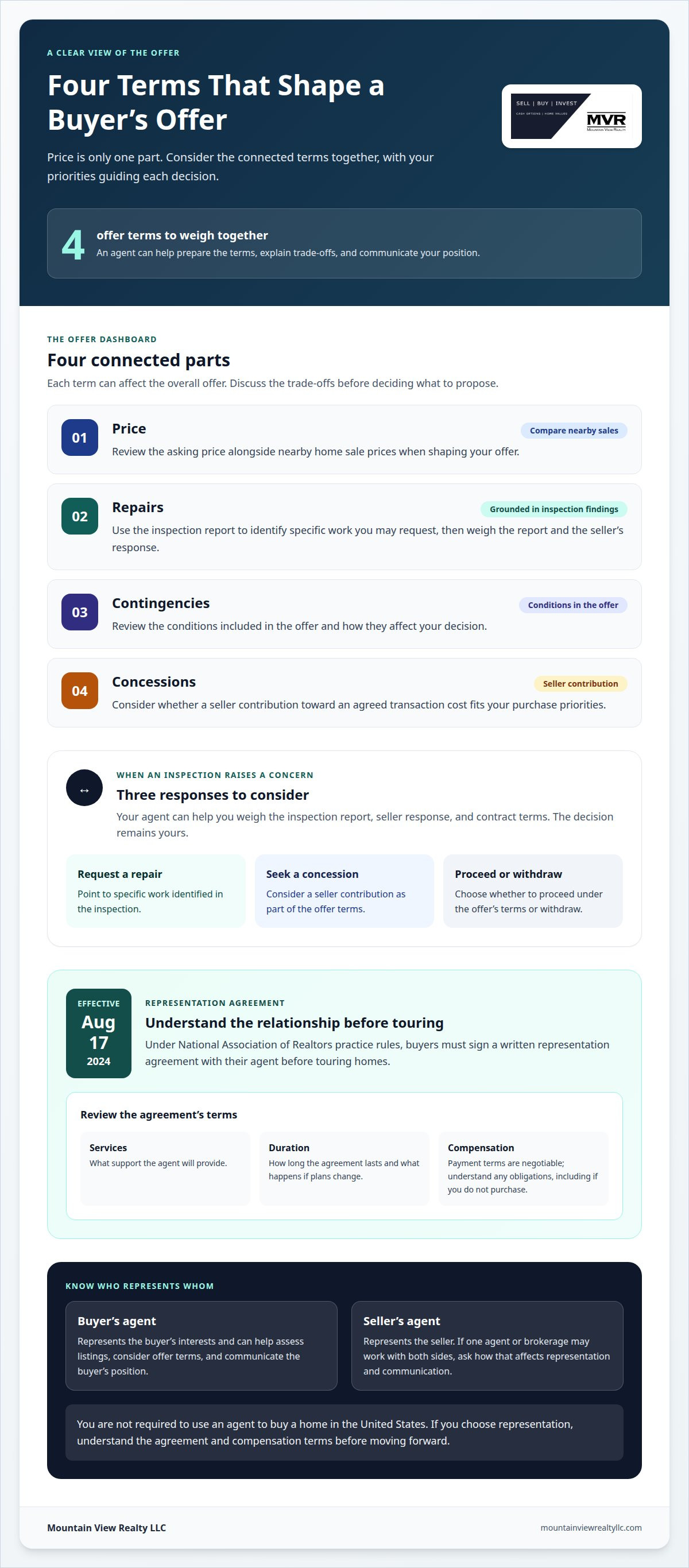
Negotiation can involve several parts of an offer, not just its price. For example, an agent may help you consider repair requests after an inspection, contingencies tied to contract conditions, and seller concessions. A concession could address an agreed transaction cost. Each request affects the overall offer, so discuss the trade-offs with your agent before deciding what to propose.
Offer preparation puts those terms in writing. Your agent can help prepare an offer that sets out the proposed price, timing, contingencies, and concessions. If an inspection report raises concerns, the agent can help you consider a response, such as requesting repairs or withdrawing the offer. The report and contract terms give you specific information to weigh before choosing your next step.
- Price: Compare the asking price with nearby home sale prices when shaping an offer.
- Repairs: Use inspection findings to identify specific work you may request.
- Contingencies: Review the conditions included in the offer and how they affect your decision.
- Concessions: Consider whether a seller contribution fits your purchase priorities.
Buyer-agent compensation is another term to understand early. The National Association of Realtors states that real estate commissions are negotiable. Sellers have often paid commissions for both the listing agent and buyer’s agent, according to the National Association of Realtors. The parties can negotiate payment terms, so review your representation agreement and understand the compensation arrangement before making an offer.
The National Association of Realtors defines a Realtor as a licensed real estate agent who belongs to its organization. In New Mexico, the New Mexico Real Estate Commission explains the state’s broker and associate broker framework. Understanding the brokerage relationship helps clarify who supervises the transaction and how the agent’s role fits within that structure.
Consider a home where an inspection identifies a repair concern. Your agent can help you weigh the report, the seller’s response, and the contract terms together. You might request a repair, seek a concession, or proceed under the offer’s terms. The decision remains yours. Your agent can explain options and communicate your position while helping you keep the offer’s connected terms in view.
Buyer-agent representation and advocacy
A buyer’s agent represents your interests during a home purchase, while the seller’s agent represents the seller. The agent can help you assess whether a listing fits your priorities and explain the support they’ll provide. You make the decisions; representation gives you someone to discuss questions and options with as the transaction moves forward.
Beginning August 17, 2024, buyers must sign a written representation agreement with their real estate agent before touring homes under National Association of Realtors practice rules, according to the National Association of Realtors’ settlement guidance. Read the agreement before signing. It describes the relationship and may cover services, duration, and compensation. Those terms matter because they define what you’re agreeing to before the home search begins.
Discuss the scope of support you want. For example, clarify how the agent will communicate with you, help assess listings, and assist if you decide to make an offer. Ask how long the agreement lasts and what happens if your plans change. The National Association of Realtors explains that compensation is negotiable and agreements can vary. Review the specific terms so you understand any payment obligations, including what applies if you don’t purchase a home.
The buyer’s agent and listing agent have different roles: one works with the buyer, while the other represents the seller. If one agent or brokerage may work with both sides, ask how the arrangement affects representation and communication. The agreement and applicable state rules define the agent’s role. Understanding that relationship helps you know whose interests the agent represents and how information will be handled.
The benefits of using a buyer’s agent include personalized search support, market context, and help communicating your position to the seller. The drawbacks can include agreement obligations and compensation terms you should understand before touring or making an offer. You’re not required to use an agent to buy a home in the United States.
Representation also gives you someone to help organize decisions. Imagine a seller responding to your offer with different terms. Your agent can explain what changed and help you consider the response against your priorities. The agent can communicate your position, while you decide whether to proceed, revise the offer, or step away.
Before signing, make sure you can explain the agreement’s services, duration, and compensation terms in your own words. Understanding these details at the start helps you set expectations for the working relationship and make informed choices as your search develops.
Contract paperwork and transaction coordination
A buyer’s agent can help coordinate inspections, make sense of appraisal information, and guide you through closing steps. The Consumer Financial Protection Bureau’s homebuying resources explain how inspections, appraisals, and closing fit into a purchase.
Purchase Paperwork and Deadlines
Purchase paperwork records the offer, agreed terms, and contract dates that shape the transaction. Those dates matter because they affect when you need to respond or complete a contract step. Your agent can help you track the dates written into your documents and organize questions before a response is due. The National Association of Realtors’ homebuyer guidance also describes an agent’s role in the buying process.
Keep copies of signed documents, inspection reports, and written communications together. If an inspection raises a concern, refer to the report and relevant contract language when discussing next steps. Your agent can help connect those details and communicate your decision to the seller’s side.
Escrow and Closing Support
Escrow and closing support involves coordinating paperwork and communication as the purchase moves toward completion. The CFPB explains that closing involves reviewing documents and completing the home purchase. Your agent can help you track questions, identify documents that need attention, and understand how each task fits into the transaction.
A title search checks whether the seller has the right to sell the property. Your agent may help arrange the search and coordinate with the parties handling the transaction. This is separate from an inspection, which reviews the home’s physical condition. Keeping the tasks distinct helps you understand what each report or record addresses.
Inspections provide information about a property’s condition. After the buyer and seller enter an agreement of sale, an agent can arrange a professional inspection of the foundation, plumbing, heating, cooling, and electrical systems. An agent may also schedule termite, radon, or mold inspections. The CFPB’s homebuying resources explain how an inspection can inform a buyer’s decision.
An appraisal addresses a property’s value in the purchase and mortgage process. The CFPB describes appraisals as part of homebuying and mortgage lending. Your agent can help you understand the appraisal’s place in the transaction, organize questions, and coordinate communication about the result. The appraiser determines the valuation; your agent helps connect that information to the next steps.
As closing approaches, keep the accepted offer, inspection reports, title information, and closing documents organized. Your agent can help track outstanding questions and coordinate with the people involved in the transaction. This makes it easier to see which paperwork is complete and what still needs your attention before the purchase is finalized.
Finding homes and arranging showings
A buyer’s agent turns your priorities into a focused home search. The agent can use listing information and coordinate viewings so you can compare suitable properties efficiently.
Finding Homes That Match Buyer Needs
Finding suitable homes means filtering listings by your needs, budget, and preferred location. A clear search keeps your attention on homes that fit your purchase plans. Share practical priorities, such as required rooms, accessibility needs, preferred areas, and features you’re willing to compromise on.
An agent can use MLS listings and knowledge of listing descriptions to identify homes within your price range. MLS information may include property details or sale conditions that aren’t available to the public. An agent can narrow the options to about a dozen homes that fit your needs, giving you a manageable starting point.
Turn broad preferences into specific search criteria. For example, separate must-haves from nice-to-haves, then compare each listing against both groups. A listing’s description can guide questions about features, but the property itself matters too. Your agent can help you assess whether a home’s listed details match what you want from buying or selling decisions.
Location also shapes the search. If you’re comparing Albuquerque with Rio Rancho, identify which area better fits your daily priorities before choosing homes to view. A specific location, price range, and feature list give your agent a clearer basis for identifying relevant listings.
Arranging Home Viewings
Arranging home viewings means coordinating access to selected properties with the sellers’ agents. It matters because seeing a home lets you compare its layout and condition with the listing details. Your agent can contact the listing side, organize appointments, and help guide you through the viewing process.
Before each showing, note the property address and the features you want to assess. During the visit, compare the room layout, visible condition, and practical fit with your needs. For example, a home may match your location preference but lack a feature you consider essential. That comparison helps you decide whether it belongs on your shortlist.
After a viewing, record what stood out while the details are fresh. Note questions about the property, listing description, or association information relevant to your decision. Your agent can help gather listing details and clarify questions with the seller’s agent. This gives you a useful basis for comparing homes, rather than relying on memory alone.
When a home remains a strong candidate, discuss what you learned before taking another step. Your agent can help connect the showing to the next stage, including deciding whether to prepare an offer and reviewing the contract terms. A focused search and organized viewings make it easier to move from browsing listings to considering a specific home.
Local market and neighborhood expertise
A local agent helps you assess how a property fits its neighborhood and your priorities. In the Albuquerque area, the questions you weigh may vary by property. An agent can help you consider nearby sale prices, possible repair costs, local schools, and taxes when comparing homes. These details add context beyond a listing’s photos and description.
Market knowledge can help you interpret a home’s asking price alongside nearby sales. For example, two properties with similar features may still warrant different consideration if their locations or conditions differ. Your agent can help compare the relevant details and identify questions to explore before you decide whether a home fits your plans.
Neighborhoods also shape day-to-day suitability. Start with the places and features that matter to you, then assess each property against them. A buyer who prioritizes access to particular local schools, for instance, may weigh a neighborhood differently from someone focused on repair needs or property taxes. Your agent can help organize those factors without making the choice for you.
Condition deserves a close look as well. A property’s visible features may not reveal the full scope of potential repairs. An agent can help you consider repair costs as part of the overall decision and connect questions about condition to information from the property review. That context helps you assess the home as a whole, rather than focusing only on its appearance.
Local insight is useful when listing language leaves room for interpretation. If a description highlights an updated feature, compare it with what you observe at the property and learn through inspections. Your agent can help identify questions and explain how the answers may affect your view of the home. You decide which trade-offs feel acceptable.
A licensed real estate agent can also help you make sense of how property, neighborhood, and market information fit together. Across different Albuquerque communities, you might compare a home’s condition and taxes with your location priorities. You can apply the same thoughtful approach to every property you consider. The useful recommendation is one tied to your stated needs, not a one-size-fits-all preference.
Before choosing a home, list your priorities and compare each candidate against them. Consider location, repair costs, schools, taxes, and nearby sale information as separate factors. An agent can help you review those details, explain local context, and guide you through questions that matter to your purchase. This focused process makes it easier to judge whether a property suits your plans.
Mountain View Realty LLC: CashOffer+
Mountain View Realty LLC offers CashOffer+ as a home-sale option to consider when buying another property also means selling your current home. Your priorities can shape the path forward, whether you’re considering a cash offer, a home trade-in, or renovation support before selling.
CashOffer+ may be relevant if you want to explore a sale option alongside your next move. Mountain View Realty LLC also offers Home Trade-In, Renovate & Sell, and Sell & Stay. These options address selling decisions rather than buyer-agent tasks such as searching for homes or preparing a purchase offer.
If you’re planning a move and weighing how to sell your current home, contact Mountain View Realty LLC to discuss your options.
Make Your Next Move With Clarity
Before beginning your home search, define what matters most: the features you need, the trade-offs you can accept, and the questions you want answered. Knowing what a real estate agent does for a buyer can help you decide what guidance would be useful at each stage. An initial conversation can also clarify how you prefer to communicate and make decisions.
A thoughtful purchase is not about rushing toward the first appealing property. It’s about choosing a home with a clear view of the terms, the location, and how the decision fits your plans. Share your priorities and concerns. They can shape a more focused conversation about the path ahead.
With clear priorities and informed support, you can approach your next move with confidence and make decisions at a pace that feels right for you.
Frequently Asked Questions
What is a buyer’s agent?
A buyer’s agent is a licensed real estate professional who represents the purchaser’s interests in a home transaction. Unlike the listing agent, who represents the seller, the buyer’s agent focuses on your goals and communicates your position. For an Albuquerque buyer, that may include discussing location priorities and clarifying questions about a property. You decide whether the home and proposed terms fit your needs.
What services does a buyer's real estate agent provide?
A buyer’s agent can help organize your search, coordinate property visits, explain local market details, and support offer and closing tasks. For example, you might ask the agent to compare two homes with different layouts or identify questions to raise after reviewing property information. The agent can also coordinate communication with the seller’s side. Mortgage decisions and lending remain separate from the agent’s real estate role.
How does a buyer's agent help find and evaluate homes?
A buyer’s agent can use listing information and your priorities to identify homes worth considering. As you compare properties, weigh practical factors such as repair needs, neighborhood fit, local schools, and taxes. For example, a home with your preferred layout may need more repairs than another option. The agent can help you consider these factors together, so your shortlist reflects more than photos or asking prices.
What does a buyer's agent do during a home tour?
During a tour, assess how the property works for your daily needs. Look at room flow, visible condition, storage, and features you may need to maintain. An agent can help connect your observations with listing details and note questions for follow-up. If a feature described in the listing is unclear in person, for instance, record the question rather than relying on memory later.
How does a buyer's agent help make an offer and negotiate?
A buyer’s agent can help turn your preferred terms into a written offer and communicate them to the seller’s side. If the seller responds with different terms, the agent can explain what changed and help you consider possible responses. You decide whether to accept, counter, or decline. If an inspection report raises concerns, you can also discuss how the contract terms relate to your options.
How are buyer's agents paid in the United States?
Buyer-agent compensation is negotiable, and the terms should be clear in your written agreement. Commissions are often calculated as a percentage of the home’s final sale price, but the amount is not fixed. Sellers have traditionally paid both agents’ commissions in U.S. transactions, though payment terms can be negotiated. Before agreeing to representation, review who may pay, how compensation is determined, and what you could owe.
What is a buyer representation agreement and when is it required?
A buyer representation agreement is a written contract describing the relationship between you and your agent, including agreed services and compensation terms. Under National Association of Realtors practice rules, buyers must sign a written agreement before touring homes, effective August 17, 2024. Read its scope and duration before signing. Make sure you understand how the agreement handles compensation and what happens if your home search or plans change.

Article by
Robb Krautbauer
Robb Krautbauer is the Owner and Qualifying Broker of Mountain View Realty, serving Albuquerque, Rio Rancho, Santa Fe, and surrounding New Mexico communities. With more than a decade of real estate experience, Robb specializes in luxury homes, strategic home marketing, and helping homeowners navigate important life transitions with confidence.
Known for combining luxury-level marketing, AI-powered technology, and innovative selling strategies, Robb helps clients maximize their home's value while creating a smooth, personalized selling experience. Whether assisting luxury homeowners, retirees, families downsizing, or real estate investors, his focus is always on delivering expert guidance, honest advice, and exceptional results.
When he's not helping clients achieve their real estate goals, Robb enjoys studying market trends, emerging technology, and investment strategies that keep Mountain View Realty at the forefront of the industry.
Disclaimer
**Disclaimer:** The information provided in this article is for general educational purposes only and should not be considered legal, tax, financial, or professional advice. Real estate laws, market conditions, and regulations change over time and may vary based on your individual circumstances. Before making any real estate decision, consult with qualified legal, tax, or financial professionals. If you have questions about buying or selling real estate in New Mexico, contact Mountain View Realty for guidance specific to your situation. © 2026 Mountain View Realty. All rights reserved. The content on this website may not be reproduced without written permission.


