
How Long a Short Sale Takes in NM and What Affects Timing
A short sale is rarely quick. If you’re asking how long a short sale takes in NM, our general experience is that many take about three to six months from start to finish; each case can differ. Because the sale proceeds may not cover the mortgage balance, the lender may need to approve the sale. That review means the timeline can depend on more than finding a buyer.
It’s understandable to want a clear date, especially when you’re weighing a sale amid financial pressure or possible foreclosure. In our experience, the lender’s review, the seller’s eligibility and paperwork, and any foreclosure dates can affect the pace. If more than one lienholder must approve the sale, additional coordination may lengthen the process.
This guide explains what a short sale is and how the New Mexico process typically unfolds, from preparing the lender package to closing. You’ll learn which delays may be within the seller’s control, how lender approval fits in, and why foreclosure timing matters. Understanding each stage can help you assess whether a short sale fits your situation and what to expect.
Key Takeaways
- Many short sales take three to six months, and multiple lienholders can extend the timeline.
- Starting a short sale does not automatically stop foreclosure; the sale date needs close attention throughout the process.
- A complete lender package helps keep the review moving, while missing paperwork can delay processing.
- Negative equity and financial hardship can affect short sale eligibility, even if mortgage payments are current.
- Professional guidance can help coordinate lender communication, approvals, and the sale timeline.
Can any Real Estate Agent Handle My Short Sale Effectively?
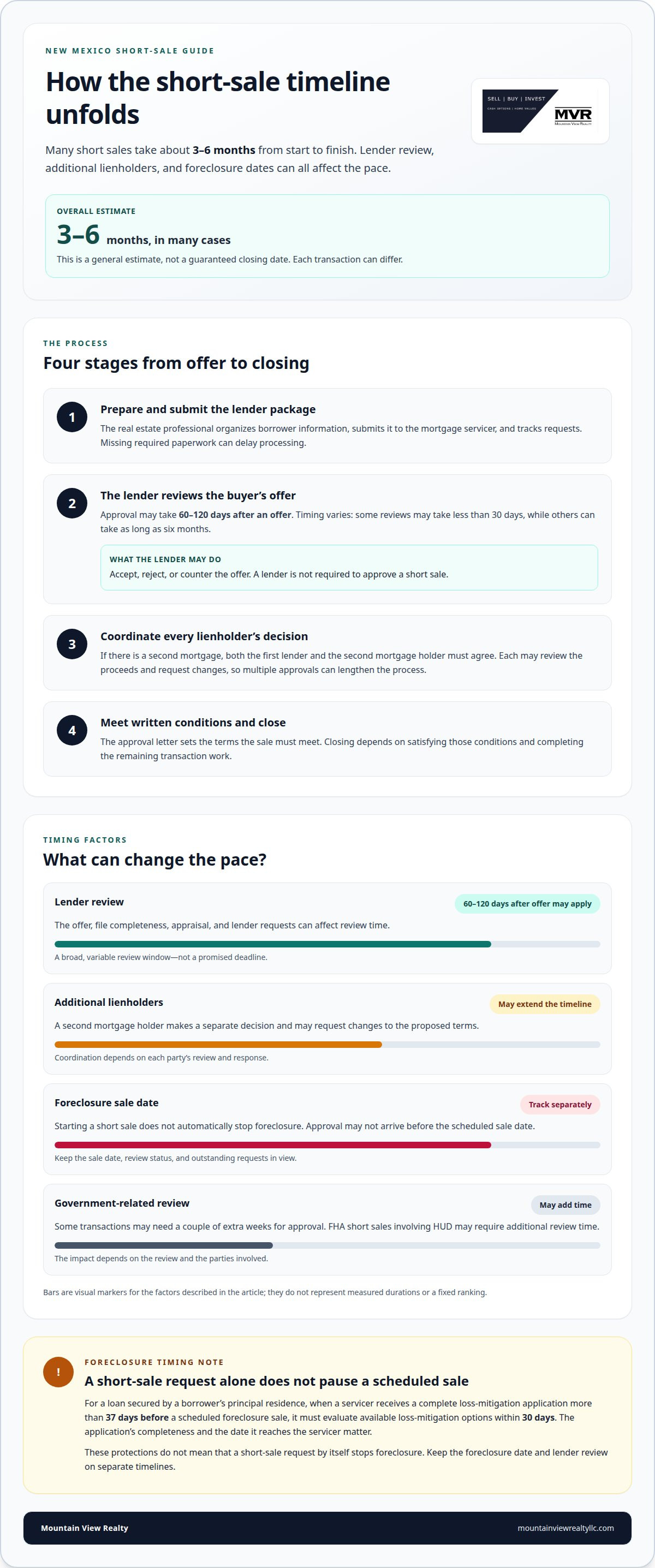
A short sale needs more than a conventional listing. The lender must agree to accept less than the mortgage balance, and it can reject the proposed terms. As a general estimate, some short sales take three to six months to finish, but the timeline varies. Lender approval may take 60 to 120 days after a buyer makes an offer, though it can take less or more time. The overall timeline includes both lender review and the remaining steps before closing.
A second mortgage adds another decision-maker. If the property has multiple mortgages, both the first lender and the second mortgage holder must agree to the sale. Each reviews the proposed proceeds and may request changes to the terms. Coordinating those approvals can take longer than a single lender’s review. An agent experienced with short sales can track each approval, relay document requests, and update the parties as decisions come in.
Lender review is not automatic approval. A bank may accept, reject, or counter the buyer’s offer, and it does not have to agree to a short sale. Approval may take less than 30 days in some cases or as long as six months in others; timing varies by transaction. The buyer’s offer, the completeness of the file, and the number of lienholders can affect the timeline. An agent can manage communication but cannot control the lender’s decision.
Government involvement may affect the timeline, but the impact depends on the review and the parties involved. Some transactions may require a couple of extra weeks for approval, though that is not a fixed timeframe. FHA short sales involving HUD may also require additional review time. Identifying all parties early helps account for each review when estimating a likely closing window.
For a New Mexico short sale, the main timing factors are lender review, any additional lienholder approvals, and foreclosure dates. Account for each when planning the sale.
After approval, closing depends on meeting the lender’s written conditions and completing the remaining transaction work. The approval letter sets the terms the sale must meet, guiding the final steps. The closing timeline depends on those requirements and how promptly everyone satisfies them.
When choosing an agent, focus on how they manage approvals: tracking lender requests, coordinating with each lienholder, and communicating changes to the buyer and seller. A second mortgage holder’s response can affect the closing plan even after the first lender approves the offer. Clear coordination keeps everyone working from current terms and aware of what remains before closing.
Can a short sale close before the foreclosure sale date?
Yes, a short sale may close before a scheduled foreclosure sale, but starting the process does not automatically stop foreclosure. If you’re behind on mortgage payments, treat the foreclosure date and lender review as separate timelines. A buyer may be ready to proceed while the lender is still reviewing the offer, ordering an appraisal, or considering the sale terms.
For loans secured by a borrower’s principal residence, a servicer that receives a complete loss-mitigation application more than 37 days before a scheduled foreclosure sale must evaluate available loss-mitigation options within 30 days. The CFPB mortgage-servicing rule also restricts dual tracking, when foreclosure activity and loss-mitigation review proceed at the same time. These protections do not mean a short-sale request alone pauses a sale. The application’s completeness and the date it reaches the servicer matter.
New Mexico sellers and buyers should account for the possibility that lender approval may not arrive before the foreclosure date. A buyer may face uncertainty while waiting for a decision, and a seller may lose time if the file is incomplete or the lender requests more information. An appraisal can also affect the offer review if the lender uses it to assess the property’s value. Clear updates on the sale date, review status, and outstanding requests help everyone understand the timing.
California deadlines sometimes appear in short-sale discussions, but they are not New Mexico rules. In California, at least three months must pass after a Notice of Default before a Notice of Sale can issue, and the Notice of Sale must be recorded, posted, published, and mailed at least twenty days before the sale. Do not use those state-specific deadlines to estimate a New Mexico foreclosure timeline.
Alternatives depend on the homeowner’s circumstances and available loss-mitigation options. A servicer may evaluate options beyond a short sale when it receives a complete application within the applicable review period. Consider the sale process, possible foreclosure, and other options together. An offer or appraisal alone does not resolve a scheduled sale.
A New Mexico short sale carries timing risks for both sides: the seller faces a foreclosure date that may arrive before approval, while the buyer may wait through lender review without knowing the final terms. A short-sale professional can help coordinate sale communications and keep the transaction aligned with the lender’s requests. For guidance on short-sale timing and foreclosure dates, consider discussing the transaction’s key dates with a local real estate professional.
How a real estate professional prepares and submits the lender package
A New Mexico short-sale package follows clear steps: a real estate professional organizes the borrower’s information, submits it to the mortgage servicer, and tracks requests. The borrower provides the records the servicer asks for. Before submission, review the package for missing items. Bank negotiators will not process a short-sale file without required paperwork, so an incomplete submission can stall the review before it begins.
The professional also coordinates the buyer’s offer with the lender’s review. The package connects the proposed sale to the borrower, mortgage, and property. If the servicer requests more information, identify what is outstanding and coordinate its delivery. A file can remain inactive while required materials are missing. Keeping a clear record of submissions and lender responses also helps the borrower understand the current stage.
Submission does not mean the lender has started a full review. There is no single acknowledgment timeline; a 10-to-30-day estimate should not be treated as a standard or guarantee. During the wait, the professional tracks whether the servicer has logged the file and responds to any request for missing documents. Acknowledgment and a substantive decision are separate milestones. Buyers should not treat a received package as approval to proceed to closing.
The proposed price can shape the lender’s decision. After the property goes under contract, the lender may order an appraisal or broker price opinion. There is no set timeline for ordering a valuation, so a two-week-to-two-month estimate is not a guaranteed timeframe. The appraised value can influence whether the lender accepts, rejects, or counters the buyer’s contract. A real estate professional can explain how the proposed price relates to the valuation and communicate any counteroffer to the parties.
Lender timelines differ because each servicer manages its own file review and valuation process. One lender may acknowledge a package while another is still collecting information or arranging an appraisal. When a government program is involved, confirm its requirements and process with the servicer; review timelines can vary. Track each lender’s requests separately, especially when the borrower has more than one mortgage or needs approval from multiple lienholders.
For buyers, the lender’s written decision is an important step, but it does not replace closing preparation. If the lender counters the offer, the buyer and seller must decide whether the revised terms work. The professional communicates those terms and coordinates the next steps, keeping the borrower, buyer, and servicer aligned on the current offer and valuation report rather than an outdated proposal.
Negative equity and short sale eligibility
Negative equity means the seller owes more on the mortgage than the home is worth. This can make a conventional sale difficult because the proceeds may not cover the mortgage balance. For example, a homeowner who bought recently and must sell after a market change could face negative equity. As a general possibility, someone selling within two to three years of buying may also owe more than the home is worth, particularly if its value has not kept pace with the debt.
Negative equity alone does not establish eligibility. Depending on the lender’s requirements, a homeowner may be considered for a short sale when they owe more than the home is worth and financial hardship makes timely mortgage payments difficult. The hardship and the property’s value may both be relevant. The seller’s circumstances explain the payment difficulty; the home’s value shows why a regular sale may not repay the mortgage in full.
A missed payment may not be required for a short-sale review, but requirements vary by lender. A seller who has never missed a mortgage payment may still ask the lender to consider a short sale. This may matter to homeowners who anticipate difficulty but remain current. The real estate agent helps present the property and sale terms, while the lender reviews the borrower’s circumstances and decides whether to approve the proposed sale.
Eligibility review and lender approval are separate stages. A seller may appear to meet basic conditions, but the lender still needs to review the short-sale request. If the lender declines, the transaction cannot proceed as an approved short sale. If it accepts, the approval letter sets the terms for completing the sale. The buyer and seller must meet those terms before closing.
A real estate professional helps connect the seller’s hardship, mortgage position, and proposed sale in a clear file. The lender needs to understand why the seller is seeking a short sale and how the offer relates to the property. If the home’s value or the seller’s circumstances change during review, the information may need updating. Clear communication can prevent avoidable confusion among the borrower, agent, buyer, and lender.
Waiting can be difficult, especially when a seller is weighing ongoing payments against a pending sale. The lender’s decision depends on its review, not simply on the seller’s preference or the buyer’s willingness to proceed. Patience helps, but active coordination matters too: the real estate agent can track lender requests, relay responses, and keep everyone informed about the next decision point.
For a New Mexico homeowner, the key distinction is between having negative equity and meeting the lender’s short-sale requirements. A seller who owes more than the home is worth and faces hardship may ask the lender to consider a short sale, even while current on payments. The lender must still approve the proposed terms before the sale can move forward as a short sale.
Sale postponements during short sale review
A scheduled foreclosure sale and a short-sale review can move on separate tracks. Starting a short sale does not automatically stop or postpone a foreclosure sale. The seller needs to confirm whether the scheduled sale has actually been postponed, rather than assume that listing the property or submitting an offer changed the date.
For a seller, the key milestones are the servicer’s review, any written approval, and the scheduled sale date. If the lender has not completed its review, a postponement may give the transaction more time. It does not mean the short sale is approved. The lender still must decide whether to accept the terms, and the buyer and seller must complete the transaction before closing.
Consider a home listed while the lender reviews a buyer’s offer. If the foreclosure date approaches before the review ends, the status of that date becomes central to the seller’s choices. A listing does not establish a postponement, and a buyer’s willingness to proceed cannot replace lender approval. Clear updates on the review stage and sale date help both parties see what remains unresolved.
Buyers also face timing uncertainty. A buyer may be ready to proceed, but the lender could still be reviewing the offer or setting conditions. If a scheduled foreclosure sale proceeds before the short sale closes, the expected purchase may not happen as planned. An appraisal or lender counteroffer may also require changes before the parties can move toward closing.
Postponement and approval address different issues. A postponement changes the time available before a foreclosure sale; approval sets the lender’s terms for selling the property. Keep those milestones distinct when deciding whether to continue listing the home or pursue another option. The lender’s letter can clarify approval conditions, including how the proposed proceeds and closing costs fit the transaction.
The word “forgiven” also deserves care. A postponed sale does not itself cancel mortgage debt. If mortgage debt is canceled, the IRS says lenders generally report canceled debt on Form 1099-C, and the canceled amount is generally included on the borrower’s tax return for the year cancellation occurred. The timing and treatment of any canceled debt are separate from the foreclosure postponement and sale closing.
If you want to keep a short sale moving, track lender communications alongside the foreclosure date to clarify the next decision. A real estate professional can coordinate updates and keep the buyer informed as review terms change. This cannot control the lender’s decision, but it keeps the sale status and scheduled date in view together.
Mountain View Realty: Short Sale
Mountain View Realty LLC helps Albuquerque-area homeowners navigate a Short Sale when mortgage debt exceeds the home’s value and hardship affects payments. The process involves coordinating the property sale and lender review, while keeping the seller informed about requests, decisions, and how long does a short sale take in NM. A short sale may suit homeowners facing negative equity, but the lender must approve the proposed terms.
If your priorities point toward a different path, CashOffer+, Home Trade-In, and Renovate & Sell offer other ways to approach a home sale in New Mexico. The right fit depends on your property and goals. A conversation can help clarify the options and what each means for your next move.
Contact Mountain View Realty LLC to discuss your short sale and selling priorities.
Choose a next step that fits your priorities
Your next move can begin with a clear view of what matters most: protecting your remaining equity, reducing uncertainty, or planning where you’ll live next. If you’re weighing how long a short sale takes in NM, consider the broader decision too. The right path depends on your property, financial circumstances, and plans after selling.
A focused conversation can help you identify your priorities and the questions to address before committing to a direction. Discuss the home’s situation, available choices, and what you want your next chapter to look like. A thoughtful plan is more useful than reacting to each new development.
Whatever path you choose, informed decisions can make a complex transition more manageable. Take time to choose an approach that supports your property goals and the life you’re planning beyond the sale.
Frequently Asked Questions
What is a Short Sale?
A short sale is a lender-approved home sale in which the proceeds fall short of the mortgage balance. The buyer and seller negotiate the purchase, but the lender must agree to the terms. That approval is separate from the parties’ agreement, so an accepted offer alone does not complete a short sale. The lender’s written decision determines whether the proposed sale can proceed on those terms.
Are short sales a longer process?
They often take longer because the buyer’s and seller’s agreement is only one part of the transaction. The lender’s review, property valuation, and title work may each affect the schedule. Buyers planning a move should not treat an accepted offer as a firm closing date. Coordinating a lease end, another purchase, or moving plans around lender approval can reduce conflicts if the schedule shifts.
Are There Tax Consequences?
Potentially. The tax question concerns whether the lender cancels mortgage debt, not simply whether the home sells below its loan balance. According to the IRS, canceled mortgage debt is generally reported on Form 1099-C, and the canceled amount is generally included on the borrower’s tax return for that year. Keep lender statements and tax forms together when preparing records for the year the debt cancellation occurs.
Can FHA, Conventional or VA loans receive a short sale?
A short sale may be considered for different mortgage types, but the loan label alone does not determine the outcome. The servicer reviews the borrower’s file and proposed sale under the requirements that apply to that mortgage. FHA files may involve HUD review. For conventional or VA-backed mortgages, the borrower’s circumstances, the servicer’s process, and any other lienholders’ interests remain relevant.
Does My Loan Type Change How Long It Takes?
The mortgage type can affect which parties review the file and what information they require. Distinguish the mortgage program from the servicer handling the request: the servicer’s process and any required approvals shape the schedule. For example, a government program may involve additional review. The loan type is one timing factor, not a closing date by itself.
Does having a second mortgage make a short sale take longer?
Multiple mortgages can add coordination because the sale must address more than one mortgage interest. The proposed proceeds may need to be divided between lienholders, and their terms must align before the transaction can finish. One lender’s response may not resolve every outstanding approval. A real estate professional can track separate responses and communicate changes to the buyer as the terms develop.
How long does a short sale take in New Mexico from offer to closing?
There is no single closing date for every New Mexico short sale. After an offer, the lender’s review and valuation work come before the parties can complete closing requirements. The number of lienholders, outstanding lender requests, and conditions in the approval letter can all affect the final schedule. Buyers should keep plans flexible until the lender’s conditions and transaction requirements are met.
What New Mexico laws or local requirements affect short sale timelines?
For a principal-residence loan, a servicer that receives a complete loss-mitigation application more than 37 days before a scheduled foreclosure sale must evaluate available options within 30 days. Federal servicing rules also restrict dual tracking, but starting a short sale does not automatically stop foreclosure.

Article by
Robb Krautbauer
Robb Krautbauer is the Owner and Qualifying Broker of Mountain View Realty, serving Albuquerque, Rio Rancho, Santa Fe, and surrounding New Mexico communities. With more than a decade of real estate experience, Robb specializes in luxury homes, strategic home marketing, and helping homeowners navigate important life transitions with confidence.
Known for combining luxury-level marketing, AI-powered technology, and innovative selling strategies, Robb helps clients maximize their home's value while creating a smooth, personalized selling experience. Whether assisting luxury homeowners, retirees, families downsizing, or real estate investors, his focus is always on delivering expert guidance, honest advice, and exceptional results.
When he's not helping clients achieve their real estate goals, Robb enjoys studying market trends, emerging technology, and investment strategies that keep Mountain View Realty at the forefront of the industry.
Disclaimer
**Disclaimer:** The information provided in this article is for general educational purposes only and should not be considered legal, tax, financial, or professional advice. Real estate laws, market conditions, and regulations change over time and may vary based on your individual circumstances. Before making any real estate decision, consult with qualified legal, tax, or financial professionals. If you have questions about buying or selling real estate in New Mexico, contact Mountain View Realty for guidance specific to your situation. © 2026 Mountain View Realty. All rights reserved. The content on this website may not be reproduced without written permission.


