
How to sell a parent's house to pay for care
A parent’s home can help fund care, but selling isn’t always the first step. Understanding how to sell a parent's house to pay for care starts with confirming who has legal authority to sell and weighing the home’s value against the care plan. According to the Internal Revenue Service, an individual may qualify to exclude up to $250,000 of capital gain from selling a qualifying primary residence, or up to $500,000 for a married couple filing jointly, if the ownership and use requirements are met.
It’s understandable to focus on a home’s equity when care costs are approaching, but savings, income, insurance, benefits, and loans may also help cover expenses. This guide explains when selling may make sense, what other funding options to consider, and how taxes, legal authority, timing, and family emotions can shape the decision. You’ll have a clearer framework for discussing next steps with your parent and planning the transition with care.
Key Takeaways
- Before planning a sale, clarify who has legal authority to act for your parent and what documents support that authority.
- Compare possible care funding sources, including income, savings, insurance, benefits, loans, and home-sale proceeds.
- Consider your parent’s wishes and involve them in decisions about belongings and the move whenever possible.
- A home sale may make sense when care needs change, the property is difficult to maintain, or its equity is needed to fund care.
- Explore whether a traditional sale or options such as CashOffer+, Home Trade-In, Renovate & Sell, or Sell & Stay better fits your family’s timing and priorities.
1. Capital-gains tax exclusions for home sales
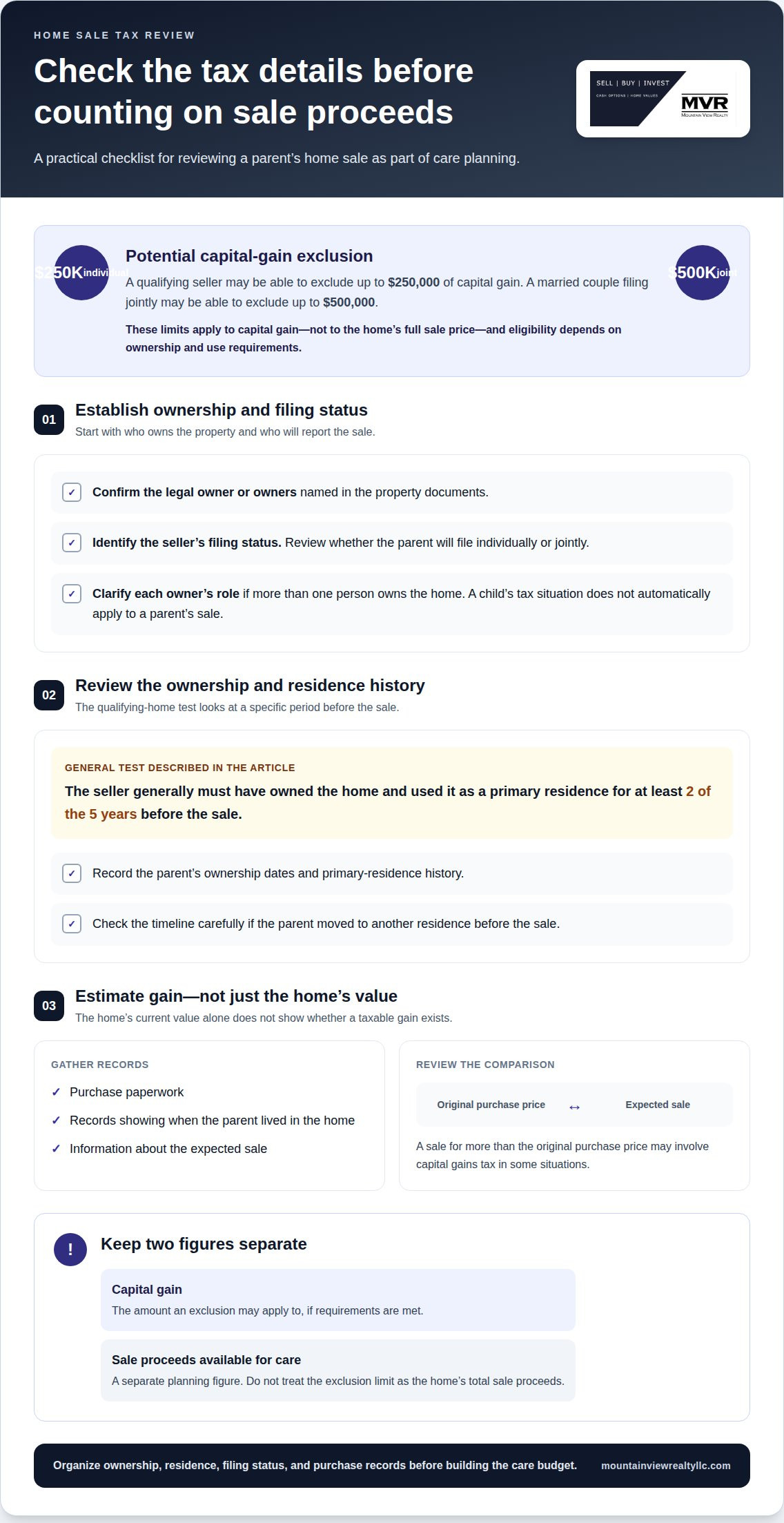
Before counting on a home sale to fund care, estimate whether the sale could create a taxable gain. The Internal Revenue Service says an individual may be able to exclude up to $250,000 of capital gain from selling a qualifying primary residence. A married couple filing jointly may qualify to exclude up to $500,000 of capital gain, according to the Internal Revenue Service.
These exclusions apply to capital gain, not the home’s full sale price. Capital gains taxes may apply in some situations when a home sells for more than its original purchase price. For a parent’s home, start by gathering purchase records and estimating the likely sale proceeds. The home’s current value alone does not show whether a taxable gain exists.
Eligibility depends on the home’s ownership and use. According to the Internal Revenue Service, the seller generally must have owned the property and used it as their primary residence for at least two of the five years before the sale. Review that period against your parent’s actual living arrangements, especially if they moved to another residence before the sale.
Identify who owns the property and who will report the sale before making care-funding plans. If your parent owns and sells the home, their ownership, residence history, and filing status matter. A child’s tax situation does not automatically apply instead. If more than one person owns the home, establish each owner’s role before estimating the proceeds available.
Create a simple record folder before setting a care budget. Include purchase paperwork, records showing when your parent lived in the home, and information about the expected sale. These documents help organize the details needed to assess whether an exclusion may apply. Keep that estimate separate from the amount available for care, since a tax exclusion concerns gain, not total proceeds.
- Confirm the legal owner or owners named on the property documents.
- Record the parent’s ownership dates and primary-residence history.
- Identify whether the parent will file individually or jointly.
- Compare the expected sale with the original purchase price to flag a possible gain.
- Keep the exclusion amount separate from the sale proceeds used in care planning.
For example, if a parent lived in the home for only part of the relevant period, review the two-of-five-year test before relying on an exclusion. If a married couple files jointly, assess the $500,000 limit rather than assuming the individual limit applies. The Internal Revenue Service criteria offer a starting point, not a substitute for organizing the family’s specific ownership and residence records.
Use this tax review alongside the care timeline. Estimate proceeds after considering whether an exclusion may apply and how the sale fits your parent’s move. Clear records of ownership, residence, and filing status will make the next funding discussion more grounded.
2. Emotional considerations when selling a family home
A parent’s home may hold decades of memories, routines, and family milestones. Selling can feel like losing more than a building, especially when a change in care needs prompts the move. Make room for that reaction in the timeline. A decision that looks practical on paper can still be difficult for the person leaving home.
Whenever possible, involve your parent in downsizing decisions. Their input can help preserve a sense of control and dignity during the move. Start with choices they can make directly, such as which keepsakes to bring, which room to sort first, or whom to invite for support. If they have strong feelings about an item, pause and discuss options rather than treating it as something to discard.
A family meeting can break an overwhelming move into smaller decisions. Choose a time when your parent is comfortable, then agree on the next step together. One conversation might cover what they want to keep; another can focus on the home’s contents or the sale timeline. Write down decisions and unresolved concerns so relatives can follow the same plan.
- Ask your parent which belongings matter most before sorting begins.
- Set aside keepsakes for family members to discuss together.
- Give your parent a clear role in decisions that affect their move.
- Choose one manageable room or task to begin with.
Disagreements can arise when siblings have different views about timing, belongings, or care. Keep the discussion centered on your parent’s expressed wishes and practical needs. Name the specific decision at hand, such as whether to prepare the home for sale now or organize personal items first. Avoid combining every family concern into one conversation.
Financial details also shape the emotional timeline. Include any remaining mortgage balance when estimating proceeds from a sale. If the home has a reverse mortgage, account for the lender’s repayment requirement when the homeowner no longer lives there. A planned move can be an important time to review the loan and sale timeline.
For example, a parent moving to assisted living may want time to choose which furniture to bring. Meanwhile, the family may need to understand how the mortgage affects sale proceeds. Keep both needs visible in the plan. A written timeline can track care-related dates, sorting tasks, and financial questions without forcing every decision into one day.
When your family is ready to discuss timing, a calm conversation about planning the home sale can help connect the move with the property’s next steps. Keep your parent’s preferences central, and revisit the plan as their care arrangements and comfort level become clearer.
3. Who needs legal authority to sell the home?
An adult child can sell a parent’s house only if legally authorized to act for the owner. The parent may sell personally, or someone with valid authority may act on their behalf.
Before listing, identify the property owner and review any document that gives someone else authority to act. A financial power of attorney can authorize a named person to manage financial matters, including selling property. Read its terms and confirm that they cover the proposed sale.
A power of attorney does not make the adult child the owner. It allows the designated agent to act within the authority granted by the document. For example, if one sibling is named, another sibling cannot sign for the parent solely because they are family.
If the parent lacks mental capacity and no power of attorney authorizes someone to act, the family may need to seek legal authority before selling the home on the parent’s behalf. Distinguish family involvement from legal authority: helping with care decisions does not, by itself, authorize anyone to sign sale documents.
For a New Mexico home, confirm who can sign before listing and share the relevant authority documents with the professionals handling the transaction. Long-term-care and Medicaid rules can also affect the decision. Medicaid may exclude a primary residence from countable assets under certain conditions, such as the applicant’s intent to return home or a qualifying person living there. State rules may also limit excluded home equity. New Mexico eligibility depends on the applicable state rules and the family’s circumstances.
Can an adult child sell a parent’s house to pay for their care? Yes, if the parent sells personally or the child has valid authority, such as a financial power of attorney that covers the sale. Being an adult child alone does not grant signing authority.
Who has legal authority to sell a parent’s home if they lack capacity? An agent acting under a valid power of attorney may sell if the document grants that authority. The family may need to obtain legal authority before selling on the parent’s behalf.
What state-specific rules govern selling a parent’s home and paying for long-term care? State Medicaid rules determine when a home may be excluded from countable assets and whether equity limits apply. New Mexico families should consider those rules alongside ownership and signing authority.
How much does it cost to sell a home, including agent commissions, closing costs, and repairs? There is no single total. Agent compensation depends on the agreement, closing expenses on the transaction, and repair costs on the home’s condition. Estimate each category separately to understand its effect on proceeds.
What steps are involved in selling an elderly parent’s home in the United States? Identify the owner, establish who can sign, review any power of attorney or court guardianship, and consider effects on care benefits. Then plan the sale, account for transaction costs, and direct proceeds toward the parent’s care needs.
Keep copies of ownership and authority documents together before discussing a listing. A clear record helps the family distinguish who can make decisions, who can sign, and which questions about care benefits need attention.
4. Funding care with income, savings, insurance, benefits, and loans
A home sale is one possible funding source, not the only one. Families can combine savings and investments, Social Security income, retirement accounts, long-term care insurance, veterans benefits, life insurance, loans or bridge financing, and sale proceeds. List each source, who controls it, and when funds can be used. Then compare that schedule with your parent’s care plan.
Separate steady income from funds that require a decision or transaction. Social Security and retirement income can contribute regularly, while savings, investments, and life insurance may involve different access steps. Review long-term care insurance and veterans benefits as separate resources. A written monthly budget can show which sources cover ongoing care and where a one-time home sale could help.
VA pension rules require special attention. According to the U.S. Department of Veterans Affairs, the net-worth rules include a three-year lookback period. Gifting assets or selling them for less than fair market value can result in a period of ineligibility. The VA generally excludes a veteran’s primary residence from its net-worth calculation, but proceeds from its sale may become countable and affect eligibility.
That distinction matters when comparing keeping the home with selling it. A veteran’s home may be treated differently from the cash received after a sale. Before transferring ownership or accepting less than fair market value, document the transaction and consider its effect on the benefit plan.
How does selling a home affect Medicaid eligibility and the look-back period? Medicaid may exclude a primary residence when conditions apply, such as the applicant intending to return home or a qualifying person living there. State rules can limit excluded home equity, so distinguish Medicaid’s residence and equity rules from the VA’s three-year lookback.
What protections apply if a parent sells their home to a family member below market value? VA rules identify below-market sales as a potential asset-transfer issue that can result in a period of ineligibility. Keep clear records of the sale terms and fair market value, and consider the effect on benefits before transferring the property.
Reverse mortgages also depend on occupancy. A lender often requires repayment when the homeowner no longer lives in the property. If your parent plans to move into care, include that repayment obligation in discussions about timing and proceeds rather than treating the loan as ongoing care income.
- List income, savings, insurance, benefits, loans, and sale proceeds separately.
- Identify which funds recur and which become available only after a transaction.
- Review VA transfer rules before gifting property or accepting below-market value.
- Include reverse mortgage repayment when a homeowner plans to leave the property.
For Medicaid and VA planning, compare your parent’s residence, expected move, sale proceeds, and proposed transfers. These details help clarify how a home sale fits alongside income and other resources.
5. When to sell a parent’s home to fund senior care
A sale may make sense when a parent plans to move into assisted living or memory care, the home would sit vacant, upkeep becomes difficult or unsafe, or equity is needed for care. For families considering how to sell a parent's house to pay for care, timing should reflect the care plan, the parent’s wishes, and the home’s likely use. Selling isn’t automatic just because care needs have changed.
Start with the expected living arrangement. If your parent intends to return home, keeping the property may support that plan. If a move to assisted living or memory care is expected to be permanent, compare keeping the home with using its equity for care. An empty property may still need attention, while an occupied home may serve an ongoing purpose.
Should a family sell, rent, or keep a parent's home to pay for long-term care? Compare the parent’s care plan, whether someone will live in the home, upkeep demands, and the need for available equity. Selling may fit when the home is vacant or difficult to maintain. Keeping or renting may work when the property remains useful and its ongoing responsibilities are manageable.
Renting involves decisions about tenants, repairs, and ongoing upkeep. If relatives cannot take on those responsibilities, rental income may not make the arrangement practical. Keeping the home also means identifying other funding sources while the property remains unsold. Compare these trade-offs rather than treating rent as effortless income.
Use a decision worksheet to make the options concrete. Record the expected move, whether your parent may return, who could occupy the home, its upkeep needs, and whether equity is needed for care. Add your parent’s preferences and each relative’s capacity to help. This turns how to sell a parent's house to pay for care into specific decisions relatives can discuss.
Medicaid adds a separate consideration for families planning a sale. The timing of a move, your parent’s living arrangements, and the home’s role in the family’s plans can all matter. Keep these details with the care plan so the family can distinguish a housing decision from questions about future estate recovery.
Can Medicaid recover care costs from a parent’s home after death? Federal law requires states to pursue estate recovery for certain long-term care benefits paid for Medicaid recipients age 55 and older, subject to protections and hardship exceptions. The applicable protections and hardship circumstances matter when assessing how recovery may affect a family.
For an Albuquerque family, compare the care timeline with the home’s expected use. If a move is planned, the property is difficult to maintain, and its equity is needed, a sale may align with the care plan. Families deciding how to sell a parent's house to pay for care can use these factors to shape a timeline that respects the parent’s preferences.
Mountain View Realty: CashOffer+
Mountain View Realty LLC helps families consider a home-sale approach that fits their parent’s care transition. If selling is part of the plan, CashOffer+ is one option to discuss. Renovate & Sell may suit families considering improvements before selling, while Home Trade-In offers another path when a home transition involves a new purchase. Each option addresses a different situation, so start with the parent’s timing, the property’s condition, and the family’s priorities.
A thoughtful conversation can clarify which approach fits the care plan and the parent’s wishes. The goal is to make the home decision easier to evaluate alongside the other steps involved in a senior transition.
Contact Mountain View Realty LLC to discuss a home-sale approach for your family.
Choose a home-sale path that fits the care plan
The next step is to turn your family’s priorities into a shared plan. Decide which questions need attention first, who will coordinate each task, and how your parent wants to be involved. A written plan can keep conversations focused and help relatives move forward together.
For an Albuquerque family, a local perspective can help put the property decision in context. Bring your goals, concerns, and preferred timing to a conversation about the home’s next chapter. You can approach the process one decision at a time.
A thoughtful plan can help your family approach this transition with care.
Robb Krautbauer, Owner & Qualifying Broker
Frequently Asked Questions
What are some other ways to pay for long-term care?
Families can create a coordinated funding plan instead of relying on one payment source. Lay out care expenses by due date, then match them with funds available at those times. For example, distinguish regular bills from move-in expenses or other one-time charges. This timeline can show whether resources will be available when needed and help relatives discuss which funds to use first.
Can a person with dementia sell their house?
A person with dementia may be able to sell their home if they can understand and complete the transaction. The family can support the process by explaining the proposed sale clearly, allowing time for questions, and recording the parent’s wishes. If the parent can’t manage the transaction, the sale must proceed through someone with legal authority to act for them.
Who needs legal authority to sell the home?
The person signing sale documents must have authority connected to the property. Compare the owner’s name on the property records with the name of the person expected to sign. If they differ, identify the document or court appointment that supports the signer’s role. This can surface ownership or paperwork questions before the family sets a sale schedule.
How do power of attorney and guardianship affect selling a parent's house?
A power of attorney and a court appointment establish different routes for someone to handle a sale for a parent. Before setting transaction dates, organize the relevant document and note who is named, what responsibilities it describes, and any limits it sets. Share the applicable paperwork with those preparing the sale documents so the parent’s representative and signing arrangements are clear.
How is a parent's home sale taxed, including capital gains and the home-sale exclusion?
Keep a tax file for the sale with the closing statement, purchase records, and documents showing your parent’s residence history. These records give a tax professional the details needed to assess your parent’s return. Also track who owned the home and who received the proceeds, since those details help clarify whose tax situation is being reviewed.
What alternatives to selling a parent's house can pay for care, such as a reverse mortgage or home equity loan?
A home equity loan may let a parent access funds while retaining the home, but it adds borrowing obligations tied to the property. Compare the loan’s repayment schedule with the care budget and the parent’s plans for staying in the home. A reverse mortgage is another option to consider alongside other resources, taking into account its fit with longer-term housing and cash-flow plans.

Article by
Robb Krautbauer
Robb Krautbauer is the Owner and Qualifying Broker of Mountain View Realty, serving Albuquerque, Rio Rancho, Santa Fe, and surrounding New Mexico communities. With more than a decade of real estate experience, Robb specializes in luxury homes, strategic home marketing, and helping homeowners navigate important life transitions with confidence.
Known for combining luxury-level marketing, AI-powered technology, and innovative selling strategies, Robb helps clients maximize their home's value while creating a smooth, personalized selling experience. Whether assisting luxury homeowners, retirees, families downsizing, or real estate investors, his focus is always on delivering expert guidance, honest advice, and exceptional results.
When he's not helping clients achieve their real estate goals, Robb enjoys studying market trends, emerging technology, and investment strategies that keep Mountain View Realty at the forefront of the industry.
Disclaimer
**Disclaimer:** The information provided in this article is for general educational purposes only and should not be considered legal, tax, financial, or professional advice. Real estate laws, market conditions, and regulations change over time and may vary based on your individual circumstances. Before making any real estate decision, consult with qualified legal, tax, or financial professionals. If you have questions about buying or selling real estate in New Mexico, contact Mountain View Realty for guidance specific to your situation. © 2026 Mountain View Realty. All rights reserved. The content on this website may not be reproduced without written permission.


