How to Sell an Inherited House in New Mexico and Understand the Costs
New Mexico has no state inheritance tax or estate tax, but selling an inherited house in New Mexico can still involve probate, closing costs, and possible capital gains tax. Whether you can sell before probate closes depends on how the home is titled and who has authority to act for the estate. The tax basis is generally adjusted to the home’s fair market value on the owner’s date of death, which can affect whether a later sale results in a taxable gain.
It’s understandable to focus on sale costs and timing, especially when family members need to agree on what happens next. The right approach depends on the estate’s status, the home’s condition, and whether you want to sell as-is or prepare it for the market.
This guide explains how to establish who can sell, understand New Mexico taxes and cost basis, estimate expenses that affect proceeds, and compare an as-is sale with an agent-assisted listing. You’ll have a practical framework for choosing a next step without assuming every inherited home or family situation is the same.
Key Takeaways
- Confirm who has legal authority to act before signing a listing agreement or sale contract.
- Separate New Mexico inheritance and estate taxes from potential federal tax obligations and tax on a home sale.
- Coordinate with co-heirs on ownership, mortgage payments, upkeep, and the decision to sell or keep the property.
- Use the date-of-death value to understand the home’s tax basis and how a later sale may affect capital gains.
- Compare an as-is sale with repairs or a traditional listing by weighing preparation, timing, and expected net proceeds.
Can I List or Sell Before Probate Closes?
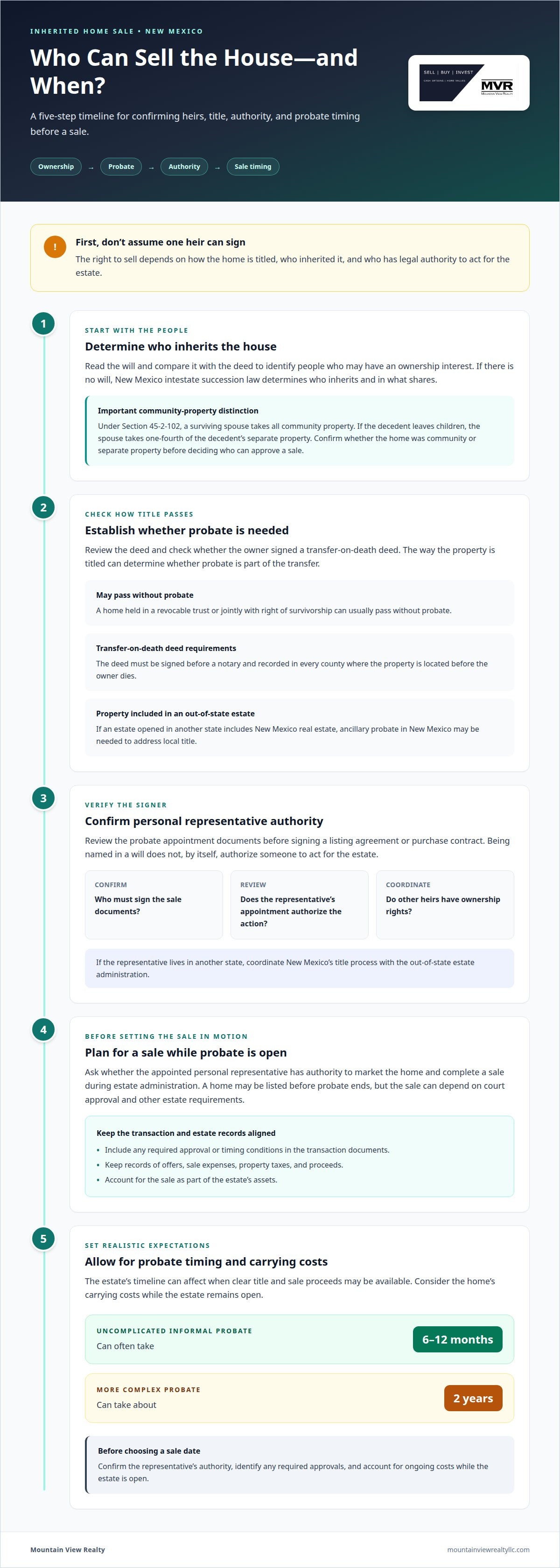
Before selling, establish who inherited the house, whether probate is required, and who can sign for the estate. A will names beneficiaries. If someone dies without a will, New Mexico intestate succession law determines who inherits and in what shares.
-
Determine Who Inherits the House
Read the will and compare it with the deed to identify the people with a potential ownership interest. If there’s no will, New Mexico intestate succession applies: under Section 45-2-102, a surviving spouse takes all community property, but takes one-fourth of the decedent’s separate property when the decedent leaves children. Confirm whether the house was community or separate property before assuming one heir can decide to sell.
-
Establish Whether Probate Is Needed
Check how the deed holds title and whether the owner signed a transfer-on-death deed. A home held in a revocable trust or jointly with right of survivorship can usually pass without probate. A New Mexico transfer-on-death deed must be signed before a notary and recorded in every county where the property is located before the owner dies. If an estate opened in another state includes New Mexico real estate, ancillary probate in New Mexico may be needed to address local title.
-
Confirm Personal Representative Authority
Review the probate appointment documents before signing a listing agreement or purchase contract. Being named in a will doesn’t, by itself, authorize you to act for the estate. A personal representative’s authority depends on the estate administration and their appointment. If the representative lives in another state, coordinate New Mexico’s title process with the out-of-state estate administration. Confirm who must sign and whether other heirs have ownership rights.
-
Plan a Sale Before Probate Closes
Ask whether the appointed personal representative has authority to market the home and complete a sale during estate administration. A home may be listed before probate ends, but the sale can depend on court approval and other estate requirements. Include any required approval or timing conditions in the transaction documents. Keep estate records of offers, sale expenses, property taxes, and proceeds so the representative can account for the assets.
- Set expectations around probate timing before choosing a sale date. Uncomplicated informal probate estates in New Mexico can often take six to twelve months; more complex probate can take about two years. These timelines affect when clear title and sale proceeds may be available. Also consider the home’s carrying costs while the estate is open. For tax year 2025, the federal 0% long-term capital gains rate applies to single filers with taxable income of $48,350 or less, according to the Internal Revenue Service.
Does New Mexico Have an Inheritance Tax or Estate Tax?
New Mexico has no state inheritance tax or estate tax, but selling a home may result in capital gains tax. Gather the deed, death certificate, will or probate appointment papers, and mortgage information to document ownership and authority.
-
Review Estate and Inheritance Tax Rules
Separate New Mexico taxes from possible federal estate tax before estimating what beneficiaries may receive. The 2025 federal estate tax exclusion is $13,990,000, according to the Internal Revenue Service. New Mexico does not impose an inheritance tax or state estate tax. An estate above the federal exclusion may have federal estate tax exposure; the exclusion concerns the estate, not each heir’s sale proceeds.
-
Handle Tax Reporting
Track income earned after death, including rent, interest, and gains from a sale. An estate reports that income on Form 1041. Heirs report their shares of an inherited-home sale on Form 8949 and Schedule D of their personal tax returns. New Mexico taxes capital gains not excluded from tax as ordinary income at rates up to 5.9%. Keep sale records and repair receipts to support the figures reported.
- Gather estate and property records before planning the transfer. Collect the deed, death certificate, will, personal representative appointment papers, mortgage statements, and available property-tax records. These documents help establish ownership, signing authority, and obligations that may affect the sale. Keep estate notices and written agreements among beneficiaries in the same file.
- Do not assume a small-estate affidavit can transfer a house. New Mexico’s small estate affidavit applies to estates valued at no more than $50,000, less liens, but it cannot be used to perfect title to real estate. At least 30 days must pass after the decedent’s death before using the affidavit. Treat it as a possible tool for eligible estate property, not as a substitute for resolving the inherited home’s title.
- List the estate’s debts and identify the funds that will cover them. Review mortgage statements, property-tax balances, utility bills, and repair invoices, then compare them with estate records. Responsibility for expenses depends on the ownership structure, estate administration, agreements among the parties, and applicable law. A mortgage balance affects net proceeds, so include the payoff when planning the sale rather than dividing the full market value among heirs.
- Keep a closing file that links the sale price to the estate’s final accounting. Save the signed sale agreement, settlement statement, debt payoffs, repair records, and documentation of how proceeds were distributed. If the estate received income before the sale, keep it separate from beneficiaries’ individual reporting. When several heirs are involved, document each person’s share and any agreed expense adjustments in writing.
Organized records make it easier to understand the home’s sale proceeds and tax reporting. A thoughtful home-sale plan can help keep the real estate decision aligned with the estate’s priorities.
Is there a time limit on selling inherited property?
New Mexico has no single sale deadline for every inherited home. Timing depends on title transfer, estate administration, decisions among co-heirs, mortgage obligations, and the property’s condition.
- Identify every beneficiary and document each ownership share. A will, probate records, deed, and written agreements can clarify who must approve the sale. If heirs disagree, don’t assume one person can sell the entire property alone. Responsibility for property expenses depends on ownership, estate administration, agreements, and applicable law.
- Review the mortgage and keep payments organized while ownership is being settled. The Garn-St Germain Act generally prevents a lender from calling a mortgage due solely because the property transferred at death to a relative. The servicer still needs a death certificate and updated contact information. Keep loan statements with the estate documents, and include the payoff when estimating sale proceeds.
- Assess the home’s condition and document maintenance needs before choosing a sale path. Note urgent repairs, visible damage, and basic upkeep, then consider how each may affect buyer interest and the estate’s net proceeds. Save invoices for work completed after the owner’s death. Selling costs and post-death improvements can reduce taxable gain, so organized records may be useful at tax time.
- Save the date-of-death valuation to establish the property’s starting tax basis. Inherited property generally receives a basis adjusted to fair market value when the owner died. If the sale price exceeds that value, the difference may create taxable gain, reduced by eligible selling costs and post-death improvements. Keep the appraisal and documents supporting the home’s condition and value in the valuation file.
- Ask how community-property ownership affects a surviving spouse before arranging a transfer. New Mexico intestate succession gives a surviving spouse all community property, but one-fourth of separate property when the decedent leaves children. A qualifying community-property homestead affidavit may apply to a residence assessed at no more than $500,000. Section 45-3-1205 (2025) concerns transfer of a homestead to a surviving spouse by affidavit.
- Discuss a buyout or sale process with co-heirs before a dispute reaches court. New Mexico adopted the Uniform Partition of Heirs Property Act in 2017. The process generally favors dividing property in kind unless that would cause manifest prejudice to co-tenants as a group. After court notice, co-tenants generally have 45 days to buy out the co-tenant seeking sale at the appraised pro-rata price.
Inherited-home cost basis and capital gains
For probate and tax purposes, start with the home’s fair market value on the owner’s date of death. That value generally becomes the inherited property’s tax basis.
-
Determine the Inherited Home's Value
Build a valuation file using the home’s condition and fair market value on the date of death. A licensed appraiser can prepare a date-of-death valuation; keep the appraisal with the estate and tax documents. The probate court may also need a value for estate administration, but that figure serves a different purpose. Don’t use a current online estimate in place of a historical valuation.
-
Apply the Stepped-Up Basis
Use the date-of-death value as the starting basis when calculating a later gain. Keep the appraisal, sale statement, and receipts for improvements made after death. These records help explain how the property’s basis and final calculation differ.
- Calculate potential gain by comparing the sale proceeds with the adjusted basis. Eligible selling costs and documented post-death improvements can reduce the gain. Ordinary repairs and improvements may receive different tax treatment, so keep itemized receipts that describe the work. If there are several beneficiaries, determine each person’s share before preparing individual tax records. The estate’s records should match the final sale documents.
- Account for federal capital gains rules before estimating what each heir keeps. Inherited property is treated as long-term property for federal tax purposes, regardless of how long an heir holds it. Depending on income, long-term gains may face federal rates of 0%, 15%, or 20%. A gain isn’t automatically tax-free just because the home passed through an estate.
- Review whether the federal home-sale exclusion applies to the heir who sells. Eligible homeowners may exclude up to $250,000 of gain, or $500,000 for married joint filers, if they meet ownership and use tests. Generally, the home must be owned and used as a principal residence for two out of the five years before sale. Inheriting a home alone doesn’t establish those conditions.
- Include New Mexico’s capital-gains deduction in the state tax review. Starting in 2025, the deduction is $2,500 or 40% of up to $1 million of a taxpayer’s long-term capital gain. Compare the sale records, ownership share, and applicable deduction when organizing tax details. An heir’s result depends on their reported gain and tax situation, not simply the home’s full sale price.
Selling as-is versus listing with an agent
Compare expected net proceeds, preparation work, and timing before choosing an as-is sale or traditional listing. For families selling an inherited house in New Mexico, the better fit depends on the home’s condition and the heirs’ priorities, not just the first offer.
- Assess the home before agreeing to repairs. Walk through each room and note safety concerns, deferred maintenance, and belongings left by the deceased. Separate urgent work from cosmetic updates. An as-is sale may avoid repair projects, while selective improvements may support a traditional listing. Keep receipts for completed work because post-death improvements can affect capital-gains calculations.
- Estimate likely proceeds for both options. Include the mortgage payoff, property taxes, closing costs, and expenses the heirs have agreed to share. A higher offer may not produce a better net result if the home needs extensive preparation. Put your assumptions in writing so beneficiaries can compare both options using the same cost categories before approving a sale.
- Use timing as a comparison, not a promise. New Mexico homes listed with an agent spend an average of 79 days on the market before an offer is accepted. A traditional sale typically closes 30 to 45 days after offer acceptance. Overall, an inherited-home sale may take 60 to 90+ days, including marketing and closing, once the home is ready and sale authority is in place.
- Consider an as-is sale if heirs want to limit repairs, cleanout work, or preparation time. “As-is” describes the sale condition; it doesn’t remove the need for clear ownership, accurate property information, or an authorized seller. Review the purchase agreement for the closing date, contingencies, and terms for belongings left in the home. When selling an inherited house in New Mexico, align these details with the estate’s needs.
- Consider a traditional listing if the estate can manage preparation and the heirs want broad market exposure. A listing plan may include presentation, targeted repairs, and time for showings. Weigh likely buyer interest against the work involved. If beneficiaries live in different states, assign a coordinator for property access, document sharing, and decisions under the heirs’ written agreement.
- Confirm the seller’s authority and required signatures before signing. The title and estate documents determine who can sign the listing and sale agreements. Resolve ownership or probate questions before the transaction advances. At closing, review the settlement statement for the mortgage payoff, property taxes, and distribution of proceeds. This helps heirs understand the sale’s actual result. For anyone selling an inherited house in New Mexico, comparing these terms can clarify the next step.
Mountain View Realty: CashOffer+
Mountain View Realty LLC offers CashOffer+ as an alternative for heirs considering a sale without preparing a traditional listing. It can be relevant when the home needs work, heirs live elsewhere, or beneficiaries want to compare a cash-sale path with listing options. The right choice depends on the property, estate priorities, and the authority to sell.
If repairs could improve the sale plan, Renovate & Sell offers another route. Home Trade-In may suit heirs coordinating the sale with a next home, while Sell & Stay may be relevant when a seller needs to remain in the home after the sale. These options offer different ways to approach a complex transition.
For a conversation about which approach fits your inherited home, contact Mountain View Realty LLC or visit mountainviewrealtyllc.com.
Choose a Clear Next Step Together
Selling an inherited house in New Mexico can be more than a transaction. It can turn a difficult family responsibility into a shared decision about what comes next. Before moving ahead, agree on what a successful outcome means to everyone involved. That might mean less coordination, protecting the home’s value, or reaching a decision everyone understands.
Choose one person to organize communication and record the family’s decisions. A short written plan can keep conversations focused as circumstances change. It also gives each heir a chance to raise concerns before the next step feels final. The goal isn’t to avoid every difficult choice, but to make those choices with care and a clear sense of what matters most.
Take this one decision at a time and move forward with a plan that respects both the property and the people connected to it.
Frequently Asked Questions
Step 6: Should You Make Repairs Before Selling an Inherited House?
Not necessarily. Compare the likely benefit of each repair with its cost, time, and coordination demands. Start with a written condition list and identify work affecting safety, access, or the home’s basic function. Then consider whether cleanup or selective improvements make more sense than a major renovation. If heirs disagree, document the options and expected costs before authorizing work or choosing an as-is sale.
Step 7: How Do You Sell an Inherited Home When the Heirs Live in Different States?
Choose one person to coordinate communication, documents, and decisions among the heirs. Keep a shared record of ownership interests, expenses, approvals, and the preferred sale approach. Remote signing may be possible, depending on the transaction and the requirements of the title company and any lender. Allow time for document delivery and review, especially when several heirs must approve the same decision.
Can I sell an inherited house before probate is complete?
A home can often be listed during probate, but the representative’s authority to sell and any required court approval matter. A listing can be structured so the sale depends on the necessary estate approval. Before accepting an offer, identify who can sign for the estate and what conditions must be met before closing. This lets heirs discuss a potential sale without treating an offer as proof that title is ready to transfer.
Can a Mortgage, HELOC, Lien, or Reverse Mortgage Delay Closing?
Yes. A loan balance or recorded lien can affect the amount available at closing and the documents needed to transfer clear title. Gather current statements and identify every account secured by the property, including a home equity line or reverse mortgage. The closing team must account for valid payoffs or releases in the transaction. If a mortgage transferred at death to a relative, the Garn-St Germain Act generally prevents the lender from calling it due solely because of the transfer.
Do I have to pay capital gains tax on an inherited home?
Not automatically. A taxable gain can arise if the home sells above its fair market value on the owner’s date of death, after eligible selling costs and post-death improvements are considered. Inherited property is treated as long-term property for federal tax purposes, regardless of how long the heir holds it. Each heir reports their share on Form 8949 and Schedule D, using records that support the value and sale calculation.
Do all heirs have to sign the real estate contract?
Not in every case. Required signatures depend on how the deed holds title and who has authority to act for the estate. A personal representative with authority may sign for the estate; heirs who own interests directly may have separate signing roles. Before preparing a contract, compare the deed and probate appointment documents with the proposed seller names. This helps avoid leaving out an owner or authorized representative.
Does This Property Need Probate in New Mexico?
It depends on how the home was titled and transferred. Property held in a revocable trust, jointly with right of survivorship, or under a properly recorded transfer-on-death deed can usually pass without probate. If the deceased owned the home solely in their name, estate administration may be needed to establish authority and transfer title. A small estate affidavit cannot be used to perfect title to New Mexico real estate.
Does an inherited house in New Mexico need to go through probate before it can be sold?
There is no single rule for every inherited house. If probate is required, an authorized personal representative may be able to list the property before administration ends, subject to estate requirements and any court approval. The sale still needs proper authority and signatures to transfer title. If the property passed through a trust, survivorship ownership, or a transfer-on-death deed, the title process may differ from a probate sale.

Article by
Robb Krautbauer
Robb Krautbauer is the Owner and Qualifying Broker of Mountain View Realty, serving Albuquerque, Rio Rancho, Santa Fe, and surrounding New Mexico communities. With more than a decade of real estate experience, Robb specializes in luxury homes, strategic home marketing, and helping homeowners navigate important life transitions with confidence.
Known for combining luxury-level marketing, AI-powered technology, and innovative selling strategies, Robb helps clients maximize their home's value while creating a smooth, personalized selling experience. Whether assisting luxury homeowners, retirees, families downsizing, or real estate investors, his focus is always on delivering expert guidance, honest advice, and exceptional results.
When he's not helping clients achieve their real estate goals, Robb enjoys studying market trends, emerging technology, and investment strategies that keep Mountain View Realty at the forefront of the industry.
Disclaimer
**Disclaimer:** The information provided in this article is for general educational purposes only and should not be considered legal, tax, financial, or professional advice. Real estate laws, market conditions, and regulations change over time and may vary based on your individual circumstances. Before making any real estate decision, consult with qualified legal, tax, or financial professionals. If you have questions about buying or selling real estate in New Mexico, contact Mountain View Realty for guidance specific to your situation. © 2026 Mountain View Realty. All rights reserved. The content on this website may not be reproduced without written permission.


