Permit requirements for home renovations in Albuquerque: When to apply and schedule inspections
The permit requirements for home renovations in Albuquerque depend on the work. Cosmetic bathroom updates that leave plumbing, wiring, and structure unchanged generally don’t need a permit. Room additions, covered patios, patio enclosures, and reroofing do. Changes to plumbing, electrical systems, or walls can also require permits. For a patio, the key distinction is whether it remains open to the sky or adds a roof or enclosure.
A renovation permit is not just a single formality: the project affects who can apply, which plans are needed, and when inspections take place. This guide covers common permit triggers, who may apply, how Albuquerque plan review works, and when to schedule inspections. Covered patios deserve particular attention because an enclosure can change how the space is used.
Key Takeaways
- Separate cosmetic updates from work that changes plumbing, wiring, or structure to understand when permits may be needed.
- Who applies depends on the project and property. Homeowners and licensed contractors have different permit responsibilities.
- Complete plans can help keep Albuquerque’s residential plan review on track; HOA approval may also be needed before applying.
- For a roof replacement, plan the mid-project inspection when the roof is at least 50% complete and provide one business day’s notice.
- Homeowners doing electrical or plumbing work must meet permit and exam requirements before work begins.
Albuquerque plan review and permit deadlines
The permit requirements for home renovations in Albuquerque depend on the project, location, and plans. Additions, garage conversions, and casitas can involve different review steps. HOA approval or historic-area review may also be needed before a City application is ready.
The City of Albuquerque outlines its permit and inspection process here:
Addition Permit and Plan Review Fees
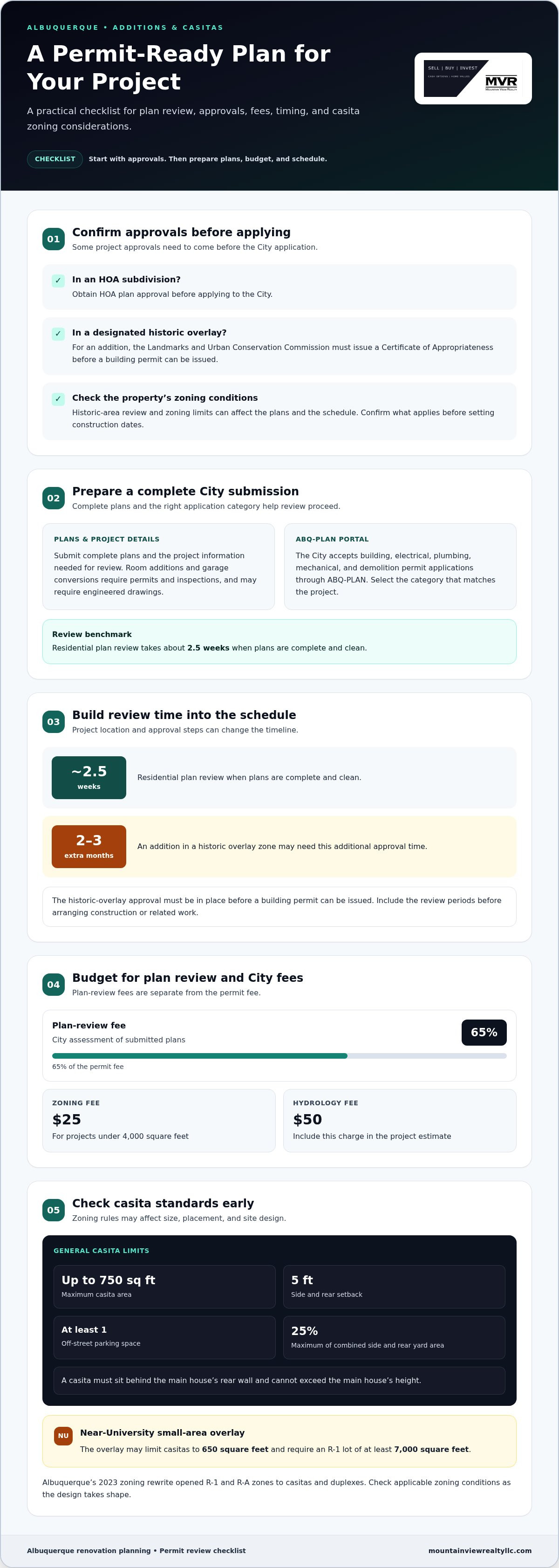
Plan-review fees cover the City’s assessment of submitted plans and are separate from the permit fee. In Albuquerque, plan-review fees are 65% of the permit fee. The City also charges a $25 zoning fee for projects under 4,000 square feet and a $50 hydrology fee. Include these charges when estimating an addition’s permitting budget.
Casita plans must also account for zoning limits. A casita may be up to 750 square feet, must sit behind the main house’s rear wall, and cannot exceed the main house’s height. It also needs a 5-foot side and rear setback, at least one off-street parking space, and must stay within 25% of the combined side and rear yard area.
Plan Review and Inspection Timelines
Residential plan review in Albuquerque takes about two and a half weeks when plans are complete and clean. An addition in a historic overlay zone may need an extra 2 to 3 months for approval. Include those review periods in the schedule before setting construction dates or arranging related work.
Room additions and garage conversions require permits and inspections, and may require engineered drawings. For an addition in a historic overlay, the Landmarks and Urban Conservation Commission must issue a Certificate of Appropriateness before a building permit can be issued. Complete plans and required approvals affect when City review can proceed.
Applying Through ABQ-PLAN
The City of Albuquerque’s ABQ-PLAN portal accepts building, electrical, plumbing, mechanical, and demolition permit applications around the clock. Select the permit category that matches the project, then provide the plans and project information needed for review. The permit requirements for home renovations in Albuquerque include approvals that may need to precede the City application.
If the home is in an HOA subdivision, obtain HOA plan approval before applying to the City. For additions in designated historic overlay zones, secure a Certificate of Appropriateness from the Landmarks and Urban Conservation Commission before the building permit can be issued.
Albuquerque’s 2023 zoning rewrite opened R-1 and R-A zones to casitas and duplexes. The Near-University small-area overlay may limit casitas to 650 square feet and require an R-1 lot of at least 7,000 square feet. These zoning conditions influence project plans and should be considered as the design takes shape.
Who is allowed to pull the permit?
In Albuquerque, who may apply depends on the property and the work. The City of Albuquerque’s Building Safety Division issues building and trade permits, while New Mexico’s Construction Industries Division provides state-level construction licensing oversight.
Homeowner and Contractor Permit Responsibilities
The permit applicant is responsible for the permitted work and its requirements. Albuquerque allows an owner who occupies a single-family home to apply for a reroof permit. If the homeowner applies, they assume legal responsibility as the project’s general contractor, including responsibility for compliance and required inspections.
Some work and properties require a licensed contractor. Albuquerque requires licensed contractors to install plumbing or mechanical equipment and ductwork, as well as water heaters. A licensed contractor must obtain permits for homes leased or rented to others. Roofing work at a rental, duplex, or commercial property also requires a licensed New Mexico contractor to apply.
Permit Applications by Homeowners and Contractors
Application rules turn on occupancy, property type, and project scope. New Mexico’s Construction Industries Division requires homeowners applying for a building permit to read, sign, and notarize the homeowner responsibilities form. For a covered patio or patio enclosure in Albuquerque, the City requires an application from a state-licensed GB-2 or GB-98 contractor, or from the homeowner under a homeowner’s construction permit.
Before work starts, clarify who will hold the permit and what work it covers. A homeowner who applies for a reroof permit for an owner-occupied home assumes general-contractor responsibility. For roofing at a rental, duplex, or commercial property, Albuquerque requires a licensed New Mexico contractor to apply.
Licensing classifications also matter. Albuquerque’s covered-patio rule specifies GB-2 or GB-98 contractors, while other rules require licensed contractors for particular installations or property types. Discuss the project scope, permit applicant, and inspection responsibilities before construction starts. Those details help align the permit application with the work planned.
- For an owner-occupied, single-family re-roof, the homeowner may apply and accept general-contractor responsibility.
- For roofing at a rental, duplex, or commercial property, a licensed New Mexico contractor must apply.
- For plumbing or mechanical equipment, ductwork, or water-heater installation, Albuquerque requires a licensed contractor to complete the work.
- For a covered patio or enclosure, the applicant must meet the GB-2, GB-98, or homeowner construction permit rule.
If renovation decisions are part of a future sale, renovation and sale planning can help you consider how the project fits your next move.
When should you schedule the mid-project inspection?
For an Albuquerque roof replacement, schedule the mid-project inspection after the roof reaches at least 50% completion. The City of Albuquerque Building Safety Division conducts inspections within city limits; identify the permitting jurisdiction before coordinating an inspection.
Inspection timing matters because work can move past a required checkpoint. Match the inspection request to the permitted project and the construction stage specified for that work. For a roof, the required completion point and notice period provide a clear scheduling guide.
Mid-Project Roof Inspections
The City of Albuquerque requires a mid-project roof inspection once the roof is at least 50% complete. The City also requires one business day’s notice before the inspection. Together, these requirements set both the stage of work and the advance notice needed for the request.
Coordinate the request with the roofing schedule so the roof reaches the required stage before inspection. If installation is nearing the halfway point, plan the request around that milestone. This is a mid-project checkpoint, not a final inspection. The City requires the request to be made one business day before the planned inspection.
Patio Projects and Required Inspections
Albuquerque requires permits and inspections for covered patios and patio enclosures. A ground-level, uncovered patio in New Mexico does not require a building permit. Since the permit paths differ, make clear whether the design is covered or uncovered when planning the work and inspections.
An enclosure that creates habitable space must meet residential energy code requirements, and sleeping rooms must have egress windows. Include these features in the project scope and coordinate inspections with the construction stage. Because City review and inspections address the permitted design, changes to the enclosure can affect what inspectors need to examine.
Bathroom Renovations and Inspection Planning
Bathroom work that changes plumbing, wiring, or structure generally requires a permit in Albuquerque. Examples include relocating supply or drain lines, adding a circuit, installing an exhaust fan, or altering a wall. Cosmetic updates that leave those systems and the structure unchanged generally do not require a permit.
For permitted bathroom work, coordinate inspections with the approved scope and construction sequence. Plumbing, wiring, or walls may be concealed as the renovation progresses. Keep the work accessible at the relevant inspection stage, and coordinate inspection requests with the City of Albuquerque Building Safety Division.
For a roof, the City’s requirement is specific: request the mid-project inspection at 50% completion or later and provide one business day’s notice. Patio and bathroom projects have different scopes, so schedule their inspections against the work approved for those projects.
Requirements for homeowners doing electrical or plumbing work
Electrical, plumbing, and mechanical work can require separate trade permits, even when a building project is exempt. The permit requirements for home renovations in Albuquerque depend on which systems the project changes and who performs the work.
Homeowner Eligibility for Permit Applications
Homeowners seeking an Albuquerque electrical or plumbing permit must score at least 75% on the applicable written exam. They have two attempts, and may pass the required exam only once a year. A homeowner who fails may retake the exam 30 days later. Each electrical or plumbing exam allows four hours.
Homeowners performing this work under a homeowner permit must pass the required exam. In New Mexico, a homeowner may not perform electrical, plumbing, or mechanical work under that permit without applying for and passing the Construction Industries Division exam for the relevant trade. This requirement applies to the person doing the work, not just the applicant.
Homeowner Construction Permits
A homeowner construction permit allows an eligible homeowner to apply for covered work on their residence. New Mexico homeowners applying for a building permit must read, sign, and notarize the homeowner responsibilities form. A homeowner doing the work personally may also need to sign an affidavit accepting responsibility for code compliance and completing the work themselves.
Obtain required permits before construction begins. In Albuquerque, homeowners or contractors must secure permits before starting work. An exemption from a building permit does not automatically exempt separate electrical, plumbing, or mechanical work. For example, a small detached accessory building may qualify for a building-permit exemption, while wiring or plumbing inside it may still need a separate trade permit.
Electrical, Plumbing, and Mechanical Permits
Albuquerque requires electrical permits to install or alter electrical appliances, devices, wiring, or equipment. Plumbing or mechanical permits cover heating or cooling work, exhaust hood installation, and certain piping, equipment, ductwork, sewer, and water-service work. New Mexico also requires permits for outdoor electrical work, including lighting, fans, and outlets.
A bathroom renovation shows how the scope determines the permit path. Cosmetic updates that leave plumbing, wiring, and structure unchanged generally do not need a permit. Moving plumbing or supply or drain lines, adding a circuit, installing an exhaust fan, or altering a wall generally requires a permit in Albuquerque.
Unpermitted work may require retroactive permit review in New Mexico. Inspectors may require finished areas to be opened so they can examine concealed construction. Unpermitted roofing work in Albuquerque triggers double fees. Understanding the permit requirements for home renovations in Albuquerque before work begins helps identify separate trade permits and avoid concealing work before inspection.
Albuquerque covered patio requirements
A covered patio is treated differently from a ground-level, uncovered patio. Albuquerque requires a building permit and inspections for covered patios and patio enclosures. The design also affects who may apply and which standards the completed space must meet.
Covered Patio Permits and Plans
First determine whether the project adds a roof, encloses the patio, or leaves it open to the sky. A ground-level, uncovered patio in New Mexico does not need a building permit; a covered patio or enclosure in Albuquerque does. This distinction helps define the permit scope before plans are prepared.
For Albuquerque covered patios, the permit must be obtained by a state-licensed GB-2 or GB-98 contractor, or by the homeowner under a homeowner’s construction permit. Room additions and garage conversions also require permits and inspections, and may require engineered drawings. Patio plans should show the proposed construction clearly enough for the city’s review.
New Mexico’s residential patio code reference is the 2018 IRC with New Mexico amendments. That reference matters when the design includes structural work. For example, a roofed patio needs plans that reflect the proposed covered structure, rather than treating it as an uncovered patio. The project’s actual scope determines what the permit review must address.
Setbacks, Enclosures, and Safety Details
Location can change the construction requirements. In Albuquerque, a covered patio within 5 feet of a property line requires one-hour fire-resistive construction. Show the patio’s location in relation to the property line on the plans. That detail helps reviewers assess whether the design meets the rule before construction proceeds.
An enclosure that creates habitable space has additional requirements. It must meet residential energy code standards, and sleeping rooms must include egress windows. If a patio enclosure will be used as a sleeping room, account for the window requirement in the design rather than adding it later.
Separate building work from related systems. If the project adds heating, cooling, or other mechanical work, Albuquerque requires mechanical permits for covered categories of work. Reroofing is also distinct from adding a patio cover: Albuquerque requires a general building permit for reroofing. Identify each part of the scope so the application covers the work being done.
Schedule Review Before Construction
Residential patio plan review takes approximately two and a half weeks in Albuquerque. A patio permit application expires if the permit is not issued within six months. Account for review time in the schedule, and submit complete plans showing the cover, enclosure, location, and intended use.
Because covered patio projects require inspections, plan construction around the required inspection stages. The City’s permit review and inspections apply to the permitted scope, including any enclosure that creates habitable space.
Mountain View Realty: CashOffer+
If you’re weighing a sale alongside renovation work, Mountain View Realty LLC’s CashOffer+ is one option to consider. Permit requirements still apply, but your plans for the property can also help determine whether renovating before selling makes sense.
For homeowners considering updates before listing, Renovate & Sell connects renovation planning with a sale strategy. Home Trade-In and Sell & Stay offer other ways to approach a sale. The right path depends on your priorities for the property and your next move.
Talk with Mountain View Realty LLC about which sale path fits your plans.
Make Your Next Move With Clarity
Understanding the permit requirements for home renovations in Albuquerque is one part of a larger decision: what do you want this property to do for your next chapter? Before committing to a renovation, define the intended result, whether that means improving daily comfort, adapting the home to changing needs, or preparing for a future sale.
That goal can help determine which improvements matter and how much disruption makes sense. Keep the project scope, approvals, and completion records organized as work progresses. These records provide a practical reference for future maintenance, ownership decisions, or a sale. They also help keep the renovation focused instead of allowing its scope to expand without a clear purpose.
If selling is part of your plans, consider how the home’s condition and your preferred timing fit into the decision. A thoughtful next step starts with your priorities and the outcome you want for the property.
Your home’s next chapter can begin with a clear plan and a decision that feels right for you.
Frequently Asked Questions
Do You Need a Permit for a Bathroom Remodel, Room Addition, or Roof in New Mexico?
It depends on the work. Cosmetic bathroom updates generally need no permit if plumbing, wiring, and structure remain unchanged. Moving plumbing, changing a wall, or adding a circuit generally requires a permit in Albuquerque. Room additions require permits and inspections, and reroofing requires a general building permit. For projects outside Albuquerque city limits, the state Construction Industries Division may handle permits.
What documents should you have ready before you apply?
Prepare project plans that clearly show the proposed work, plus any approvals required for your property. New Mexico residential building-permit applications require two complete plan sets, drawn at a minimum scale of 1/4 inch equals 1 foot. For residential alterations or repairs without structural changes, two sets of work and material lists may be submitted instead. Homeowners applying for a building permit must also sign and notarize the homeowner responsibilities form.
What does a roofing permit cost in Albuquerque?
Treat this as the permit charge, not the full renovation budget. The application may involve other costs, and unpermitted roofing work triggers double fees. Include permits in your planning before scheduling work, and distinguish residential reroofing from commercial roofing, which has separate application requirements.
Which home renovation projects require a building permit in Albuquerque, New Mexico?
Examples include room additions, garage conversions, covered patios, patio enclosures, reroofing, and photovoltaic solar systems. A one-story detached accessory shed or similar building may be exempt from a building permit if its floor area does not exceed 200 square feet. That exemption does not automatically exempt separate electrical, plumbing, or mechanical work. The project’s components matter, so a single renovation can involve multiple permit types.
Do kitchen and bathroom remodels require permits in Albuquerque?
Cosmetic work that leaves plumbing, wiring, and structure unchanged generally does not require a permit. In a bathroom, relocating a drain or supply line, adding a circuit, installing an exhaust fan, or altering a wall generally does. The same practical test applies to a kitchen: focus on whether the work changes building systems or structure, not just the room or finish materials.
Do roofing, window replacement, fencing, or exterior renovations require permits in Albuquerque?
Albuquerque requires a general building permit for reroofing. Walls and fences over six feet high require a building permit; those under six feet require a permit from the Zoning Counter. Window work depends on the change: a wall-mounted awning projecting no more than 54 inches, with no additional support, is exempt from a New Mexico building permit. Other exterior work depends on its scope.
How do I apply for a residential renovation permit through the City of Albuquerque?
Submit the application through ABQ-PLAN, Albuquerque’s online portal for building and trade permits. The portal accepts applications at any time. Select the category that matches the work, such as building, electrical, plumbing, mechanical, or demolition, and include the plans or supporting documents required for that application. If the property is in an HOA subdivision, obtain HOA plan approval before applying to the City.
What plans, documents, and inspections are required for Albuquerque home renovation permits?
Residential applications generally need two complete plan sets, with a minimum scale of 1/4 inch equals 1 foot. For nonstructural residential repairs or alterations, two sets of work and material lists may be used instead. Permit inspections depend on the scope and permit. Keep permitted work available for inspection at required stages; in New Mexico, a building cannot be used or occupied until the building official issues a certificate of occupancy.

Article by
Robb Krautbauer
Robb Krautbauer is the Owner and Qualifying Broker of Mountain View Realty, serving Albuquerque, Rio Rancho, Santa Fe, and surrounding New Mexico communities. With more than a decade of real estate experience, Robb specializes in luxury homes, strategic home marketing, and helping homeowners navigate important life transitions with confidence.
Known for combining luxury-level marketing, AI-powered technology, and innovative selling strategies, Robb helps clients maximize their home's value while creating a smooth, personalized selling experience. Whether assisting luxury homeowners, retirees, families downsizing, or real estate investors, his focus is always on delivering expert guidance, honest advice, and exceptional results.
When he's not helping clients achieve their real estate goals, Robb enjoys studying market trends, emerging technology, and investment strategies that keep Mountain View Realty at the forefront of the industry.
Disclaimer
**Disclaimer:** The information provided in this article is for general educational purposes only and should not be considered legal, tax, financial, or professional advice. Real estate laws, market conditions, and regulations change over time and may vary based on your individual circumstances. Before making any real estate decision, consult with qualified legal, tax, or financial professionals. If you have questions about buying or selling real estate in New Mexico, contact Mountain View Realty for guidance specific to your situation. © 2026 Mountain View Realty. All rights reserved. The content on this website may not be reproduced without written permission.


