
Seller Concessions in New Mexico: Which Costs Can They Cover
Seller concessions in Albuquerque real estate are negotiated contributions a seller makes toward a buyer’s eligible costs, such as closing costs, prepaid expenses, or agreed repairs. Because the local market has no fixed buyer-seller split for most closing costs, these terms can be negotiated and recorded in the purchase agreement. The amount a buyer can use depends on the loan program and its specific limits.
It’s understandable to want a clear figure before making or reviewing an offer in the Albuquerque area. Closing costs can amount to 2% to 5% of a home’s sale price, but that doesn’t mean a seller can automatically cover every expense or contribute that full amount. Loan rules and the buyer’s actual eligible costs shape what’s possible.
This guide explains which costs concessions may cover, how loan limits work, and how a concession compares with a price reduction. Mountain View Realty LLC helps Albuquerque sellers navigate these details, showing how local market conditions and offer terms affect whether a concession works for both sides.
Key Takeaways
- Use local market conditions to gauge whether a concession could strengthen an offer or whether demand gives you room to negotiate differently.
- Compare the loan program’s contribution limits with the buyer’s eligible costs before settling on a concession amount.
- Consider eligible closing expenses, prepaid costs, and negotiated repairs when deciding how a credit could help the buyer.
- Put agreed concessions clearly into the purchase offer so the terms are part of the transaction.
- Compare the seller’s likely net proceeds from a concession with those from a price reduction before choosing between them.
What Are Seller Concessions?
A seller concession is an agreed contribution toward a buyer’s eligible costs at closing. In New Mexico, buyers and sellers negotiate the amount, purpose, and contract terms rather than follow a fixed split.
Negotiating Concessions Across Market Conditions
Market conditions influence how much room buyers and sellers have to negotiate concessions. In a buyer’s market, sellers may offer closing-cost help to compete with nearby listings. In a seller’s market, stronger demand can make concessions less common.
For example, a seller competing with several similar Albuquerque listings might consider a closing credit to make an offer more appealing. Buyers and sellers can weigh local inventory, days on market, and comparable sales during negotiations. These signals help determine whether a concession fits the property and the strength of the offer.
There is no fixed average concession amount for New Mexico home sales because each agreement depends on the offer and circumstances. New Mexico sellers typically pay closing costs equal to about 2.73% of the final sale price, but that figure describes seller costs, not an average concession.
Allocation of Closing Costs
Closing-cost allocation is the negotiated division of transaction expenses between the buyer and seller. New Mexico has no statute requiring a fixed buyer-seller split for most real estate closing costs, so the parties can discuss which costs each will pay.
Home closing costs can amount to 2% to 5% of a home’s sale price. That range describes total closing costs, not the amount a seller must contribute. Buyers can request help with eligible costs, while sellers can consider the request alongside their expected proceeds and the offer’s other terms.
For instance, an offer may ask the seller to cover a specified portion of closing costs rather than leave the allocation open-ended. A clear request helps both parties evaluate the proposal and gives their agents a concrete term to negotiate.
Documenting Concession Agreements
Documentation turns a negotiated concession into a clear transaction term. In New Mexico, NMAR Form 2103 is the Residential Purchase Agreement form used to document closing-cost allocation. The agreement should identify the amount and intended use so the parties understand what they accepted.
Concessions generally become binding when included in a contract, such as the purchase agreement. They may be offered upfront or negotiated with an offer, but the written terms should capture the final agreement. The settlement statement then shows the amount and value of the seller concessions allowed.
Buyers risk requesting a credit that exceeds loan limits or eligible expenses. Sellers risk agreeing to a credit that reduces their net proceeds more than expected, so the amount and purpose matter.
Disclosure, Tax, and Legal Rules
New Mexico disclosure and tax rules still apply when a sale includes concessions. Under NMSA 1978, Section 47-13-2, sellers who know about HOA transfer fees or special assessments appearing at closing must disclose them. Under NMSA 1978, Section 7-38-49, property taxes attach to the land on January 1 each year.
New Mexico sellers must provide marketable title under NMSA 1978, Section 47-13-4. These requirements concern the sale and property, rather than creating a standard concession amount. Buyers and sellers should keep disclosures, negotiated credits, and closing-cost allocation distinct in the transaction documents.
Seller concession limits for conventional and FHA loans
Yes. In New Mexico, seller-contribution limits depend on the loan program, down payment, and eligible buyer expenses. The lender applies the relevant program rules when reviewing the transaction, so the amount requested in an offer may differ from the usable credit.
Conventional Loan Contribution Limits
Conventional loan contribution limits cap how much a seller can contribute toward a buyer’s eligible costs. A negotiated credit must fit both the loan rules and the buyer’s documented expenses.
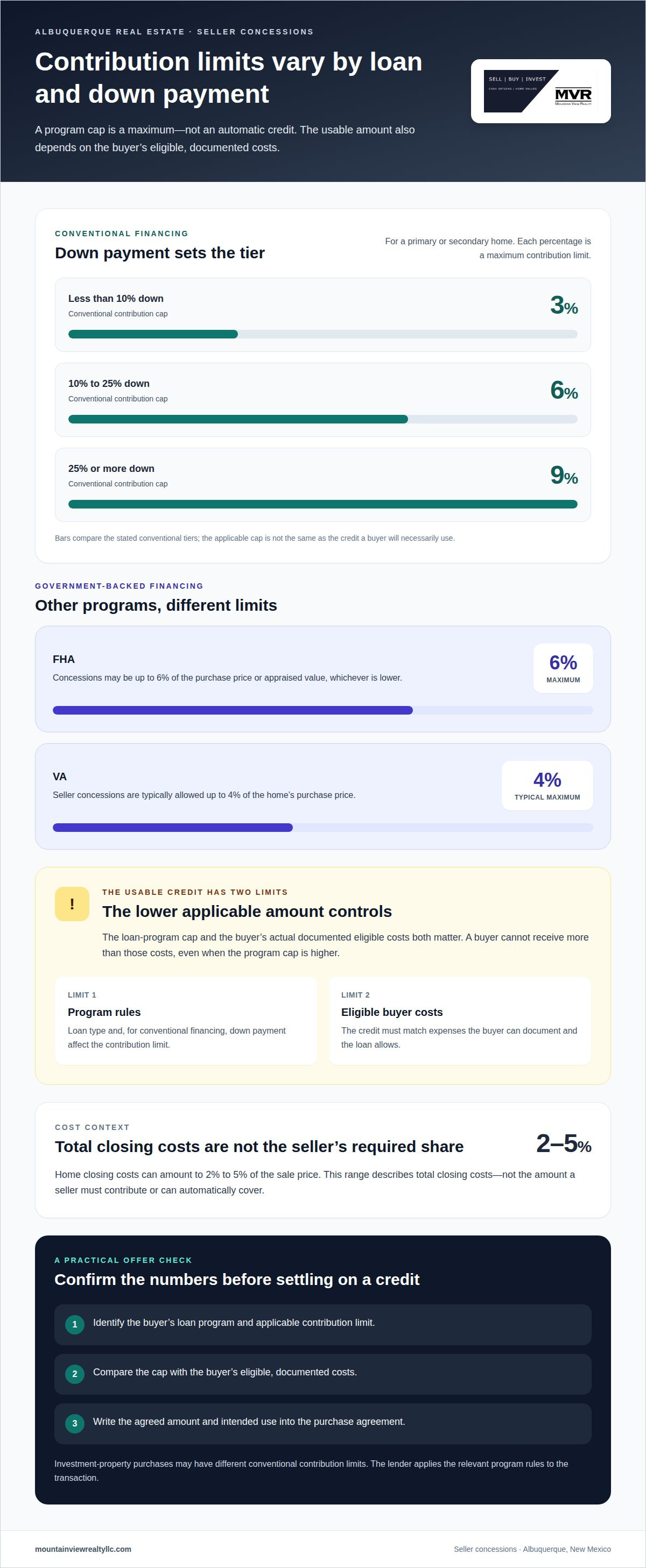
For a primary or secondary home, conventional limits commonly follow the buyer’s down payment. The applicable cap is 3% with less than 10% down, 6% with 10% to 25% down, and 9% with 25% or more down. These are maximum contribution limits, not automatic credits. A buyer cannot receive more than actual documented closing costs.
Investment-property purchases may be subject to different conventional seller-contribution limits. That distinction can change negotiations for an investor buying a rental home compared with an owner-occupied purchase. A listing can offer a concession, but the buyer’s loan terms and eligible expenses still shape the usable amount. The lender applies the appropriate limit to the transaction.
The percentage applies to the purchase price, but the buyer’s documented costs may be lower. The lesser applicable amount controls the credit available at closing.
Limits by Down Payment
For conventional financing, the buyer’s down payment determines which contribution tier applies. This matters because a larger down payment can correspond to a higher permitted seller contribution for a primary or secondary home.
With less than 10% down, the cap is 3%. With 10% to 25% down, it is 6%. With 25% or more down, it is 9%. These limits help buyers and sellers frame an offer that matches the financing instead of requesting an unusable amount.
Government-backed programs use different rules. The Federal Housing Administration permits concessions up to 6% of the purchase price or appraised value, whichever is lower.
The U.S. Department of Veterans Affairs typically allows seller concessions of up to 4% of the home's purchase price. The U.S. Department of Agriculture loan program permits seller concessions of up to 6% of the home's purchase price.
These program limits are not interchangeable. A buyer comparing FHA, VA, USDA, or conventional financing needs the cap for the specific loan. The lender also considers the buyer’s documented costs, which may be below the program maximum.
Closing costs that seller concessions can cover
Seller concessions can help cover eligible costs the buyer would otherwise pay at closing. The purchase agreement should state how the credit will be used, while loan rules and documented expenses determine what can be applied.
Eligible Closing Costs and Expenses
Eligible costs are transaction expenses the buyer’s loan and closing documents allow the seller’s contribution to cover. A credit reduces upfront cash needs only when it matches an eligible expense.
Common examples include appraisal fees, title search fees, loan origination fees, inspection fees, homeowner association fees, and real estate taxes. These charges arise at different stages, but a negotiated credit can help address them at closing.
One buyer might request help with appraisal and title search fees, while another may need assistance with an HOA fee. The purchase agreement can identify the intended expense or describe the concession as a credit toward eligible closing costs. The settlement statement shows how the agreed amount is applied.
Concessions cannot create a cash payment beyond the buyer’s actual documented closing costs. If the agreed credit exceeds those costs, the unused amount does not become extra cash for the buyer. Matching the request to expected expenses makes the offer clearer for both parties.
Closing Cost Assistance and Credits
A closing-cost credit is a seller contribution applied to eligible buyer expenses during closing. It can preserve the agreed purchase price while lowering the funds the buyer needs to bring to the transaction.
For example, a seller contributing 3% of a $300,000 home price provides $9,000 toward the buyer’s closing costs and other relevant expenses. The final usable credit still depends on the buyer’s documented costs and loan rules. The amount should be written into the purchase agreement, not left as an informal promise.
Credits can also help buyers manage prepaid expenses due at closing. The buyer and seller can negotiate which expenses the contribution addresses, then the closing documents reflect the approved allocation. This gives the seller a defined concession and the buyer a clearer picture of upfront costs.
Repairs and Other Potential Costs
Yes, concessions may apply to prepaid expenses, real estate taxes, and repairs negotiated after an inspection. A seller may offer a closing credit for future repairs instead of completing the work before closing. Eligible loan costs may also include discount points for a rate buydown, subject to the loan program’s rules.
Mortgage discount points may be used to lower a buyer’s interest rate. A credit used for points may reduce the rate, while a repair credit addresses a different need. The buyer and seller should specify the agreed purpose in the purchase agreement.
Inspection findings can shape negotiations. If the parties agree on a repair credit, the written terms should identify the amount and intended use. A concession does not guarantee that every repair or prepaid item qualifies; loan rules and closing documents determine how the credit can be applied.
How seller concessions work in a purchase offer
A buyer can request a seller credit in the purchase offer, and the seller can accept, reject, or negotiate that term. The written agreement should state the amount and intended use.
Credits Instead of Completed Repairs
A repair credit is an agreed contribution toward repair costs instead of the seller completing the work before closing. It gives both parties a way to address inspection findings while keeping the transaction moving.
For example, after an inspection identifies a repair concern, the buyer might request a closing credit rather than ask the seller to arrange the work. The seller can consider the proposed amount and whether a credit fits the rest of the offer. The agreement should spell out the accepted credit and its purpose.
A credit does not mean the buyer receives unrestricted cash. It is applied through closing, and loan rules and eligible expenses govern its use. The appraisal also matters: whether concessions can be rolled into a mortgage depends on the loan type and appraisal, and the home must appraise at the agreed price to validate the concession.
Seller Reasons for Offering Concessions
Sellers may offer concessions to make a listing more appealing, address a buyer’s expense concerns, or resolve repair negotiations. This can provide flexibility without changing the stated purchase price, though the credit still reduces the seller’s proceeds.
For instance, a seller could offer a $5,000 credit toward a buyer’s closing costs while keeping the purchase price intact. That may help a buyer manage upfront costs, but the credit must fit loan limits and eligible expenses. A credit is not automatically better than a price reduction; each changes the transaction differently.
Some sellers offer a concession upfront to attract buyers, while others negotiate one after an offer or inspection report. In either case, the buyer and seller can assess the amount alongside the price, requested repairs, and other contract terms. A clear dollar figure makes the proposal easier to evaluate.
Once both parties agree, the purchase agreement records the concession rather than relying on a verbal understanding. The settlement statement reflects the allowed concession at closing. If the appraisal does not support the agreed price, the parties may need to revisit the terms because the appraisal can affect whether the credit works with the loan.
Comparing concessions with a price reduction
A seller concession keeps the contract’s purchase price intact, while a price reduction lowers it. In New Mexico, the appraisal and loan program affect whether a concession can be used and how much the buyer can receive. The home must appraise at the agreed price to validate a concession.
Consider a $400,000 offer with a $10,000 seller concession. Before selling costs, that gives the seller the same net as a $390,000 offer without a concession. The buyer’s immediate benefit differs: the credit can help cover eligible closing expenses, while the lower purchase price does not provide a closing credit.
Start the comparison with the buyer’s cash needs and the seller’s expected proceeds. A buyer short on upfront funds may value an eligible credit more than a lower price. A buyer focused on the mortgage balance may prefer a reduced purchase price, which can affect the amount financed. The lender also applies loan limits and documented-cost rules to concessions.
Appraisal is a key distinction. A concession does not automatically make the home worth more, and the agreed price still needs appraisal support for the concession to work with the loan. If the appraisal comes in below the contract price, the buyer and seller may need to reconsider the price or terms. A price reduction changes the contract price directly, while a credit remains a separate negotiated term.
Interest and long-term financing can also shape the choice. A purchase-price reduction may lower the amount financed, depending on the loan and down payment. A seller credit could instead help cover eligible expenses or discount points, if the loan allows that use. For example, one mortgage discount point lowers the buyer’s interest rate by 0.25%, but the buyer must compare that use with other eligible costs.
For the seller, a concession and a price reduction affect the negotiated deal in different ways, even when the estimated net is similar. The $400,000 and $390,000 example leaves out selling costs, and the buyer’s usable credit depends on eligible expenses. Comparing the contract price, likely net proceeds, appraisal, and loan terms makes the trade-off clearer.
Mountain View Realty
Mountain View Realty LLC helps New Mexico sellers weigh buyer concessions against other ways to structure a sale. The right approach depends on your priorities, property condition, and desired timing. A conversation can clarify how a concession may affect your expected proceeds and whether another selling path better fits your plans.
For sellers considering alternatives to a traditional listing, CashOffer+, Home Trade-In, Renovate & Sell, and Short Sale offer different ways to approach a home sale. Each addresses a different situation, from exploring an off-market cash offer to preparing a home for the market or managing a short sale. The focus is on matching the sale strategy to your circumstances, not assuming concessions are always the answer.
Contact Mountain View Realty LLC to discuss your home sale and the options that fit your goals.
Choose the selling approach that fits your priorities
Start by deciding what matters most in your sale. You might prioritize timing, preparation, or flexibility around your next move. Naming those priorities helps keep decisions focused as you consider the path ahead.
A conversation about seller concessions in New Mexico real estate can be part of a broader review of your selling goals. Mountain View Realty LLC can help you think through how the terms of a sale fit your circumstances and what you want your next chapter to look like.
With a clear sense of your priorities, you can approach your next move with greater confidence.
Frequently Asked Questions
What are some examples of concessions I can offer?
A seller might offer to pay a buyer’s attorney fee as part of an offer negotiation. This can be useful for a buyer who wants legal help with the transaction. Another option is agreeing to leave a requested non-realty item, if both parties include it in their agreement. Keep personal property distinct from credits toward transaction expenses, since the sale terms handle them differently.
What are seller concessions in a New Mexico real estate transaction?
They are negotiated seller contributions or terms that address specific buyer expenses or requests within a home sale. For an advertised MLS concession, the seller must state the total sum offered and cannot make it conditional on using or paying a buyer’s agent. A seller’s payment toward a buyer’s broker fee is treated separately, excluded from the concession limit, and must be made off-MLS.
What closing costs can New Mexico sellers pay for buyers?
Sellers can agree to pay eligible buyer expenses allowed by the loan and transaction terms. Property taxes are typically based on assessed value rather than the specific financial arrangements of the sale. A negotiated credit or different division of transaction expenses does not itself set the property’s tax assessment. Closing documents show how approved payments are applied.
How do New Mexico seller concession limits vary by loan type and down payment?
The applicable limit depends on the financing program, down payment, and whether a conventional purchase is for an investment property or a primary or secondary home. FHA, VA, and USDA loans each have program-specific rules. Treat the program’s maximum as a ceiling, not an amount the buyer automatically receives. The practical figure is constrained by eligible, documented expenses and the selected loan’s rules.
How are seller concessions negotiated and written into a New Mexico purchase agreement?
The offer should state the agreed terms clearly, while buyer-agent compensation follows its own agreement. NMAR Form 2140 is the Buyer Representation Agreement used to establish compensation terms with a client before showing property. This distinction helps prevent a seller’s advertised concession from being tied to using or paying a particular buyer’s agent. The MLS display rules for concessions can also differ by MLS.
How do seller concessions compare with a price reduction in a New Mexico home purchase?
A concession and a price reduction affect the negotiated sale differently, but neither alone determines property taxes. New Mexico property taxes are typically based on assessed value rather than the financial arrangements of a sale. Buyers and sellers should compare how each proposed term fits the financing and agreed terms, rather than assume either option changes the tax assessment by itself.
What is the average amount or percentage of seller concessions in New Mexico home sales?
There is no fixed average seller-concession amount in New Mexico; it depends on the offer and circumstances. Sellers typically pay closing costs of about 2.73% of the final sale price, but that is not an average concession.

Article by
Robb Krautbauer
Robb Krautbauer is the Owner and Qualifying Broker of Mountain View Realty, serving Albuquerque, Rio Rancho, Santa Fe, and surrounding New Mexico communities. With more than a decade of real estate experience, Robb specializes in luxury homes, strategic home marketing, and helping homeowners navigate important life transitions with confidence.
Known for combining luxury-level marketing, AI-powered technology, and innovative selling strategies, Robb helps clients maximize their home's value while creating a smooth, personalized selling experience. Whether assisting luxury homeowners, retirees, families downsizing, or real estate investors, his focus is always on delivering expert guidance, honest advice, and exceptional results.
When he's not helping clients achieve their real estate goals, Robb enjoys studying market trends, emerging technology, and investment strategies that keep Mountain View Realty at the forefront of the industry.
Disclaimer
**Disclaimer:** The information provided in this article is for general educational purposes only and should not be considered legal, tax, financial, or professional advice. Real estate laws, market conditions, and regulations change over time and may vary based on your individual circumstances. Before making any real estate decision, consult with qualified legal, tax, or financial professionals. If you have questions about buying or selling real estate in New Mexico, contact Mountain View Realty for guidance specific to your situation. © 2026 Mountain View Realty. All rights reserved. The content on this website may not be reproduced without written permission.


