
Seller Leaseback Program: How a Home Sale and Rent-Back Work
A home sale doesn’t always require an immediate move. In a seller leaseback, the buyer closes on the home and the seller stays temporarily as a tenant under a written agreement. That’s what a seller leaseback program is: a way to coordinate a sale with more time to move.
It’s understandable to want clear terms before agreeing to stay in a home you’ve sold. This article explains how leasebacks work, what the agreement should cover, and how to negotiate rent, the move-out date, and responsibility for the property.
You’ll also learn how an agent can help coordinate the sale and temporary stay, so you can weigh the arrangement against your next move with greater clarity.
Key Takeaways
- A seller leaseback lets the seller remain in the home after closing as a tenant for an agreed period.
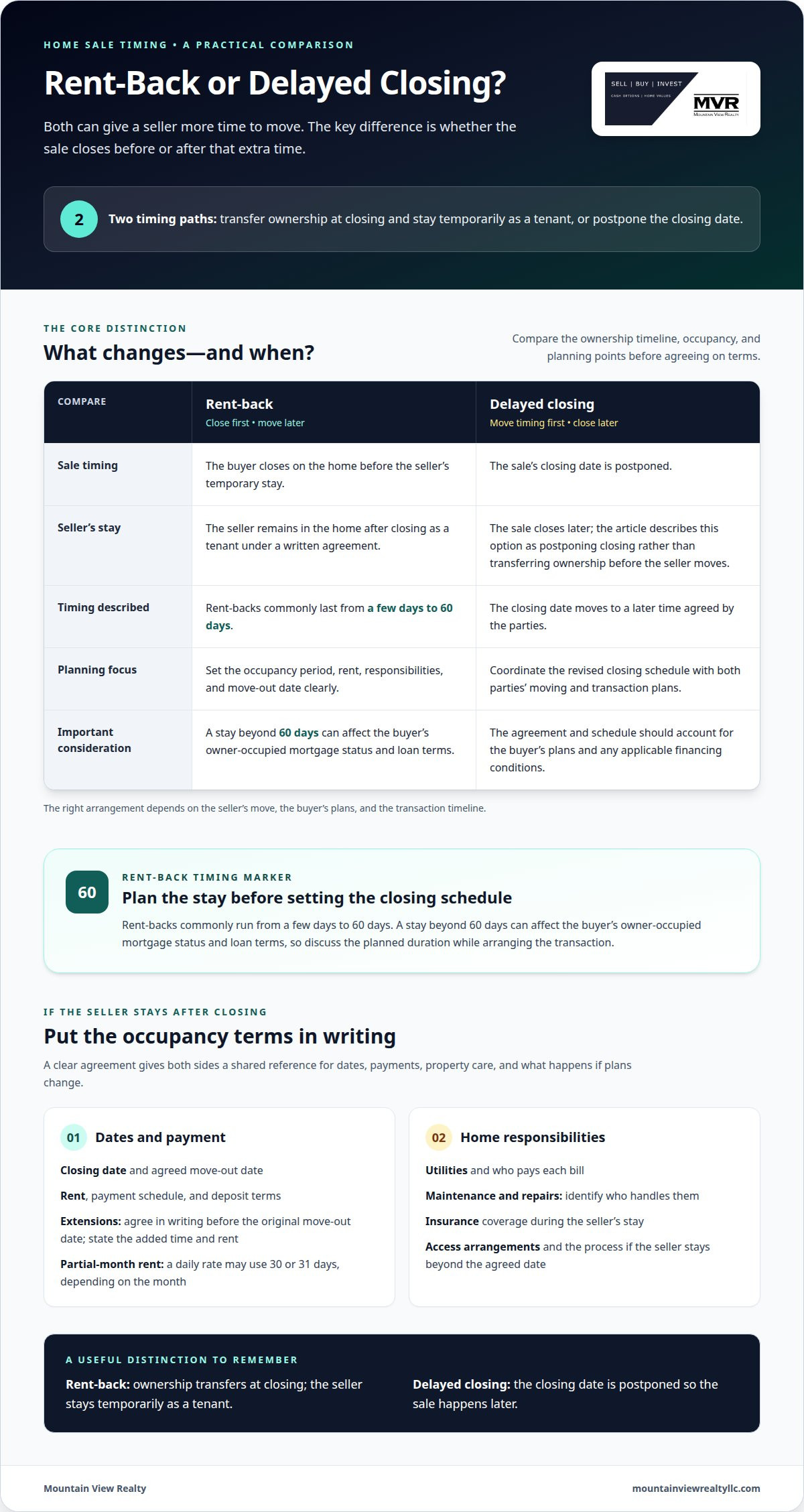
- Compare a rent-back with delayed closing: one transfers ownership before the seller moves, while the other postpones the sale’s closing date.
- Put the move-out date, rent, property responsibilities, and other key terms in a written agreement.
- Negotiating the arrangement alongside the purchase agreement can help both parties align the timing and terms.
- If you’re coordinating a sale and purchase, Mountain View Realty’s Home Trade-In may offer another path to consider.
So, what’s a leaseback and how does it work?
Understanding what a seller leaseback program involves starts with the closing date: the buyer takes ownership, and the seller remains temporarily under a written rental agreement. The arrangement can bridge a move, but rent, responsibilities, and move-out timing need clear terms.
Rent-Back and Sale-Leaseback Options
A rent-back is a short stay after closing, while sale-leaseback can describe a broader sale followed by continued occupancy as a tenant. The distinction matters because the length and purpose of the stay shape the agreement. A seller moving into a new home soon may need a brief rent-back; longer occupancy calls for closer attention to financing, lease terms, and the buyer’s plans.
Lease Terms and Renewals
Lease terms set the occupancy period, rent, and whether the parties can extend the stay. Any extension should be agreed in writing before the original move-out date, with its duration and additional rent specified. A rent escalator means rent increases at stated points or under a stated formula. Defining these details upfront helps both parties plan for a delayed move without relying on informal promises.
Payment and Property Responsibilities
Payment and property responsibilities clarify who covers rent, utilities, maintenance, and insurance during the seller’s stay. The buyer owns the home after closing, but the agreement can assign specific costs to the seller. The seller’s mortgage is generally paid off through the sale closing; the buyer’s mortgage obligations are separate from the seller’s rent. The written terms should identify who arranges repairs and maintains insurance coverage.
Who pays utilities, maintenance, and insurance during a leaseback? The agreement should name the responsible party for each expense. For example, it can assign utility bills to the seller while specifying who handles repairs and insurance during the stay.
Seller Leaseback Agreement Terms
A seller leaseback agreement should state the closing and move-out dates, rent, payment schedule, deposit terms, utilities, maintenance, insurance, and access arrangements. It should also explain the extension process and what happens if the seller stays beyond the agreed date. If the seller misses that date, the buyer may rely on the agreement’s stated remedies and applicable law. Clear terms reduce uncertainty for both sides.
Rent calculations can use a daily rate for a stay shorter than a month. Depending on the month, the calculation may divide by 30 or 31 days. The agreement should also explain how partial periods and payment dates are handled.
For tax planning, the Internal Revenue Service says the U.S. primary-residence capital-gains exclusion under IRC §121 is $250,000 for single filers and $500,000 for married couples filing jointly, subject to the residency test. A leaseback does not replace that test. Sellers should consider how the sale and occupancy timeline relate to their tax situation.
What Is a Leaseback Agreement in Real Estate?
Post-closing occupancy needs to fit the seller’s move, the buyer’s plans, and the transaction timeline. A clear schedule helps both parties coordinate possession, financing, and the next steps for the home.
Rent-Backs and Delayed Closings
A rent-back arrangement gives the seller an agreed period to remain in the home after the sale. The timing can help a seller coordinate a move, wait for a new home, or avoid storing belongings between moves. Rent-backs commonly last from a few days to 60 days.
For buyers, the planned occupancy period affects when they can use or prepare the property. An investor may plan around a tenant’s departure, while a buyer preparing to move in needs a clear possession date. Discussing those plans before finalizing the purchase helps set realistic expectations for both parties.
Some sellers need more time because their next home is still being built or an estate transition involves several family members. A buyer may have their own moving or renovation schedule. The parties can consider those timing needs together and set a practical occupancy plan.
Rules for Post-Closing Occupancy
Post-closing occupancy is shaped by the written agreement and the rules that apply where the property is located. In the United States, forms and requirements can vary by state, so terms used for a home in one location may not suit a New Mexico transaction.
The agreement should connect the occupancy period to the purchase documents and the buyer’s financing conditions. A stay beyond 60 days can affect a buyer’s owner-occupied mortgage status and loan terms. That makes the planned duration important to discuss while the transaction is being arranged, rather than after the closing schedule is set.
Local rules may also shape how the parties document possession and address a seller who stays beyond the agreed date. A written record of dates, payments, and responsibilities gives both parties a reference for carrying out their agreement.
Risks for Buyers and Sellers
A seller’s continued occupancy can affect the buyer’s move-in plans, property preparations, or intended rental schedule. For example, a buyer planning immediate renovations may need to reschedule contractors if the seller’s move takes longer than expected. Agreeing on access and possession arrangements can help the buyer plan around the occupancy period.
Sellers also face practical risks. A delayed move can affect their next housing arrangement, while unclear terms can lead to disagreement about property care or the handover. Documenting the expected move-out date and what happens if plans change can reduce uncertainty.
In Albuquerque, buyers and sellers can discuss how the proposed timeline fits the transaction and their next steps. A conversation about home-sale timing can help bring those priorities into focus before the parties settle their plans.
Negotiating a leaseback during a home sale
Negotiate occupancy, rent, and purchase terms together, before signing the contract. The right balance depends on whether the seller needs a brief move-out window or a longer rental arrangement.
Sale Price Discounts and Program Fees
Sale price discounts and program fees affect how much a seller receives after selling and continuing to occupy the home. Some long-term sale-leaseback offers begin at 85-95% of fair market value before fees, with sellers potentially netting 78-90% after program fees. These figures make the offer price only one part of the comparison.
Long-term program fees are reported at 3-10% of home value, while annual rent is often 5-8% of home value. Compare the net proceeds, rental obligation, occupancy term, and any conditions that affect payment. A higher offer can be less favorable if fees or ongoing rent reduce the seller’s overall proceeds.
For a fair comparison, examine each proposal’s purchase price, deductions, rent schedule, deposit, and move-out conditions. The contract should show how each amount affects the seller’s net proceeds, rather than presenting the purchase price alone.
Long-Term Sale-Leaseback Programs
A long-term sale-leaseback lets the seller transfer ownership to an investor and remain as a residential tenant under a longer rental contract. Some programs offer terms of up to five years, and investors typically seek a tenant commitment of 10+ years. That difference makes the renewal and early-exit terms especially important.
Investors may assess the property, sale price, rental income, and occupancy period as parts of one investment. Compare the written contract’s rent increases, renewal options, deposit, maintenance duties, and termination terms. A seller planning a future move should understand how the contract handles a sale or departure before its full term ends.
State rules and forms can differ, so the agreement’s terms should fit the property’s location. Negotiation generally means agreeing on the sale and occupancy structure, recording it in writing, and aligning the closing date with the rental start.
Fees, Deposits, and Rent Amounts
Typical seller leaseback costs depend on whether the arrangement is a short rent-back or a longer sale-leaseback program.
What are typical seller leaseback fees, deposits, and rent amounts? The rent calculation and total cost depend on the written terms and occupancy period.
To arrange a leaseback, the parties negotiate the purchase and rental terms, document the occupancy agreement, and coordinate it with closing. Rules and forms vary by state, so a residential agreement should reflect the property’s location and the agreed responsibilities. A clear contract helps both parties understand the financial and move-out terms.
Sale-leaseback definition and transaction structure
A sale-leaseback pairs a property sale with a separate rental commitment. Understanding the two financial sides helps sellers assess what the proceeds mean for their next move.
Sale and Lease Transaction Structure
Think of the transaction as two connected calculations, not one net figure. The sale side sets the agreed purchase price and accounts for amounts paid from closing proceeds. The lease side sets rent and other occupancy costs over the agreed term. Looking at each separately helps sellers see how much cash may remain after sale obligations and what ongoing rental payments will require.
For example, a seller planning to buy another home can compare anticipated proceeds with the next purchase’s cash needs. The seller can then consider the rent obligation separately as part of the transition budget. This makes the tradeoff clearer: proceeds may support a next step, while rental payments continue during occupancy.
Buyers can assess the rental commitment against their financing and planned use of the property. A buyer focused on investment may weigh expected rent and future occupancy differently from someone planning to use the home personally. The transaction works best financially when the purchase terms, rental obligation, and each party’s plans are considered together.
Before agreeing, the parties can compare the sale documents and lease terms side by side. They should ensure the financial terms use consistent dates and describe payments clearly. A written schedule can show when rent is due and how the rental term relates to the sale, helping both sides understand their cash flow.
Purpose of a Seller Leaseback
The purpose is to pair access to sale proceeds with continued use of the property for an agreed period. That structure may help a seller whose next housing plans need time to settle, while giving the buyer a defined rental arrangement. The key question is whether the proceeds and rental costs support the seller’s broader financial plan.
Consider a seller deciding whether to use sale proceeds toward a replacement home or keep funds available for another priority. The choice depends on obligations due at closing, expected housing costs, and the seller’s plans after moving. A leaseback does not eliminate those tradeoffs; it gives the parties a way to structure them within the sale.
Buyers also need to consider how the arrangement affects their intended use of the property. A buyer may value the agreed rental income, while another may prioritize future personal use. The negotiated terms should reflect those interests so each party understands the financial commitment before signing.
Real estate agent assistance with leaseback agreements
A real estate agent can connect the sale terms with the seller’s move-out plan. The agent can help the parties negotiate occupancy details, align dates, and keep the transaction moving toward closing.
Start with the seller’s actual timing needs. If a home purchase, estate transition, or relocation affects the move, the agent can raise that timing with the buyer early. That gives buyers a clearer picture of the requested stay before they decide whether it fits their plans.
The agent can also help turn broad requests into terms the parties can discuss. “A little more time” becomes a specific move-out date, a defined rent arrangement, and a plan for returning possession. The buyer can then consider how the proposed rental period affects their own move, investment goals, and expected use of the property.
During negotiation, the agent can organize the practical points that need agreement:
- Set the occupancy start and end dates alongside the sale’s closing date.
- Record the rent amount, due dates, and how partial periods are calculated.
- Clarify responsibility for utilities, routine care, repairs, and insurance.
- Agree on any security deposit, its purpose, and how its return will be handled.
- Document access arrangements, property condition, and the final key handoff.
These details matter because the buyer becomes the owner while the seller remains in possession. For example, if a repair issue arises during the stay, written terms about responsibility can help prevent confusion over who coordinates the work. The agent can keep the negotiated points visible as the purchase agreement and occupancy documents are prepared.
Agents can help buyers compare the proposed stay with their financing and moving plans. A buyer expecting to occupy the home after closing may view the same leaseback differently from an investor planning rental use. The agent can raise that difference early and help both parties discuss workable terms before deadlines tighten.
For sellers, an agent can connect the leaseback timeline to the next step, such as coordinating a purchase or moving household belongings. For buyers, the agent can help clarify the expected possession date and how the seller’s temporary occupancy fits the transaction. A written record of agreed terms gives each party a practical reference through closing and move-out.
In Albuquerque and nearby New Mexico communities, a well-managed negotiation keeps the sale, temporary rental, and handover connected. The key is to address the occupancy plan as part of the transaction, not as an informal promise after the purchase terms are settled.
Mountain View Realty: Home Trade-In
Mountain View Realty’s Home Trade-In may be worth discussing if you’re selling one home while planning to buy another. A leaseback addresses the time between selling and moving; a Home Trade-In offers another approach to coordinating a home sale and purchase.
The right path depends on your priorities, including when you need to move, how you plan to handle the next purchase, and whether temporary occupancy fits your plans. A conversation can clarify how these considerations shape your options, without assuming a leaseback is the best fit.
If you’re weighing a leaseback against a coordinated sale and purchase, contact Mountain View Realty to discuss your situation.
Choose a sale path that fits your next move
Knowing what a seller leaseback program is can help you decide whether a temporary stay belongs in your plans. The next step is to look beyond the closing date and consider how you want to move forward. Do you need time between selling and buying, prefer to explore a different sale structure, or want to prepare the home before it goes on the market?
Mountain View Realty offers options such as CashOffer+, Home Trade-In, and Renovate & Sell. Each addresses a different selling priority. A conversation about your timing, property, and next purchase can help identify which approach merits consideration, without assuming a leaseback is the right fit.
Share what matters most in your move and discuss a plan that fits your goals.
A thoughtful next step can make your transition feel more manageable.
Frequently Asked Questions
What Are the Benefits?
A leaseback can help align a home sale with a seller’s next housing step. It may be useful when a move involves coordinating household members, preparing another property, or arranging transportation and storage. For buyers, the negotiated occupancy plan can make the seller’s transition part of the transaction rather than an unresolved issue. The benefit depends on whether the timing and responsibilities suit both parties’ plans.
What Is a Sale-Leaseback?
A sale-leaseback is a sale paired with a lease that lets the seller keep using the property as a tenant. In a residential transaction, the seller’s rental terms shape the period after the sale. In a commercial transaction, a business may sell its property and lease it back to continue operating there. The residential and commercial contexts differ, so the agreement should clearly describe the property’s intended use.
What Is a Seller Lease-Back in Albuquerque and When Does It Make Sense?
In Albuquerque, a seller leaseback can suit a homeowner whose next housing arrangement is not ready when the sale is set to close. It may also help coordinate a move involving family or an estate. The parties can consider whether the buyer needs immediate access, whether the seller has a firm next-step date, and how the agreement fits each person’s plans.
What is a rent-back agreement?
A rent-back agreement records the terms for a seller’s continued use of a home after its sale. It can clarify who may live in the property, whether the seller can keep pets, and how the parties will handle access for agreed purposes. Addressing these day-to-day details helps the buyer and seller understand how the arrangement will work in practice, beyond the financial terms.
How does a home seller leaseback work after closing?
After closing, the seller follows the occupancy terms agreed with the buyer. A useful practical step is to document the home’s condition and any included items before the continued stay begins. The parties can also set a clear process for reporting urgent property issues and arranging access. These details help manage the transition while the seller remains in the home.
How long can a seller stay in the home after closing?
The agreed end date determines the seller’s planned stay. A seller with a firm move-in date for another home may request a defined period, while a buyer may need a date that supports upcoming plans for the property. The agreement can also explain how the parties will handle a change in circumstances, such as a delayed move, so an extension is not left to assumption.
How is rent calculated in a seller leaseback agreement?
The parties can agree on a rental amount and specify how it applies during occupancy. Before signing, clarify whether rent is due in advance, how partial periods are handled, and which payment method the parties will use. A written payment schedule gives both sides a record of amounts due and dates, making it easier to track the rental arrangement.
How does a seller leaseback compare with a rent-back agreement or delayed closing?
A rent-back commonly describes temporary occupancy after a sale, while “seller leaseback” may refer to the broader sale-and-rental arrangement. Delayed closing changes the planned timing of the sale itself. To weigh these choices, consider whether the buyer needs access before the seller moves, how the seller’s next housing plan is progressing, and which arrangement best fits the transaction schedule.

Article by
Robb Krautbauer
Robb Krautbauer is the Owner and Qualifying Broker of Mountain View Realty, serving Albuquerque, Rio Rancho, Santa Fe, and surrounding New Mexico communities. With more than a decade of real estate experience, Robb specializes in luxury homes, strategic home marketing, and helping homeowners navigate important life transitions with confidence.
Known for combining luxury-level marketing, AI-powered technology, and innovative selling strategies, Robb helps clients maximize their home's value while creating a smooth, personalized selling experience. Whether assisting luxury homeowners, retirees, families downsizing, or real estate investors, his focus is always on delivering expert guidance, honest advice, and exceptional results.
When he's not helping clients achieve their real estate goals, Robb enjoys studying market trends, emerging technology, and investment strategies that keep Mountain View Realty at the forefront of the industry.
Disclaimer
**Disclaimer:** The information provided in this article is for general educational purposes only and should not be considered legal, tax, financial, or professional advice. Real estate laws, market conditions, and regulations change over time and may vary based on your individual circumstances. Before making any real estate decision, consult with qualified legal, tax, or financial professionals. If you have questions about buying or selling real estate in New Mexico, contact Mountain View Realty for guidance specific to your situation. © 2026 Mountain View Realty. All rights reserved. The content on this website may not be reproduced without written permission.


