
Selling My House and Renting It Back to Avoid Moving Twice
Moving twice isn’t the only way to sell your home. Selling your house and renting it back to avoid moving may let you stay after closing, but you’ll become a tenant in a home you once owned. The lease terms and total costs matter just as much as the sale price.
If you’re considering this option, you may want less disruption without losing sight of your finances or future plans. A sale-leaseback can give you time to plan your next move, but it isn’t right for every seller. Your ability to stay depends on the terms you agree to with the buyer.
This guide explains how the arrangement works, what costs and lease responsibilities to consider, and what may affect eligibility. You’ll also see how it compares with alternatives for accessing home equity, including a reverse mortgage, which is available only to homeowners age 62 and older, according to the Consumer Financial Protection Bureau. Use the key questions before signing to assess whether a sale-leaseback fits your priorities in Albuquerque and the wider New Mexico market.
Key Takeaways
- A sale-leaseback lets you sell your home and remain there as a renter, but your right to stay depends on the lease terms.
- Estimate the full cost of moving twice, then compare it with the rent and other expenses in a sale-leaseback agreement.
- Assess whether your home and financial needs fit the arrangement, and compare it with other ways to access home equity.
- Before signing, clarify rent, lease length, maintenance responsibilities, and what happens when the lease ends.
- Mountain View Realty’s Sell & Stay may be relevant if you want to explore selling while remaining in your home for a period.
Comparing sale-leasebacks with other equity options
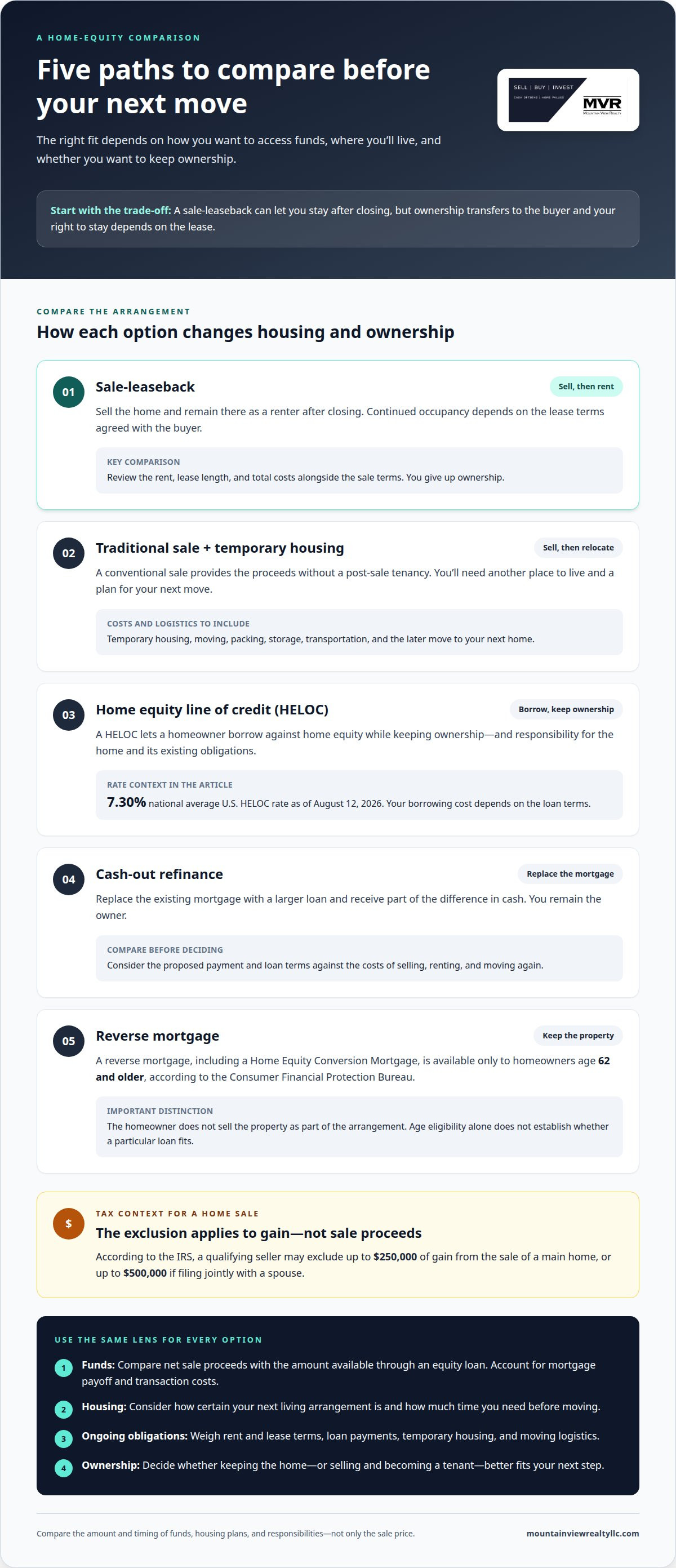
Compared with a traditional sale followed by temporary housing, a sale-leaseback may let you stay in the same home after closing. The tradeoff is that you give up ownership, and your continued stay depends on a lease with the buyer. A conventional sale gives you the proceeds without a post-sale tenancy, but you’ll need to arrange another place to live.
A home equity line of credit, or HELOC, lets a homeowner borrow against home equity while keeping ownership. The national average U.S. HELOC rate was 7.30% as of August 12, 2026. That rate gives context, but your borrowing cost depends on the loan terms. Unlike a sale-leaseback, a HELOC leaves you responsible for the home and its existing obligations.
A cash-out refinance replaces your existing mortgage with a larger loan, and you receive part of the difference in cash. It may suit an owner who wants to remain in the home and can manage the new loan. Compare the proposed payment and loan terms with the costs of selling, renting, and moving again. With a refinance, you remain the owner, not a tenant.
A reverse mortgage is another equity option for some older homeowners. A reverse mortgage, including a Home Equity Conversion Mortgage, is available only to homeowners age 62 and older, according to the Consumer Financial Protection Bureau. It differs from a sale-leaseback because the homeowner does not sell the property as part of the arrangement. Age eligibility alone does not establish whether a particular loan fits.
Taxes also belong in the comparison. A qualifying seller may exclude up to $250,000 of gain from the sale of a main home, or up to $500,000 if filing jointly with a spouse, according to the Internal Revenue Service. This exclusion concerns gain, not the amount of sale proceeds. Your equity calculation should also account for mortgage payoff and transaction costs before estimating what remains.
Consider a homeowner who needs time before moving but wants to access equity. A leaseback could reduce immediate disruption, while a HELOC or reverse mortgage may let the homeowner retain ownership. A traditional sale with temporary housing requires a separate housing plan. These options address different needs, so compare the amount and timing of funds, housing certainty, and ongoing obligations.
- Compare net sale proceeds with the borrowing amount available through an equity loan.
- For a leaseback, review the lease term and rent alongside the sale terms.
- For temporary housing, include the costs and logistics of moving out and moving again.
- For each option, weigh whether keeping ownership or leaving it behind better fits your next step.
Costs and stress of moving twice
Two moves can mean arranging transportation, packing, and temporary housing more than once. Your total costs depend on the distance, your belongings, and the time between homes.
Costs of Moving Twice
Moving twice means planning and paying for one move, then arranging another later. The second relocation can add costs that a single move wouldn’t involve. Consider the mover’s estimate, packing supplies, storage, and transportation between temporary housing and your next home. These expenses can reduce the funds available for your next transition.
Build a separate budget for each move. For the first, list packing, loading, and delivery expenses. For the second, include the new destination, storage retrieval, and any extra handling. If you’re moving into temporary housing, you may also need to transport essential belongings separately from the items you put in storage.
Use a simple worksheet to capture the details:
- List the belongings that need movers, storage, or separate transport.
- Record the expected dates and destinations for both moves.
- Include temporary housing and storage in the same transition budget.
- Update the estimate if your destination or timing changes.
This approach makes the full sequence visible and helps distinguish one-time expenses from costs that continue during the gap between homes.
Stress of Moving Twice
The stress of moving twice comes from repeating the planning, packing, and settling-in tasks. A home sale, temporary stay, and later move can also create overlapping responsibilities. For example, a household might coordinate a closing, arrange a temporary place to stay, and schedule movers for its next home.
Each transition brings practical decisions. You may need to redirect mail, update service accounts, and decide which belongings to keep accessible. A second move means handling those tasks again while adapting to a new space. For a family coordinating a school change or a senior downsizing, this can disrupt familiar routines.
Map out the sequence before setting dates. Note when you expect to leave, where you plan to stay, and what needs to go into storage. Then identify the items you’ll need during the temporary period. This plan can show whether the gap between homes is workable or whether another housing arrangement merits consideration.
Compare the full logistics, not just the mover’s estimate. A sale followed by temporary housing requires a plan for your belongings and a later destination. A sale-leaseback avoids an immediate move but creates a rental arrangement after ownership changes. Compare the options based on your timing, housing plans, and comfort with renting the home.
If you’re weighing timing and relocation needs in Albuquerque, explore sale options around your move as part of your planning.
Homeowner and property eligibility
Whether a sale-leaseback works depends on the seller, the home, and the proposed lease. Reviewing all three helps you assess whether the sale and continued occupancy can fit together.
Homeowner Eligibility
Assess whether you can complete the sale and meet the rental agreement’s terms. Selling transfers ownership, while staying requires a separate agreement with the buyer. If you plan to remain in the home, consider the rent, lease duration, and your ability to follow the lease after closing.
For example, a seller who needs a short transition has different timing needs from one who wants a longer stay. The buyer may also consider whether your plans and finances support the proposed rent. Clear details about when you expect to move out help both sides decide whether the arrangement makes practical sense.
Property Eligibility
Property eligibility means assessing whether the home’s condition, ownership details, and sale terms fit the buyer’s plans. A buyer evaluates both the property and the occupancy they would allow afterward. For example, a home needing repairs may prompt different discussions than a move-in-ready property.
Title and mortgage details also shape the sale. Understand how existing liens or a mortgage payoff affect your proceeds. The home’s location, type, and condition can influence buyer interest, and the requested lease is another consideration. No single property feature determines whether a sale-leaseback will proceed.
Start with the transaction details. Identify everyone named as an owner, any existing mortgage, and the sale terms under consideration. This helps clarify who needs to participate and which obligations the sale must address. For a jointly owned home, for example, account for all ownership interests before planning to remain as a tenant.
Then define how long you intend to stay. Set out your preferred lease start, expected duration, and a realistic move-out plan. A seller coordinating a move into a new home may need a different lease structure from someone navigating a family transition. The buyer’s willingness to accept your proposed terms is central to the plan.
Review the property’s condition candidly. Note known repairs, recent updates, and any areas that may affect the buyer’s assessment. A home with deferred maintenance may lead to different sale discussions than one in strong condition. Accurate information helps you avoid basing your stay plan on assumptions about the property or sale.
Finally, compare the proposed rent with your post-sale budget. Include recurring housing costs and the timing of your expected move. A seller whose income changes after closing may need a different plan from one with stable income. Reviewing your finances, property details, and occupancy goals together gives you a clearer picture of whether the arrangement fits.
Questions to ask before signing
Before signing, get the tax treatment, occupancy terms, rent, and responsibilities in writing. A clear agreement helps you understand what changes with the sale and what staying will require.
Tax Consequences of Selling and Renting Back
Tax consequences concern how the sale proceeds and any gain are treated after closing. A sale followed by a rent-back may have tax effects beyond the cash you receive. A qualifying main-home sale may benefit from an exclusion described earlier. The Internal Revenue Service also says an agreement that appears to be a lease may be treated as a conditional sale, depending on intent and the facts and circumstances.
Ask how the written agreement describes the transfer and occupancy. Confirm the sale price, mortgage payoff, and any amount treated as gain with a tax professional familiar with your circumstances. Under the IRS approach, the contract’s title alone does not determine its tax treatment.
Program Regulation and Restrictions
Program regulation covers the legal rules that may apply to a sale and the lease that follows. Residential sale-leaseback transactions are legal in all 50 U.S. states. That answers whether the basic arrangement is permitted nationwide, but it does not mean every contract has identical terms or tax treatment.
In New Mexico, read the sale agreement and lease as connected but distinct documents. Identify the buyer, the property being transferred, the rent, and the conditions for staying. Clarify what happens if either party does not meet a written term. The IRS’s conditional-sale guidance also makes the parties’ intent and the agreement’s details relevant to tax characterization.
Rent After a Home Sale
Rent after a home sale is the amount the former owner agrees to pay to continue living in the home. It matters because sale proceeds don’t eliminate ongoing housing expenses. Rent is negotiated for the specific home and agreement, so a national average won’t determine what you’ll pay in Albuquerque.
Ask how the proposed rent was set and whether it can change during the lease. Confirm when payment begins, how to pay, and whether a deposit or other charges apply. Compare the full housing cost with your post-sale budget, not just the sale proceeds. Put every payment obligation in the signed documents.
Rent-Back Duration After Closing
The rent-back period is the time the lease allows you to occupy the home after ownership transfers. A closing date alone doesn’t establish how long you can stay. The written lease should state its start and end dates, along with any agreed process for extending or ending occupancy.
Ask what happens if your next home or moving plans change. Clarify whether the agreement allows an extension, how either party gives notice, and which terms apply at the end. A specific move-out plan can help you judge whether the agreed period fits your transition.
- Confirm the sale and lease terms match your understanding.
- Identify the rent, payment timing, occupancy dates, and extension terms.
- Clarify maintenance duties, utilities, and the process for reporting concerns.
- Understand what happens if you need to leave early or stay longer.
How much rent do sellers typically pay after selling their home?
There’s no single rent amount for every seller who stays after closing. The proposed rent depends on the property, its location and condition, the agreed occupancy period, and the terms negotiated with the buyer. For an Albuquerque home, a useful estimate should reflect comparable local rentals with similar features, not an unrelated national figure.
Start by describing the property accurately. Note its size, layout, condition, parking, outdoor space, and included appliances or furnishings. Then compare it with rentals that share those features in a similar part of the area. A furnished home or one with distinctive features may not compare directly with a basic unfurnished rental.
The length and structure of the stay can also shape negotiations. A seller seeking a brief transition may negotiate differently from one who needs a longer lease. The buyer’s plans for the property matter, too. State your requested move-out date and any flexibility clearly so both sides can assess the rent alongside the expected occupancy.
Build your household budget around the actual lease terms. Separate rent from utilities, deposits, and any other charges assigned to you. Consider how the payment fits your income and plans after closing. If the buyer pays for certain services or the lease assigns upkeep to one party, include those terms when assessing the overall housing cost.
Review the sale proceeds and rental obligations separately. Estimate what remains after the mortgage payoff and transaction expenses, then compare the rent and other recurring costs with that amount. This helps you assess whether the arrangement supports your next housing decision, rather than relying on the sale price or a rent estimate alone.
Before agreeing, ask how the proposed rent was set and which property comparisons informed it. Confirm the payment start date, due date, payment method, and whether rent can change during the lease. Make sure every charge and responsibility appears in the written agreement so your budget matches the terms you sign.
- Compare rentals with similar features and in a similar Albuquerque location.
- Separate rent from utilities, deposits, and other charges.
- Review your post-closing budget against the full lease obligations.
- Confirm the payment schedule and any rent-change terms in writing.
Mountain View Realty
Mountain View Realty LLC helps Albuquerque homeowners compare selling options based on timing, property condition, and next-step priorities. If staying in your home after closing matters to you, weigh the sale terms and occupancy plan carefully alongside the proceeds.
Options for sellers include CashOffer+, Home Trade-In, Renovate & Sell, and Short Sale. The right fit depends on your circumstances, including whether the home needs work or you’re navigating a financial challenge. A conversation can help you understand which sale strategy aligns with your plans.
Choose a Sale Plan That Fits Your Next Chapter
If you’re considering selling your house and renting it back to avoid moving, base the decision on the life you want after closing. Staying put may support a gradual transition, while another option may better suit your plans for the home and your next move. Start by clarifying what matters most: timing, flexibility, or a clean transition to a new place.
Bring those priorities to a conversation about your Albuquerque home. Mountain View Realty can help you consider sale approaches that fit your circumstances, without treating one option as right for every seller. A thoughtful plan can make the transition more deliberate and help you move forward with confidence.
Your next move can start with a clear plan and a choice that feels right for you.
Frequently Asked Questions
Should I Sell or Rent My House When I Move?
Sell if you’re leaving permanently and prefer not to take on landlord responsibilities; consider renting if you expect to return and can manage the home. If you’re selling your house and renting it back to avoid moving, assess how the arrangement fits your future housing plan, not just the immediate transition. For a temporary relocation, consider who will handle repairs and tenant needs while you’re away. Your expected return and ability to manage the property are key factors.
How does a sell-and-rent-back agreement work in the United States?
A sale-leaseback combines a home sale with an agreement for the seller to remain in the property as a renter. Before proceeding, make sure the closing documents and occupancy agreement use consistent dates and identify the correct property and parties. Clarify how keys, access, and utility accounts will be handled when ownership changes. In the United States, tax treatment can depend on the agreement’s terms and circumstances, so consider qualified tax advice.
Can I sell my house and rent it back from the buyer?
Yes, if the buyer agrees to let you remain after purchasing the home. The buyer’s plans for moving in, making repairs, or renting out the property may affect their willingness to accommodate your request. Raise your proposed stay early in sale discussions rather than assuming it can be arranged after the buyer commits. For example, a buyer who needs immediate access may not suit a seller planning a later move.
What steps should I take to negotiate and document a rent-back agreement?
Start by explaining why you need to stay and what timing would make your transition workable. As discussions progress, clarify the home’s condition at handover, how keys will be transferred, and how you’ll communicate about access or repairs. Keep written records of agreed details and retain signed copies. A real estate attorney or tax professional can review the contract language and identify issues specific to your transaction.
What tenant rights and landlord-tenant laws apply to a seller rent-back?
After closing, the seller becomes a tenant, and the right to stay, rent, lease length, and maintenance responsibilities depend on the lease terms agreed with the buyer. Residential sale-leasebacks are legal in all 50 states.

Article by
Robb Krautbauer
Robb Krautbauer is the Owner and Qualifying Broker of Mountain View Realty, serving Albuquerque, Rio Rancho, Santa Fe, and surrounding New Mexico communities. With more than a decade of real estate experience, Robb specializes in luxury homes, strategic home marketing, and helping homeowners navigate important life transitions with confidence.
Known for combining luxury-level marketing, AI-powered technology, and innovative selling strategies, Robb helps clients maximize their home's value while creating a smooth, personalized selling experience. Whether assisting luxury homeowners, retirees, families downsizing, or real estate investors, his focus is always on delivering expert guidance, honest advice, and exceptional results.
When he's not helping clients achieve their real estate goals, Robb enjoys studying market trends, emerging technology, and investment strategies that keep Mountain View Realty at the forefront of the industry.
Disclaimer
**Disclaimer:** The information provided in this article is for general educational purposes only and should not be considered legal, tax, financial, or professional advice. Real estate laws, market conditions, and regulations change over time and may vary based on your individual circumstances. Before making any real estate decision, consult with qualified legal, tax, or financial professionals. If you have questions about buying or selling real estate in New Mexico, contact Mountain View Realty for guidance specific to your situation. © 2026 Mountain View Realty. All rights reserved. The content on this website may not be reproduced without written permission.


