Short Sale vs. Foreclosure Help in Albuquerque: A Strategic 2026 Guide
What if the most comfortable choice you make today ends up being the costliest mistake for your financial future? It's understandable to feel overwhelmed by the weight of bank notices and the confusion of legal jargon. If you're searching for short sale vs foreclosure help in the Albuquerque metro, you likely want to stop the stress and find a way to move forward with your dignity intact. We agree that protecting your hard-earned equity and credit score requires a proactive strategy rather than a passive loss of control.
This guide will help you discover the critical differences between a short sale and foreclosure so you can make an informed decision for your next move. We'll explore the 2026 expiration of federal debt relief and the specific New Mexico timelines that impact your rights as a homeowner. You'll gain a clear understanding of financial recovery periods and strategic alternatives like our CashOffer+ program. By the end of this article, you'll have the knowledge to choose a path that preserves your future buying power and provides a clean slate in our local market.
Key Takeaways
- Learn the fundamental difference between a lender-approved short sale and a judicial foreclosure to choose the path that best protects your equity.
- Discover how professional short sale vs foreclosure help can minimize credit damage, potentially saving you over 100 points compared to a standard foreclosure.
- Uncover hidden opportunities for relocation assistance and "Cash for Keys" programs that are often available through proactive lender negotiations.
- Understand how to navigate the 2026 expiration of federal debt relief and leverage New Mexico’s specific foreclosure timelines to your advantage.
- Explore modern alternatives like CashOffer+ and Sell & Stay that provide a faster exit or allow you to remain in your community as a renter.
Understanding the Basics: What is Short Sale vs. Foreclosure?
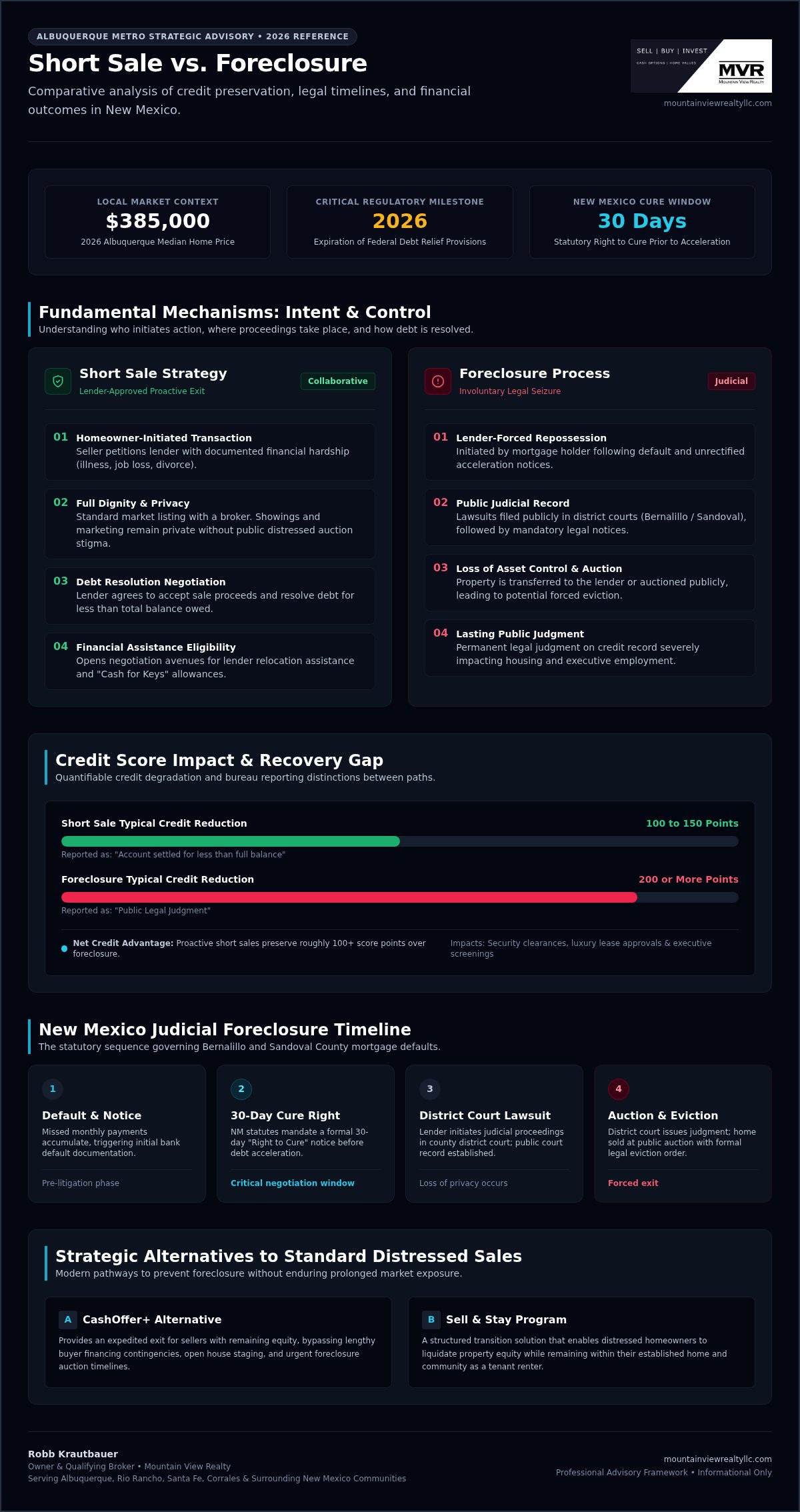
If you're seeking short sale vs foreclosure help, the first step is understanding that these aren't just legal terms; they represent two very different levels of control over your financial future. A short sale is a proactive agreement where your lender allows you to sell the home for less than the remaining mortgage balance. In contrast, a foreclosure is a reactive, legal process where the lender forcibly reclaims the property due to non-payment. The primary driver here is intent. You initiate a short sale to settle a debt; the lender initiates a foreclosure to seize an asset.
In the 2026 Albuquerque market, we're seeing these options surface more frequently as the median home price hovers around $385,000. While many homeowners have equity, sudden life changes like divorce or medical bills can make a standard sale impossible when combined with high closing costs. Choosing the right path now determines whether you walk away with a fresh start or a public judgment that follows you for years.
To better understand how a short sale functions as a strategic exit, watch this helpful video:
The Anatomy of a Short Sale
A successful short sale requires proving a legitimate financial hardship to your lender. This isn't just about being "short" on cash; it requires documented evidence of why you can no longer afford the mortgage. Common examples include a job loss, a permanent transfer, or a significant illness. Because the bank is taking a loss, they must approve the final sale price and the buyer's terms before the deal can close.
The greatest advantage here is that you remain in control of the listing process. You work with a broker to market the home, manage showings, and negotiate offers. This allows for a much more dignified exit than the alternative, as neighbors often won't even know the sale is a distressed transaction. It’s a collaborative effort to resolve the debt rather than a combative one.
The Reality of the Foreclosure Process
Foreclosure is a multi-stage process that begins after you miss several payments. In New Mexico, lenders must provide a 30 day right to cure notice before they can accelerate the debt. If the default isn't resolved, the lender files a lawsuit. This is because New Mexico primarily uses judicial and non-judicial foreclosure processes, meaning your case will likely go through the district court system in Bernalillo or Sandoval County.
This path often involves a significant loss of privacy. Public notices are filed, and your home eventually goes to a public auction. Once the lender takes the title, they have the legal right to evict all occupants. This passive loss of control is exactly what we aim to avoid when providing short sale vs foreclosure help. By acting before the court issues a judgment, you can often prevent the most damaging aspects of this process.
Credit Impact and Financial Recovery Timelines
Protecting your financial reputation is about more than just a three digit number; it's about your future flexibility. When you're evaluating short sale vs foreclosure help, the data suggests that a proactive exit is almost always the more strategic choice for your long term recovery. A foreclosure remains on your credit report as a public legal judgment, while a short sale is typically reported as an account settled for less than the full balance. This distinction is vital for professionals in Albuquerque who may need to pass background checks for executive positions, security clearances, or luxury rental applications.
To simplify the differences between these two paths, the following table outlines the typical financial impacts and recovery periods you can expect in the current market:
| Impact Factor | Short Sale Strategy | Foreclosure Process |
|---|---|---|
| Typical Credit Score Drop | 100 to 150 points | 200 or more points |
| Conventional Mortgage Wait Time | 2 to 4 years | 7 years |
| FHA Mortgage Wait Time | 3 years (0 days if current) | 3 years |
| VA Mortgage Wait Time | 2 years | 2 years |
| Public Record Status | Negative credit entry | Public civil judgment |
Wait Times for Future Home Purchases
The timeline for returning to homeownership is significantly shorter for those who choose a negotiated exit. Under Fannie Mae guidelines, you can often qualify for a new conventional mortgage in as little as two years if you can document extenuating circumstances like a medical emergency or a job transfer. Without those specific circumstances, the standard wait is four years. In contrast, a foreclosure requires a mandatory seven year waiting period. Choosing a short sale allows you to rebuild your life and return to the housing market years faster than a passive default would allow.
The Danger of Deficiency Judgments in New Mexico
A deficiency judgment is a court order that allows a lender to pursue you for the remaining balance if your home sells for less than what you owe. In New Mexico, lenders are legally permitted to seek these judgments through the judicial system. This is a critical area where luxury homeowners in areas like Sandia Heights or Corrales often feel exposed. According to the Consumer Financial Protection Bureau's guide on short sales, securing a written waiver is the only way to ensure you aren't haunted by old debt. We focus on negotiating a "full satisfaction of debt" during the process to ensure your exit is final and your future income is protected. If you're concerned about your professional standing, it may be time to evaluate our Short Sale specialized exit strategy to see how it preserves your reputation.
Why Proactive Short Sales Often Beat Passive Foreclosures
Choosing between these paths often comes down to one question: do you want to be the driver or the passenger? When homeowners seek short sale vs foreclosure help, they're usually looking for a way to stop the bleeding. A short sale offers a structured, dignified exit that respects your timeline. Foreclosure is a passive loss of control that often ends with a knock on the door from a sheriff. By choosing a proactive path, you're not just settling a debt; you're protecting your future ability to rent or buy again.
Maintaining Control of the Narrative
The optics of your exit matter, especially in close-knit Albuquerque communities like Tanoan or Glenwood Hills. A standard "For Sale" sign looks like any other transition in life. A foreclosure notice taped to your front door is a public announcement of financial distress that anyone walking by can see. Beyond the social aspect, a short sale allows you to plan your move. You can find your next rental, pack your belongings, and transition on your own terms. If you're ready to take the first step, understanding the Albuquerque Short Sale Process is essential for mapping out your specific timeline.
Lender Incentives and Relocation Help
It's a common misconception that banks only want to take the house. In reality, foreclosures are expensive and time-consuming for lenders. In 2026, many banks prefer a short sale because it's a faster, cleaner resolution. This preference often translates into financial incentives for the homeowner. Eligible owner-occupants with GSE-backed loans may qualify for up to $7,500 in relocation assistance at closing. These funds can be a lifeline, covering moving costs or the security deposit on a new home.
A short sale often allows you to remain in the property longer than you might expect. While the negotiation with the lender takes place, you aren't forced out. This extra time allows you to save money and prepare for what's next. Most importantly, following Fannie Mae's derogatory credit waiting period guidelines, you'll find that a short sale preserves your path to homeownership years faster than a foreclosure ever could. When you're weighing short sale vs foreclosure help, you're effectively trading a few months of negotiation for several years of your financial life back.
How to Get Help: Navigating the Process in Albuquerque
The first step in finding short sale vs foreclosure help is often the most difficult: acknowledging that the current path isn't working. Many homeowners "dig the hole" deeper by ignoring bank notices or hoping for a market miracle. In the Albuquerque metro, where the 120 day delinquency threshold moves quickly, early action is your best defense. Once you decide to pursue a proactive exit, the process becomes a series of manageable steps designed to settle your debt and protect your future.
After acknowledging the hardship, your next move is to consult with a professional who understands the specific landscape of New Mexico real estate law. You need someone who can navigate the requirements of the Second Judicial District Court in Bernalillo County or the Thirteenth in Sandoval County. This isn't a standard home sale. It's a complex negotiation with a lender who is looking to mitigate their loss while you're looking to save your credit.
The Role of a Short Sale Specialist
A traditional real estate agent might be excellent at marketing a luxury home in Sandia Heights, but they often lack the technical experience required for intense bank negotiations. You need a partner who understands how to speak the lender's language. Robb Krautbauer brings an "investor's eye" to every transaction, leveraging 15 years of real estate investing experience to identify the most efficient path forward. If you're ready to see how a professional manages these complexities, learn more about our Short Sale Specialist Albuquerque services.
Qualifying for a Hardship
To approve a short sale, your lender requires a "Hardship Package." This is a collection of financial documents, including tax returns and bank statements, that prove you cannot maintain the mortgage. Simply being "underwater" or having a home worth less than the loan balance is usually not enough to trigger an approval. Lenders look for specific life events that have fundamentally changed your financial situation.
- Job loss or a significant reduction in household income.
- Divorce or legal separation.
- Unforeseen medical expenses or long term illness.
- Mandatory job relocation to a different city or state.
The hardship letter is the most critical piece of the bank package because it tells the human story behind the numbers. It's your opportunity to explain the circumstances clearly and concisely. Once the hardship is established, we list the property strategically to attract an offer that satisfies the bank's appraisal requirements. The final goal is always the deficiency waiver, ensuring the bank accepts the sale proceeds as full payment for the debt.
Strategic Alternatives: Is a Distressed Sale Your Only Choice?
Many homeowners seeking short sale vs foreclosure help assume they only have two paths to choose from. While those are the most common routes, they aren't the only ways to resolve a difficult situation. We believe in an "Honest. Strategic. Educational." approach that looks at every possible exit. Sometimes, the best solution isn't a long negotiation with a bank; it's a creative strategy that preserves your equity or allows you to maintain your current lifestyle. We explore every available option to ensure you make the most informed decision for your future.
The CashOffer+ Advantage
If you have enough equity to cover the mortgage but need to move quickly, our CashOffer+ program is a powerful alternative. A traditional short sale can take months to secure lender approval, which doesn't always work if the foreclosure auction is weeks away. In contrast, a cash close can happen in a matter of days. This allows you to beat the foreclosure clock entirely and walk away with your credit intact. This is often a better fit for those in Albuquerque who need a certain, stress free exit without the uncertainty of bank bureaucracy. If speed is your main priority, you can explore our guide on how to Sell My House Fast in Albuquerque.
For homeowners who love their neighborhood in Rio Rancho or Corrales but can't sustain their current mortgage, our "Sell and Stay" program offers a unique bridge. This allows you to sell the property and remain in the home as a renter. It's a strategic way to eliminate debt and unlock equity while keeping your family in the same schools and maintaining your community ties. We also offer "List with a Twist," which targets non-traditional buyers who often provide more flexibility than standard retail shoppers.
Your Next Move: A Confidential Consultation
Dealing with a distressed property is exhausting, but you don't have to navigate it alone. Our primary goal is to provide a plan that reduces your stress and protects your financial reputation. We don't use high pressure sales tactics or false promises. Instead, we act as a strategic partner to help you find a dignified exit on your own terms. We've helped over 200 families in the Albuquerque metro navigate these exact transitions with confidence.
Every situation is unique. Whether you're a senior transitioning to a smaller home or an investor looking to protect your portfolio, we're here to provide the guidance you need. Grab a time on my calendar for a confidential consultation. There is no pressure; we'll simply look at the market data and build a clear plan for your next move. You deserve a solution that prioritizes your peace of mind.
Take Control of Your Financial Future
Deciding how to handle a distressed property is about more than just the house; it's about the life you want to lead after the sale. We've helped over 200 families in the Albuquerque metro navigate these exact transitions. By choosing a proactive strategy, you're protecting your future borrowing power and ensuring your exit is handled with professional care. Our experience in the local market ensures that you aren't just another number in a bank's foreclosure file.
If you're ready for short sale vs foreclosure help that puts your needs first, we're here to guide you through every choice. Our 15 years of real estate expertise allows us to find strategic paths beyond the standard MLS that most agents simply don't see. You don't have to face this challenge alone or feel pressured into a quick decision that doesn't serve your long term goals. We provide the clarity you need to move forward with confidence.
Let's work together to protect your equity and reduce the stress of this transition. A fresh start is possible, and it begins with a single, confidential conversation about your next move. You deserve a partner who tells you what you need to hear to make the best decision for your family.
Robb Krautbauer, Owner & Qualifying Broker, Mountain View Realty LLC
Frequently Asked Questions
Is a short sale better than a foreclosure for my credit score?
A short sale is generally much better for your credit score than a foreclosure. While a foreclosure can cause a drop of 200 points or more, a short sale typically results in a reduction of 100 to 150 points. More importantly, a short sale is often reported as "settled for less than the full balance" rather than a legal judgment. This distinction helps you rebuild your financial reputation faster with future lenders and landlords.
Can I stay in my home during the short sale process?
You can typically remain in your home throughout the entire short sale process until the transaction officially closes. Unlike a foreclosure, where an unexpected eviction notice can arrive after a public auction, a short sale follows a traditional closing timeline. This gives you several months to plan your move, secure a new rental, and transition on your own terms without the stress of an immediate forced exit from your property.
Do I have to pay my Realtor if I do a short sale in Albuquerque?
No, you typically don't have to pay your Realtor out of pocket when completing a short sale in Albuquerque. In almost all lender-approved short sales, the bank agrees to pay the real estate commissions and standard closing costs from the sale proceeds. This is part of the loss mitigation agreement. Our goal is to provide the short sale vs foreclosure help you need without adding a financial burden during a difficult time.
What happens if the bank denies my short sale request?
If a lender denies your request, we immediately pivot to alternative strategies to protect your equity. A denial usually happens because of incomplete documentation or an offer that falls below the bank's internal appraisal. We can often resubmit with better data or explore options like CashOffer+ for a quicker close. Because we look at more than one way to sell, a bank denial isn't the end of your options.
How long does a typical short sale take in New Mexico?
A typical short sale in New Mexico takes between four and nine months from the initial listing to the final closing. This timeline is largely dictated by the lender's internal review process and the complexity of your specific hardship package. While this is longer than a traditional sale, it provides you with extra time to stay in the home and save money for your next move while we negotiate the deficiency waiver.
Will I owe the bank money after a foreclosure in Albuquerque?
Yes, it's possible to owe money after a foreclosure in Albuquerque because New Mexico is a judicial foreclosure state. Lenders have the legal right to seek a deficiency judgment for the remaining balance if the home sells at auction for less than the debt. However, New Mexico law bars these judgments against households earning at or below 80% of the Area Median Income. We work to negotiate a full waiver.
Can I buy another house immediately after a short sale?
You generally cannot buy another house immediately after a short sale, but the waiting period is much shorter than a foreclosure. Under Fannie Mae guidelines, you can often qualify for a new mortgage in just two years if you have documented extenuating circumstances. Without those circumstances, the wait is typically four years. This is still three years faster than the seven year mandatory wait time required after a completed foreclosure.
What is the "Hardship Letter" and why is it important?
The Hardship Letter is a personal statement that explains to your lender why you can no longer afford your mortgage payments. It is the most important piece of your application because it provides the human context for your financial documents. Whether the cause is a job loss, medical bills, or a divorce, this letter must be clear and concise. It convinces the bank that a short sale is a better option than foreclosure.

Article by
Robb Krautbauer
Robb Krautbauer is the Owner and Qualifying Broker of Mountain View Realty, serving Albuquerque, Rio Rancho, Santa Fe, and surrounding New Mexico communities. With more than a decade of real estate experience, Robb specializes in luxury homes, strategic home marketing, and helping homeowners navigate important life transitions with confidence.
Known for combining luxury-level marketing, AI-powered technology, and innovative selling strategies, Robb helps clients maximize their home's value while creating a smooth, personalized selling experience. Whether assisting luxury homeowners, retirees, families downsizing, or real estate investors, his focus is always on delivering expert guidance, honest advice, and exceptional results.
When he's not helping clients achieve their real estate goals, Robb enjoys studying market trends, emerging technology, and investment strategies that keep Mountain View Realty at the forefront of the industry.
Disclaimer
**Disclaimer:** The information provided in this article is for general educational purposes only and should not be considered legal, tax, financial, or professional advice. Real estate laws, market conditions, and regulations change over time and may vary based on your individual circumstances. Before making any real estate decision, consult with qualified legal, tax, or financial professionals. If you have questions about buying or selling real estate in New Mexico, contact Mountain View Realty for guidance specific to your situation. © 2026 Mountain View Realty. All rights reserved. The content on this website may not be reproduced without written permission.


